
Beyond Manual Coding: Automating Mutual Gaze Analysis in Autism Therapy
An Automated Mutual Gaze Detection Framework for Social Behavior Assessment in Therapy for Children with Autism
This paper introduces an automated deep learning framework for detecting mutual gaze in children with autism during therapy sessions. Utilizing a state-of-the-art three-branch head tracking architecture (LAEO-Net), the system achieves a reliable "Mutual Gaze Ratio" that correlates strongly with expert-assessed social visual behavior scores.
TL;DR
Researchers have developed a deep learning framework capable of automatically detecting Mutual Gaze—the "locking of eyes"—between children with autism and their therapists. By leveraging a three-branch CNN architecture, the system generates a "Mutual Gaze Ratio" that mirrors the accuracy of human experts, potentially slashing hundreds of hours of manual video analysis in clinical research.
Background: The Social "Anchor" in Therapy
For children on the Autism Spectrum (ASD), mutual gaze is more than just a social convention; it is a critical diagnostic and therapeutic marker. 1 in 54 children in the U.S. is diagnosed with ASD, and interventions like Play Therapy and Music Therapy rely heavily on increasing these moments of social connection.
The bottleneck? Analyzing therapy effectiveness currently requires experts to watch thousands of hours of video, manually hand-coding every look and glance. This paper introduces an automated solution to this data-analysis burden.
Methodology: The Three-Branch Intuition
The authors didn't just look at where a child was staring; they looked at the relationship between participants over time. They adopted a state-of-the-art framework that utilizes three distinct input streams:
- Head Pose Branch A: Tracks the child's head sequence in a temporal window ( frames).
- Head Pose Branch B: Tracks the trainer's head sequence.
- Head-Map Branch: Encodes the relative spatial positions of all people in the scene.
This "head-map" is the secret sauce—it allows the model to understand when a third person (like a co-therapist) might be obstructing the view, ensuring the gaze detection remains robust even in cluttered home-based therapy environments.
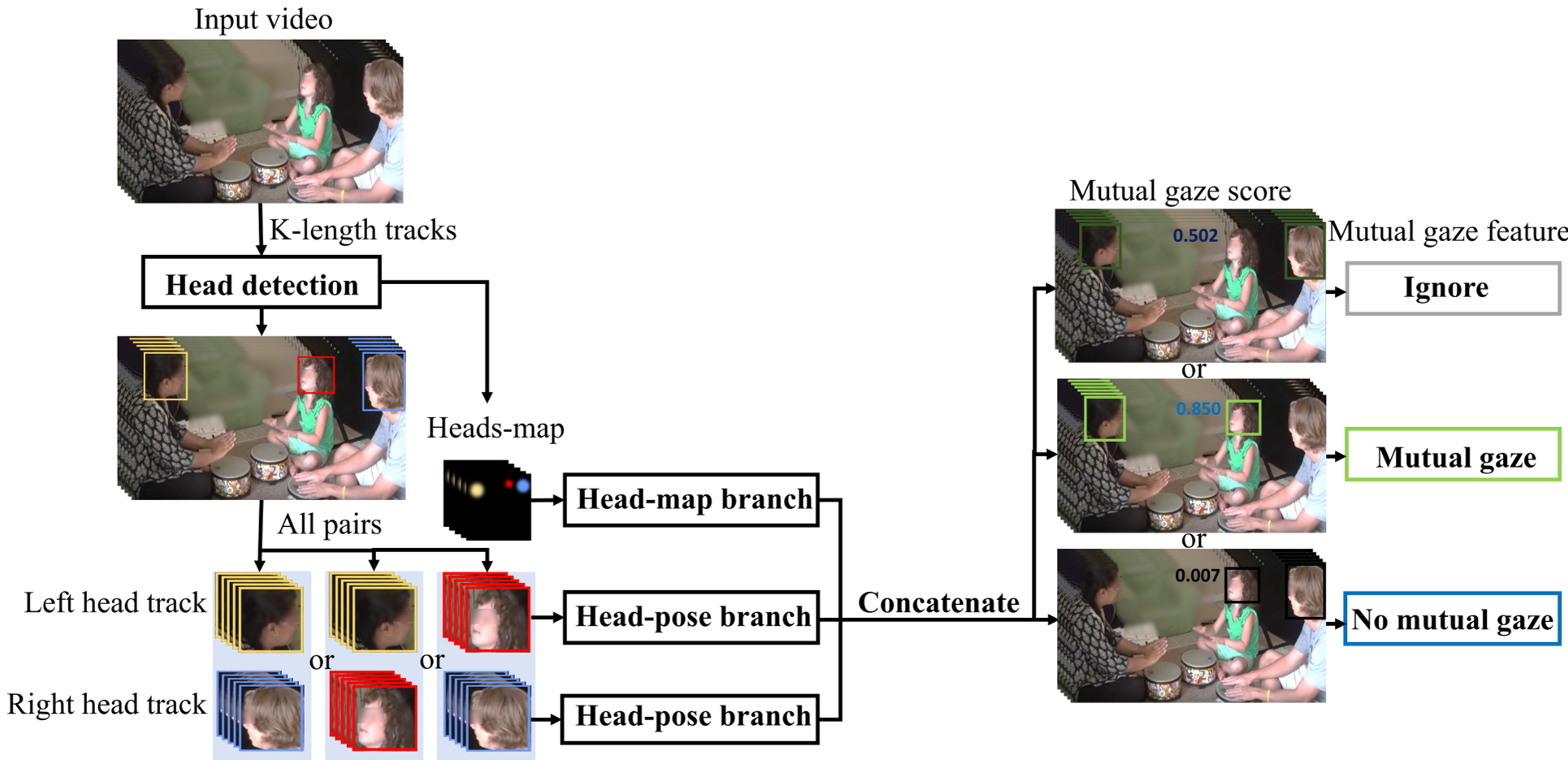 Figure 1: The deep learning architecture. By fusing temporal head sequences and spatial maps, the model outputs a confidence score for mutual gaze.
Experiments: Validating Against the Experts
To prove the model's worth, the authors used an in-house dataset of 30 video recordings featuring 10 children. They compared the model's Mutual Gaze Ratio against Social Visual Behavior scores (ground truth) provided by expert therapists.
Key Findings:
- High Correlation: The model achieved a Spearman's correlation of 0.650, indicating a strong alignment with human judgment.
- Predictive Power: When predicting a child's overall social behavior score, adding the automated gaze ratio to the child's profile (verbal/functional skills) dropped the prediction error from 0.315 to 0.177 (MSE).
- Contextual Sensitivity: The data revealed that children in Play Therapy (music and drumming) exhibited higher mutual gaze ratios than those in Standard Therapy (table-top reading), a trend captured accurately by the model.
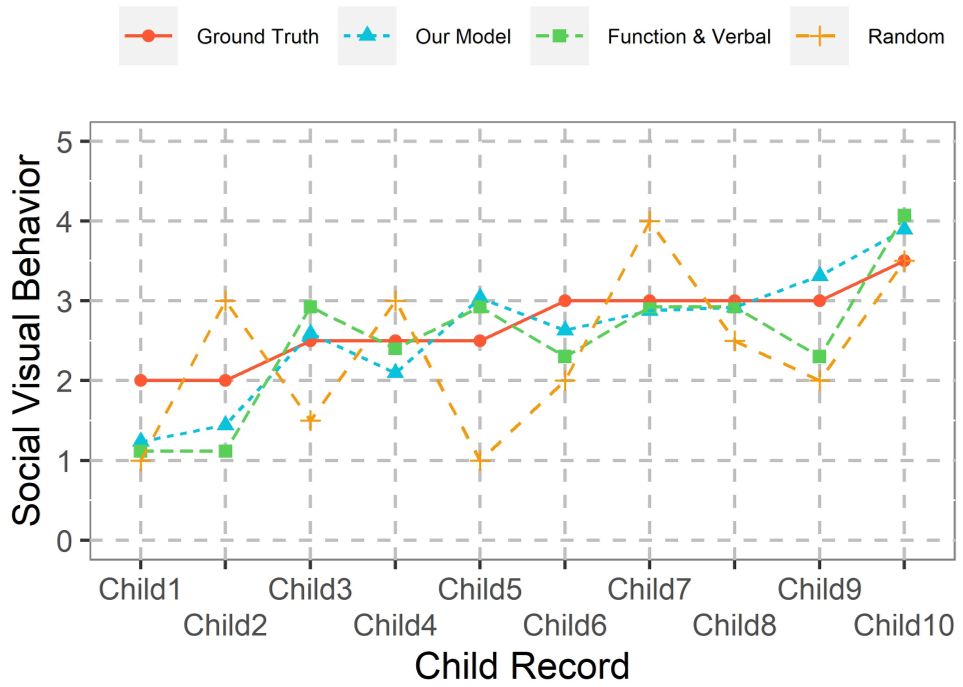 Figure 2: The blue line (automated model) closely tracks the red line (human ground truth), outperforming baseline predictions based solely on participant profiles.
Why It Matters: Deep Insights
The true value of this work lies in its Inductive Bias. The model recognizes that social behavior is not a static property but a dynamic interaction. By prioritizing mutual gaze as a variable, the framework provides a "social currency" that therapists can use to quantify progress objectively.
However, the authors acknowledge a critical limitation: Head orientation Eye gaze. In future iterations, they aim to refine the model to detect subtle eye movements that occur even when the head remains still, especially for children with specific motor or eye-tracking disorders.
Summary
This framework represents a significant leap toward "Special Education Technology 2.0." By automating the tedious task of behavioral coding, we can provide therapists with real-time feedback, ultimately leading to more personalized and effective interventions for children with autism.