
Decoding Quality: How Machine Learning Can Vet Educational Content
Automatically assessing resource quality for educational digital libraries
The paper presents a framework and machine learning system for automatically assessing the quality of web-based resources in educational digital libraries. By decomposing the abstract concept of "quality" into 12 dimensions and 7 key indicators, the authors developed a Support Vector Machine (SVM) model that achieves up to 87% accuracy in identifying specific quality traits.
TL;DR
In the vast ocean of user-generated web content, how can we distinguish a reliable educational resource from digital noise? Researchers from the University of Colorado and the University of Utah have successfully mapped the "human intuition" of library experts onto machine learning models. By breaking "quality" down into specific indicators like age-appropriateness and institutional sponsorship, they've created a system that can pre-screen resources with high accuracy, saving countless hours for digital librarians.
Background: The Subjectivity Trap
Quality is notoriously "I know it when I see it." For educational digital libraries like NSDL or DLESE, accepting a resource isn't just about whether the links work; it’s about whether the content is scientifically accurate, pedagogically sound, and suitable for the target student age. Traditionally, this required expert manual review—a process that simply doesn't scale to the thousands of resources generated daily.
The authors argue that the reason prior automated attempts failed is that they were either too simple (word counts) or too abstract. To solve this, they set out to "operationalize" quality.
Methodology: From Human Intuition to Binary Indicators
The team followed a rigorous three-step workflow to bridge the gap between human judgment and code:
- Mining Educator Insights: They analyzed raw data from focus groups and reviews to extract a taxonomy of 12 dimensions, such as Robust Pedagogical Support and Source Authority.
- Validating with Experts: They interviewed digital library curators to see which dimensions actually drove their "Accept/Reject" decisions. Surprisingly, "Has Prestigious Sponsor" (e.g., NASA, NOAA) was the strongest cue.
- The Machine Learning Pipeline: Using a corpus of 1,000 resources (including 50 known "bad" ones), they trained an SVM using features ranging from text semantics (TF-IDF) to global authority signals (Google PageRank).
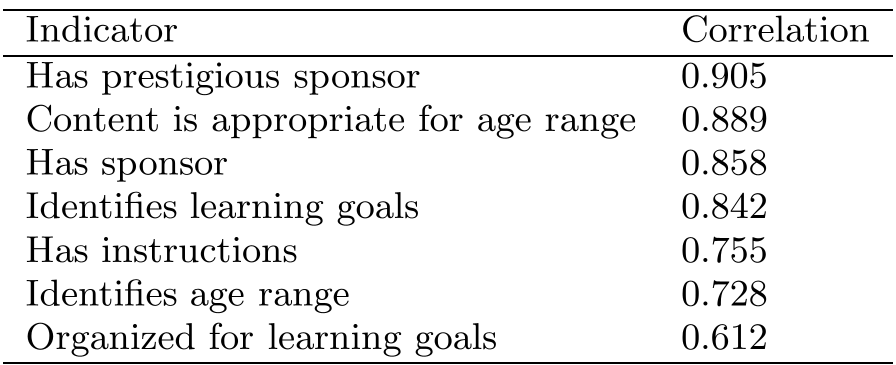 Table 1: Indicators like Prestigious Sponsors and Age Appropriateness showed the highest correlation with expert acceptance.
Why the Results Matter
The models didn't just guess; they learned to identify specific traits. Identifying whether a resource "Identifies Age Range" hit 87% accuracy, and detecting "High-Quality Sponsors" reached 81%.
The importance of this work lies in its granularity. Instead of a blunt "High/Low Quality" score, the system provides a breakdown. It might tell a curator: "This resource has excellent instructions, but the vocabulary is too advanced for its 6th-grade target." This transforms the AI from a black-box judge into a "cognitive tool" that assists human decision-making.
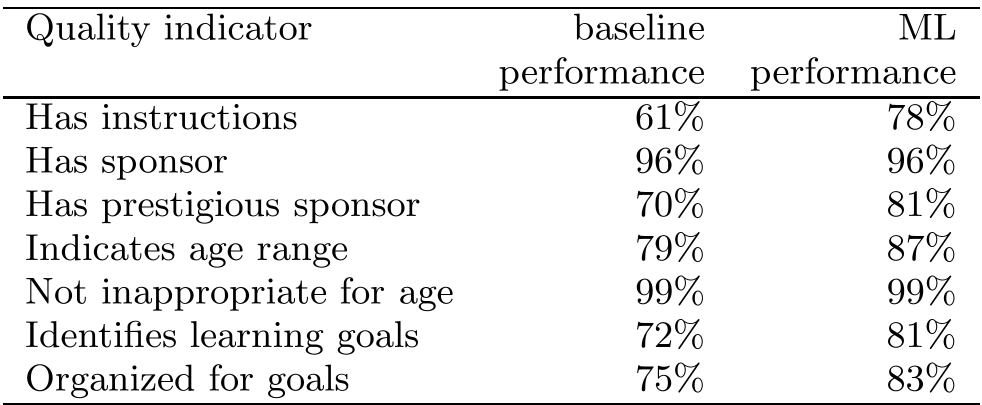 Table 2: Significant performance gains over the baseline for complex indicators like "Has Instructions."
Critical Insights & Future Outlook
While the 2009-era SVMs utilized here were powerful for their time, they faced limitations in surface structure (identifying the difference between a navigation menu and a paragraph) and semantics (recognizing that "curriculum standards" means the same thing as "learning objectives").
Today, we can view this paper as the architectural blueprint for modern AI-assisted curation. With modern Large Language Models (LLMs), we could potentially solve the "Semantic Gap" the authors identified, allowing for even deeper analysis of argumentative structure and scientific accuracy.
Conclusion
The true contribution of this research is its methodology: don't treat quality as a single number. By treating it as a composite of observable features, the authors proved that even the most subjective human tasks can be broken down, measured, and eventually, automated.