
Automated Revision: Bridging the Gap Between Medical Intuition and Clinical Data
Automated revision of expert rules for treating acute abdominal pain in children
This paper introduces an automated approach for refining medical expert knowledge using the theory revision system NEITHER. Applied to the diagnosis and treatment of Acute Abdominal Pain in Children (AAPC), the method transforms a rough, inaccurate set of expert rules into a high-performance knowledge base by integrating clinical patient records.
TL;DR
Medicine is often a mix of "textbook" theory and "real-world" practice, and the two rarely align perfectly. This paper demonstrates how the NEITHER theory revision system can take a failing set of expert rules (15% accuracy) and automatically "repair" them using patient data to reach 75% accuracy, outperforming both pure expert intuition and pure data-driven machine learning.
Contextual Positioning
In the landscape of AI, we often choose between Knowledge Engineering (hand-crafting rules) and Machine Learning (learning from data). This work sits firmly in the Theory Refinement niche—a hybrid approach that treats an expert's initial "rough draft" of knowledge as a prior bias, then uses empirical evidence to prune, sharpen, and extend those rules.
The Problem: When Experts Fail the Test
The clinical domain of Acute Abdominal Pain in Children (AAPC) is notoriously difficult. A physician must decide: Discharge, Operate, or Follow-up?
The authors discovered a startling reality: the rules provided by a senior pediatric surgeon performed abysmally on actual patient records, agreeing with real decisions only 16% of the time. This wasn't due to incompetence, but rather the "Knowledge Acquisition Bottleneck"—experts are excellent at making decisions but often struggle to codify the exact necessary and sufficient conditions for those decisions into rigid logic.
Methodology: How NEITHER Repairs Knowledge
The system used, NEITHER, addresses two fundamental flaws in any theory:
- Over-generality: The rules recommend an action (like "Operate") when they shouldn't. NEITHER fixes this by adding new conditions (specialization) or deleting the rule.
- Over-specificity: The rules fail to catch a case that should be classified. NEITHER fixes this by removing unnecessary conditions (generalization) or inducing entirely new rules.
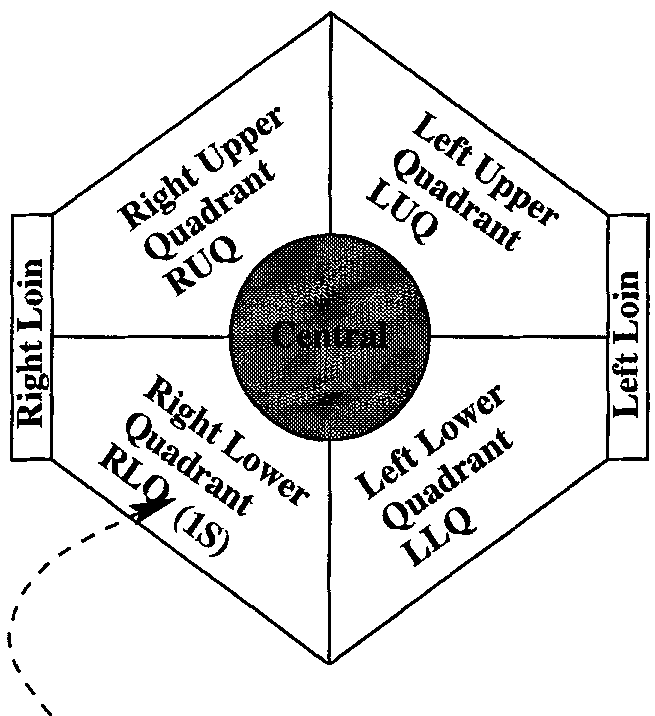 The model uses 63 attributes, including a geometric mapping of pain sites (LUQ, RLQ, etc.) to capture clinical nuances.
The Learning Curve: Efficiency vs. Accuracy
A critical contribution of this paper is the analysis of the "Learning Curve." The authors investigated how much data is actually needed to fix an expert's theory.
- Accuracy levels off quickly at around 100 examples.
- Theory Size (complexity) continues to grow as more examples are added.
This suggests a "Goldilocks zone" for theory revision: use enough data to stabilize accuracy, but not so much that the resulting rules become too bloated for a human doctor to read.
Experimental Results & Interpretation
| Theory Type | Training Accuracy | Testing Accuracy |
|---|---|---|
| Original Expert | 19% | 15% |
| Pure Induction | 100% | 73% |
| Revised Theory | 100% | 75% |
The Revised Theory emerged as the winner. Why? Because it starts with a structured logic that capture's the expert's "global" view of the disease, then uses the data to fix the "local" inconsistencies.
Anatomy of a Revision
One of the most interesting findings was what happened to the "Operate" rules. While 8 rules (mainly for "Follow-up") were deleted entirely, the "Operate" rules remained mostly intact or were specialized. This indicates that while the expert was "noisy" regarding minor cases, their logic for surgical intervention was fundamentally sound but required more specific constraints (like checking for RIGIDITY combined with specific pain sites).
Deep Insight: Why This Matters for Modern AI
Today, we often rely on Deep Learning models that act as "Black Boxes." This paper, although using propositional logic, highlights a timeless value: Interpretability.
The revised theory identified 9 "essential" attributes—including Rebound Tenderness, Neutrophil count, and Rigidity—that were present in the expert rules, the data-driven rules, and the revised rules. This validation gives clinicians the confidence to trust the system, as it mirrors established medical semiotics.
Conclusion
The study proves that we don't need to throw away expert knowledge just because it is initially inaccurate. By using automated tools like NEITHER, we can "debug" human expertise, resulting in systems that are more accurate than humans, more grounded than pure data models, and ultimately, safer for clinical application.
Limitations: The propositional representation (IF-THEN rules) is simple. Future work into First-Order Logic (like the MOBAL or FORTE systems) may capture even complex relationships that simple attribute-value pairs might miss.