
CALLIOPE: Bridging the Gap in Legal Information Retrieval through Semantic Automation
Integrated access to legal literature through automated semantic classification
This paper presents CALLIOPE (ClAssified Legal LIterature OPen access Engine), a vertical portal for Italian legal literature that integrates structured bibliographic repositories and unstructured Web documents. It utilizes the OAI-PMH protocol for metadata harvesting and Machine Learning (MSVM) for automated semantic classification, achieving a unified search experience via Dublin Core metadata.
TL;DR
The paper introduces CALLIOPE, a specialized search engine for Italian legal literature. By combining automated metadata harvesting (OAI-PMH) for library records and Multi-class Support Vector Machines (MSVM) for classifying raw Web documents, the system provides a single point of semantic access to highly fragmented legal resources.
Background & Motivation: The "Ignorantia Legis" Paradox
Access to law is a fundamental democratic right, yet "legal literature"—the critical analysis used to interpret legislation—remains trapped in silos. In the Italian context, researchers face a "digital divide" where high-quality bibliographic data (structured) and disparate Web articles (unstructured) never meet. The author's insight is that Metadata is the Bridge: by forcing all resources into a common Dublin Core schema, we can search "Criminal Law" and find both a physical textbook and a PDF blog post simultaneously.
Methodology: The Federation Architecture
The CALLIOPE system is built on a five-module federation architecture designed to handle the heterogeneity of the legal domain.
1. The OAI Harvester (Structured Data)
For established databases like DoGi, the system uses the Open Archives Initiative Protocol for Metadata Harvesting (OAI-PMH). It maps complex library formats (like UNIMARC) to simple Dublin Core tags, ensuring the system knows the "Creator," "Subject," and "Source" of every professional record.
2. The Focused Crawler & ML Classifier (Unstructured Data)
The real challenge is the Web. The authors use a Focused Crawler that doesn't just crawl blindly but predicts which links lead to legal literature based on the surrounding text. Once a document is downloaded, an Automatic Metadata Generator takes over.
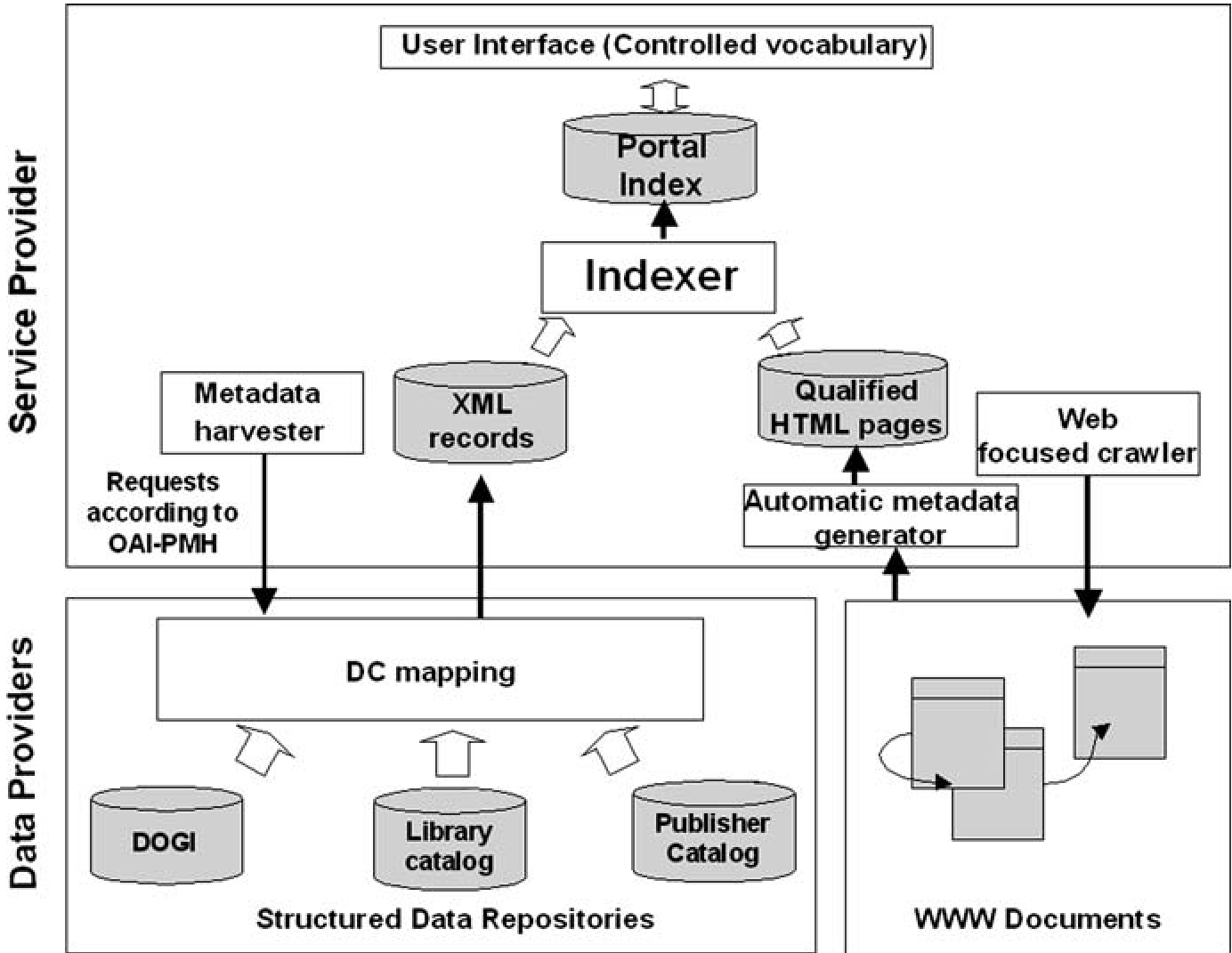
The heart of this generator is a Multi-class SVM (MSVM). While many systems use binary classifiers, CALLIOPE classifies documents into 11 distinct legal domains (e.g., Constitutional, International, Environmental Law) by analyzing the "Bag of Words" and Information Gain of terms.
Experimental Battle: MSVM vs. Naïve Bayes
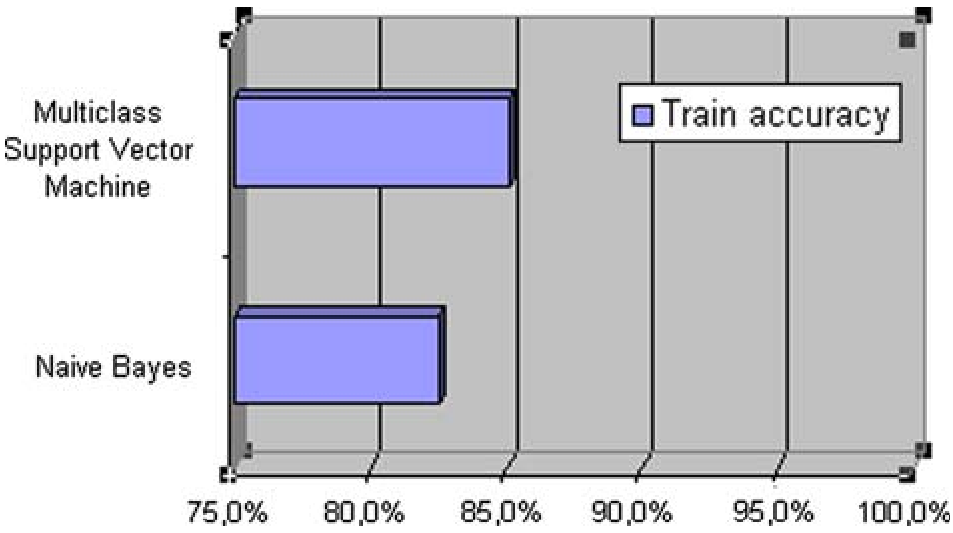
The authors rigorously tested their classification module on 2,478 documents.
- The Findings: MSVM achieved a training accuracy of 85.1%, significantly better than the standard Naïve Bayes (82.5%).
- Robustness: Using a "Leave One Out" (LOO) strategy, they achieved 74.7% accuracy, proving that the model generalizes well to new, unseen legal documents from the web.
Deep Insights: Beyond Simple Search
CALLIOPE doesn't just match keywords; it uses the DoGi controlled vocabulary (6,600 descriptors) to support Semantic Searching.
- Query Expansion: If a user searches for "recklessness" in a "Criminal Law" context and finds no results, the system automatically expands the query to broader or narrower terms defined in the legal ontology.
- Contextualization: By using the ML-generated
dc:subject, the system eliminates ambiguity (e.g., distinguishing between a "contract" in Private Law vs. International Law).
Conclusion & Future Outlook
CALLIOPE serves as a blueprint for vertical portals in specialized domains. While the 74.7% generalizeable accuracy is a strong start, the authors recognize that legal terminology evolves.
The main takeaway? Automation is not a replacement for experts but an amplifier. Use ML to do the "heavy lifting" of classification, and use expert-curated ontologies to guide the final search. Future work will likely look towards more complex semantic measures like Precision/Recall on expanded queries to further refine the user experience.
Academic Identity: Senior Tech Editor | AI & Legal Informatics Specialist