
LegalAI: Mastering the Semantic Complexity of Laws with Hybrid NLP and ML
An automated framework for the extraction of semantic legal metadata from legal texts
The paper introduces an automated framework for extracting semantic legal metadata from French legal texts using a hybrid approach of Natural Language Processing (NLP) rules and Machine Learning (ML). It achieves SOTA-level performance with precision up to 97.2% and recall of 94.9% in specific domains like traffic law.
TL;DR
Researchers have developed a sophisticated framework to automatically transform dense, "legalese" text into structured semantic metadata. By combining Tregex-based constituency parsing with Random Forest classifiers, the tool identifies obligations, prohibitions, and actors (like Agents vs. Targets) with over 90% recall. However, the study reveals a "complexity wall": as legal sentences get longer and more cross-referenced, standard NLP tools begin to struggle.
Perspective: The Architecture of Legal Meaning
Legal texts are not just sentences; they are a web of rights, duties, and conditions. Traditionally, Requirements Engineering (RE) has struggled to bridge the gap between "the law on paper" and "the law in software requirements." Previous attempts often missed the nuance—failing to distinguish between a judge (Agent) and a prosecutor (Auxiliary Party) in a given clause. This paper positions itself as a dual-action solution: harmonizing the vocabulary of legal metadata and providing the technical teeth to extract it.
Motivation: Why "Simple" NLP Fails
Most NLP pipelines used in earlier research relied on Part-of-Speech (POS) tagging or basic keyword matching. Legal text, however, is heavily nested. A single "Condition" might contain an "Action," which in turn contains a "Location." Without Constituency Parsing (to see the hierarchy) and Dependency Parsing (to see who is doing what to whom), automated tools are blind to the actual legal implications of the text.
Methodology: The Hybrid Engine
The authors propose a unified conceptual model derived from a synthesis of major legal ontologies (like Hohfeldian concepts and Deontic logic).
1. The Taxonomy
- 6 Statement-level types: Obligation, Permission, Prohibition, Penalty, Definition, Fact.
- 18 Phrase-level types: Agent, Target, Artifact, Violation, Sanction, and more.
2. Tregex Rules and ML Classifiers
For most metadata (like Time or Location), the authors use Tregex, a pattern-matching language for trees. This allows them to define rules like: "If a verb phrase (VP) contains a modality marker but excludes an exception marker, label it an Action."
However, for Actor Roles (Agent vs. Target), rules are too brittle. They implemented a Random Forest classifier using 31 features, including the "distance to the main verb" and "dependency chains."
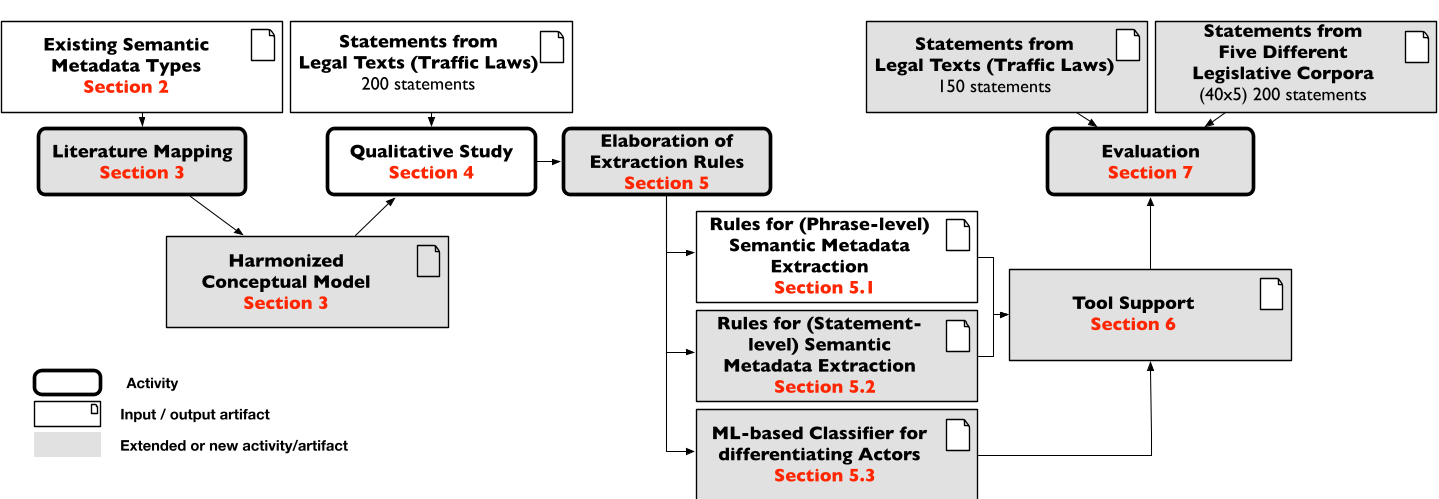 Fig 1: The overall workflow from legal text to semantic metadata extraction.
Experiments: Performance at the Edge
The team tested the framework on the Luxembourgish Traffic Code and five other legislative domains (Commerce, Health, Penal, etc.).
Key Results:
- Domain-Specific (Traffic): Precision 97.2%, Recall 94.9%.
- Cross-Domain (Penal/Health): Precision 82.4%, Recall 92.4%.
The drop in precision in the second case study is the most enlightening part of the research. As shown in the table below, the average word count per statement skyrocketed in the Penal and Environmental codes.
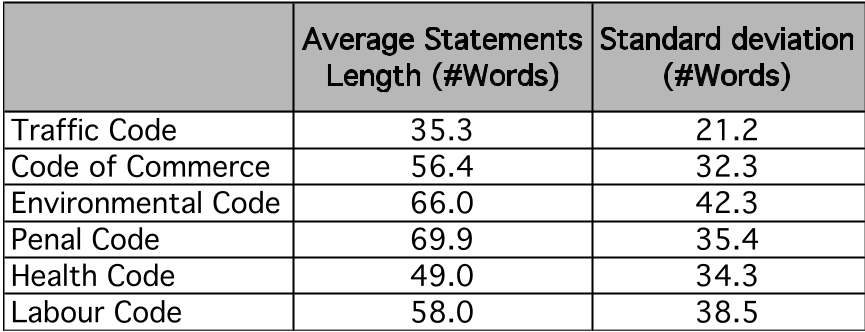 Table: Comparison of statement lengths across different legal codes.
Critical Insight: The Parser's "Complexity Wall"
Modern NLP parsers are typically trained on newspaper archives (like the Wall Street Journal). These sentences are usually 20-30 words long. In the Luxembourgish Penal Code, sentences average 69.9 words. Beyond 35 words, parser accuracy drops like a stone. This "out-of-distribution" error is a primary bottleneck for LegalAI.
Furthermore, the paper identifies Implicit Context as a major hurdle. A statement might say "The request must be sent..." without naming the Agent. A human knows who the Agent is from the previous page, but the algorithm, processing sentence-by-sentence, is left in the dark.
Conclusion & Future Work
The framework is a massive step forward in automating legal compliance. However, for a truly "human-level" understanding, the authors suggest the industry must:
- Train parsers specifically on legal corpora to handle extreme sentence length.
- Implement cross-statement resolution to track actors and subjects across an entire document.
- Integrate domain-specific glossaries to resolve polysemous terms (e.g., "seizure" as a legal sanction vs. a medical event).
This work serves as a foundational blueprint for any organization looking to turn their regulatory library into a searchable, actionable database.