
Handwashing Trajectories: A New Window into Cognitive Health
Automated Video Analysis of Handwashing Behavior as a Potential Marker of Cognitive Health in Older Adults
2015-03-16
Summary
Problem
Method
Results
Takeaways
Abstract
This paper introduces an automated video analysis system to assess the cognitive health of older adults by monitoring handwashing behavior. Using overhead video, the system extracts sink occupancy and hand motion path tortuosity features to predict Mini-Mental State Exam (MMSE) scores and dementia stages (Aware, Mild, Moderate, Severe).
## TL;DR
Researchers have developed a computer-vision-based system that analyzes *how* elderly individuals wash their hands to identify stages of dementia. By tracking hand motion "tortuosity" (irregularity) and sink region occupancy, the system can predict MMSE (Mini-Mental State Exam) scores with a correlation of 0.789, offering a passive, non-invasive way to monitor cognitive decline in real-world settings.
## The Clinical Blind Spot: Why "Routine" Isn't Enough
Dementia is a global health crisis, yet current diagnostic methods are reactive rather than proactive. Up to 76% of patients with early-stage cognitive impairment are missed during routine clinical visits. This is often because patients can "perform" well during short, structured exams, even if their ability to handle Activities of Daily Living (ADLs) is beginning to erode.
The authors argue that **handwashing** is a perfect candidate for monitoring because it requires complex motor planning and eye-hand coordination—faculties that are impacted by Alzheimer's and related conditions early on.
## Methodology: From Pixel to Path Tortuosity
The system uses an overhead camera positioned above a sink. The processing pipeline consists of skin-tone detection to isolate the hands, followed by two distinct feature extraction branches:
1. **Sink Occupancy**: Dividing the sink into functional zones (Knob, Nozzle, Drain) to measure where the hands spend time.
2. **Path Tortuosity (The "Fractal" Insight)**: This is the paper's most sophisticated contribution. By calculating the **Fractal Dimension (FD)** of the hand's motion trajectory, the system quantifies "kinks" and irregularities in movement. High tortuosity implies a lack of smooth motor planning, a known neurological signature of cognitive struggle.
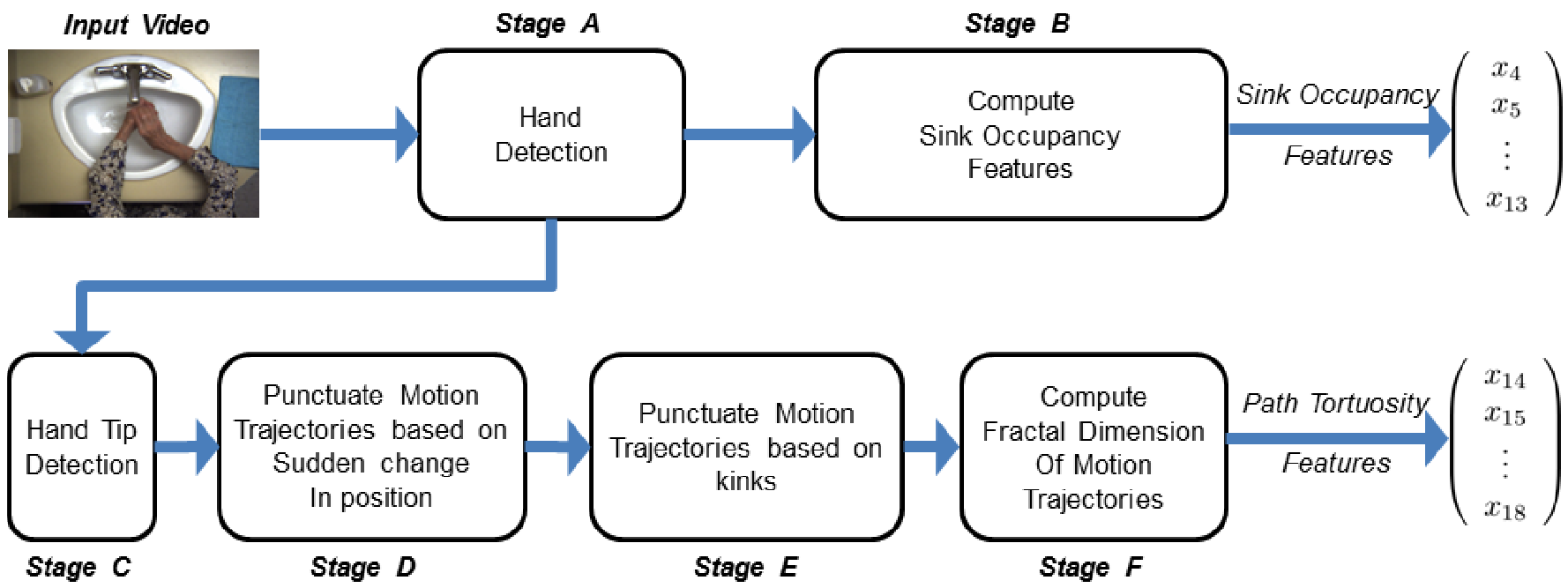
*Figure 1: The multi-stage feature extraction process involving skin detection and trajectory punctuation.*
## Quantifying Cognitive Decline: Key Findings
The study involved 27 older adults and over 700 handwashing trials. The results validated several core hypotheses:
* **Cognitive Efficiency**: Cognitively intact (Aware) participants had higher occupancy in specific sink regions, suggesting more deliberate and efficient movement.
* **The Struggle of Complexity**: Participants with moderate to severe dementia exhibited significantly higher **Path Tortuosity**. Their hand movements were less direct and more erratic.
* **Consistency is Key**: Single-trial analysis was noisy. However, when the model "collapsed" data across ~10 trials per participant, the correlation with MMSE scores jumped to **R=0.789**, and classification accuracy reached **70.4%**.
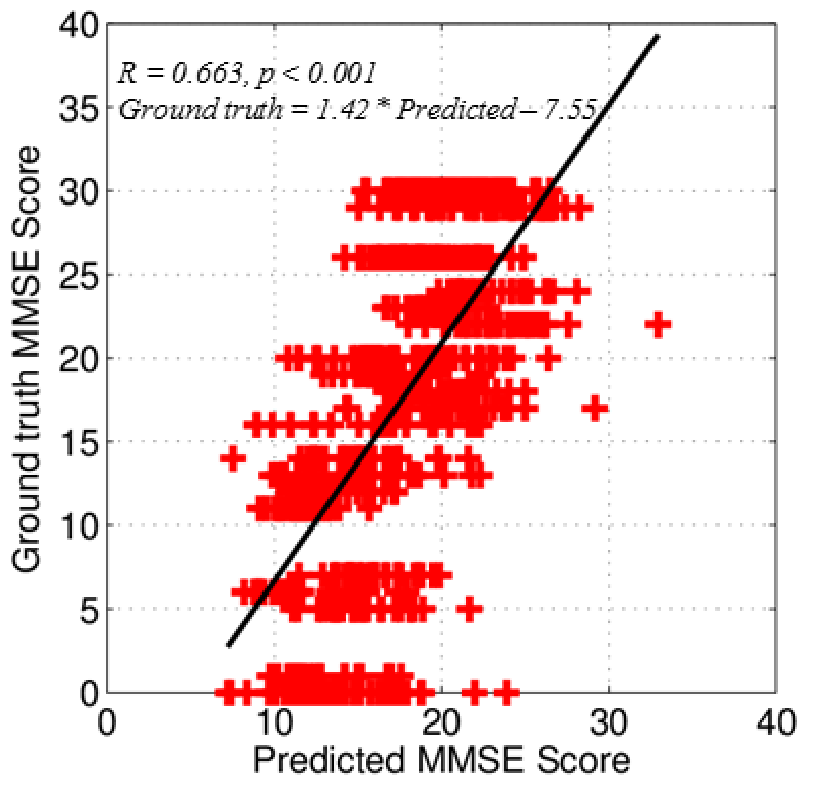
*Figure 2: Scatter plot showing the strong correlation between predicted and actual MMSE scores using the collapsed feature model.*
## Critical Analysis: The Road Ahead
One of the most interesting findings is the classification of "Mild" dementia. In the study, the model struggled to isolate the mild category, often misclassifying it as "Aware" or "Moderate." This highlights the "blurred boundary" problem in early cognitive transition.
**Limitations**:
* **Dataset Size**: With only 27 participants, the model's generalizability needs further validation with larger cohorts.
* **Vision Sensitivity**: Skin-tone detection can be lighting-dependent. Future iterations would likely benefit from 3D depth sensors (like LiDAR or Kinect) to ignore lighting variations.
## Conclusion: The Future of Smart Aging
This work shifts the paradigm from "testing" cognitive health at a clinic to "sensing" it at home. By turning a bathroom sink into a source of diagnostic data, we move closer to a future where caretakers are alerted to cognitive decline months or years earlier than current methods allow, simply by observing the subtle signatures of daily life.