
Turning Faces into Labels: Automatic Corpus Annotation via Facial Expression Analysis
Automatic Annotation of Corpora For Emotion Recognition Through Facial Expressions Analysis
The paper proposes a novel methodology for the automatic emotional annotation of text corpora by analyzing facial expressions in video subtitles. Leveraging Ekman's archetypal emotions and the OpenFace toolkit, the framework achieves an overall 4-class emotion recognition accuracy of 72% using an SVM classifier.
TL;DR
Researchers have developed a system that automatically labels text datasets with emotions by "watching" the speaker's face in videos. By combining sentiment analysis to filter noise and SVMs to classify facial muscle movements, the system achieves 72% accuracy in recognizing emotions like happiness and anger, providing a scalable alternative to manual human annotation.
Background: The Bottleneck of Digital Emotion
To build an AI that understands human feelings, we need millions of labeled sentences. However, asking humans to label "I'm fine" as happy, sarcastic, or sad is slow and expensive. Furthermore, text alone often lacks context. This paper shifts the paradigm: instead of looking at the words, it looks at the speaker's face to determine the labels for the corresponding subtitles.
The Core Insight: Faces are Universal
Based on Ekman’s theory, certain facial expressions (the six archetypal emotions) are universal across cultures. The authors leverage this to create a language-independent annotation tool. If a speaker looks angry while speaking Italian, the system can label the Italian text as "Anger" without needing an Italian emotional dictionary.
Methodology: The Pipeline from Pixels to Emotions
The methodology is structured into a rigorous 4-step pipeline:
- Source Selection & Filtering: The system avoids "expressionless" content (like news reports) and uses sentiment analysis to filter out neutral sentences, ensuring the model only trains on emotionally "rich" data.
- Semantic Video Splitting: Instead of cutting video into random 5-second clips, it splits video based on subtitle timestamps, ensuring the visual expression matches the spoken thought.
- Hybrid Feature Extraction: The authors don't just use raw pixels. They extract Action Units (AUs) (atomic muscle movements) and calculate 18 specific distances between facial landmarks (e.g., the gap between eyelids or lip corners).
- Classification: These features are fed into an SVM to predict the final emotion.

Experimental Results: Can AI Outperform Humans?
The results from 50 YouTube "monologue" videos were telling:
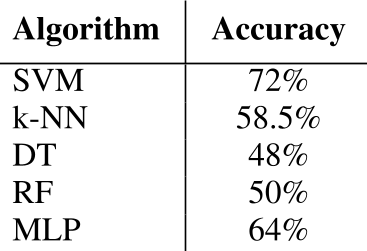
- SVM Supremacy: The SVM classifier reached 72% accuracy, significantly beating Random Forests (50%) and Multi-Layer Perceptrons (64%).
- The Saliency of Joy: Happiness and Neutral states were the easiest to detect, while Sadness proved more elusive due to subtle muscle changes.
- Context is King: In one instance, a human labeled a subtitle as "neutral," but the AI labeled it "happy." Upon further review, the speaker was using positive facial expressions that provided context missing from the isolated text fragment.
Critical Analysis & Future Outlook
While the 64.5% overall annotation accuracy is a strong start, the paper identifies a key hurdle: Phonatory Movements. When we speak, our mouth moves to form words, which can "trick" the AI into seeing an emotion that isn't there (e.g., opening the mouth for a vowel might look like surprise).
The Takeaway: This research paves the way for "Foundational Emotion Models" that can be trained on the billions of hours of video content available on platforms like YouTube without ever requiring a human to click a "label" button. Future iterations utilizing 3D facial mesh and audio-tone analysis will likely push this accuracy toward human-level performance.
Limitations
- Single-Face Constraint: The current model struggles with videos containing multiple people or side-profiles.
- Class Imbalance: It currently focuses on only four major emotion categories, excluding more complex states like "disgust" or "fear" found in the original Ekman set.