
AsEmo: Breaking the Subject-Dependency Barrier in EEG Emotion Recognition
<i>AsEmo:</i> Automatic Approach for EEG-Based Multiple Emotional State Identification
This paper introduces AsEmo, an automatic feature extraction method for EEG-based multi-class emotion recognition. It leverages the Explained Variance Ratio (EVR) to dynamically determine the optimal number of spatial filters and utilizes a subject-independent classification framework to achieve high accuracy without retraining for new users.
Executive Summary
TL;DR: The AsEmo (Automatic Emotion recognition) method solves the rigidity of traditional EEG analysis by automatically tuning spatial filters using the Explained Variance Ratio (EVR). Unlike previous models that require tedious retraining for every new user, AsEmo utilizes a subject-independent approach that boosts multi-class accuracy by 2–8% over existing SOTA methods, enabling reliable real-time emotional state monitoring.
Positioning: This work serves as an evolutionary bridge between manual feature engineering and fully automated deep learning, offering the interpretability of spatial filters with the adaptive power of statistical variance analysis.
The Bottleneck: Why EEG is a "Moving Target"
Recognizing emotions through Electroencephalogram (EEG) signals is the "Holy Grail" of affective computing. However, EEG data is notoriously "noisy" and "subject-variant."
- Prior work limitations: Standard Common Spatial Pattern (CSP) techniques were designed for binary classes (e.g., Happy vs. Sad) and often fail when scaled to complex multi-class planes (Valence-Arousal).
- The "Retraining" Trap: Most high-performance models are subject-dependent, meaning the system must be trained from scratch for every new user. This is a deal-breaker for consumer-grade real-time applications.
Methodology: The AsEmo Innovation
The core of AsEmo lies in its ability to answer the question: How many features are actually enough?
1. Automated Spatial Filtering (The EVR Insight)
Traditional MCSP requires researchers to manually pick the number of spatial filters (usually twice the number of classes). AsEmo replaces this "guesswork" with a mathematical threshold.
- It decomposes the mixed-covariance matrix into eigenvalues ().
- It calculates the Explained Variance Ratio (EVR): .
- By setting a 90% threshold, the model automatically selects the most influential spatial filters that capture the "essence" of the emotional state while discarding noise.
2. Subject-Independent Architecture
The workflow follows a "Leave-One-Subject-Out" pipeline. The model learns commonalities across a large pool of subjects, allowing it to generalize to an unseen user instantly.
 Figure 1: The overarching architecture for EEG-based emotion recognition using AsEmo.
Performance: Setting New SOTA Benchmarks
AsEmo was tested against the two most rigorous public benchmarks: DEAP and SEED.
- Class Accuracy: On the 4-class DEAP dataset, AsEmo achieved 84.20% accuracy, significantly outperforming Wentrup’s MCSP (64.9%) and Lotte's WOSF (78.3%).
- Efficiency vs. Accuracy: While methods like mRMR use up to 35 features to gain performance, AsEmo achieves higher accuracy with only ~10 features, making it computationally leaner for mobile BCI devices.
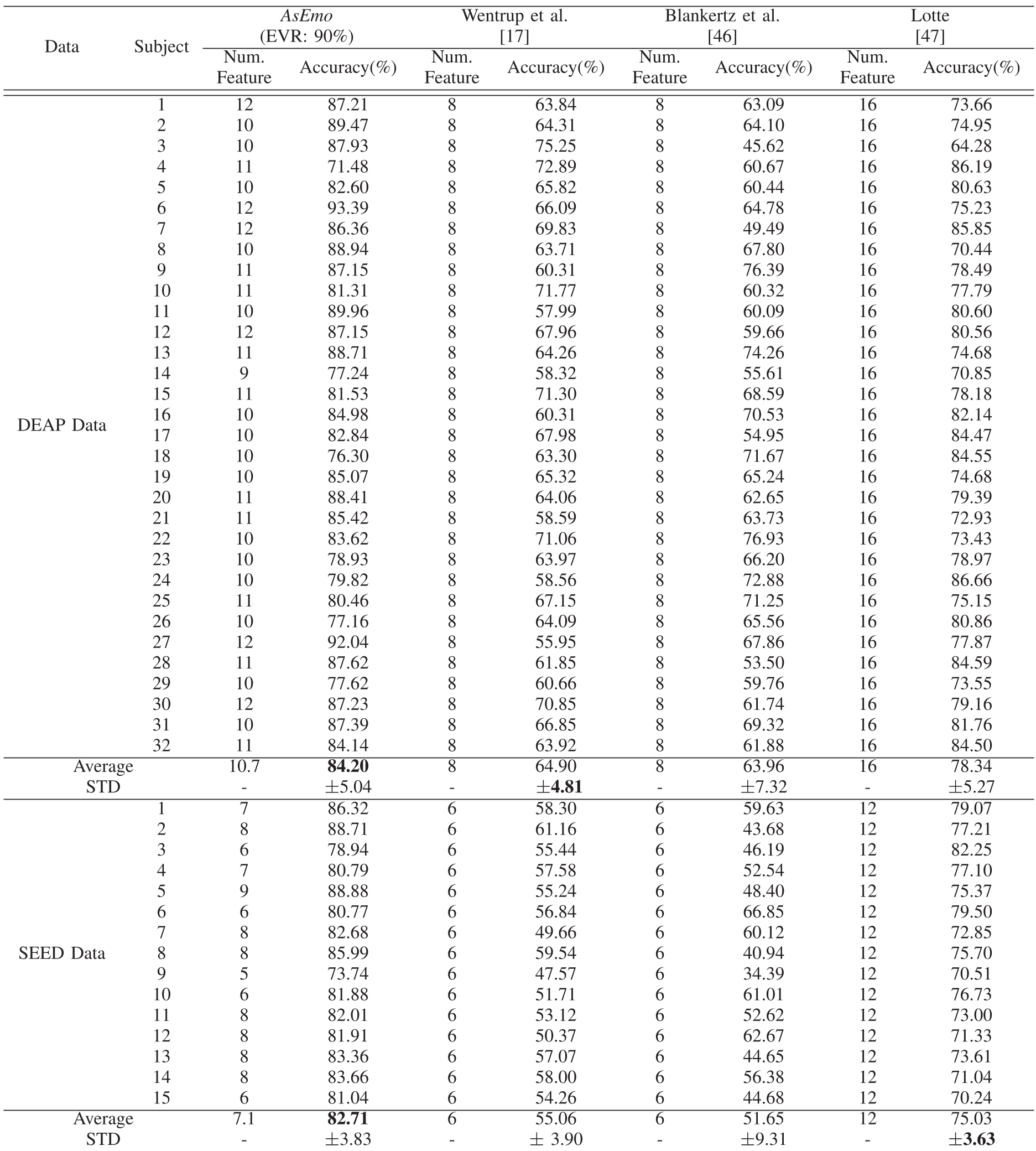 Table 1: Comparative performance across DEAP and SEED datasets.
Beyond Emotion: Versatility in Action
One of the most impressive aspects of the paper is the "Applicability" study. The authors applied AsEmo to non-emotion tasks:
- Epilepsy Detection: Achieving 78.59% accuracy.
- Motor Imagery (BCI Competition III): Achieving 80.13% accuracy. This suggests that the EVR-based MCSP approach is a universal "best practice" for any multi-class EEG task where spatial discriminability is key.
Critical Insight & Conclusion
The Takeaway
The success of AsEmo highlights that adaptive feature selection is more important than deep model complexity in physiological signal processing. By dynamically adjusting to the variance profile of the data, AsEmo maintains high accuracy () even in "Subject-Independent" tests, which are notoriously difficult.
Limitations & Future Work
While AsEmo handles spatial variance well, it still operates primarily in the frequency domain. Future iterations could integrate Temporal-Spatial Transformers to better capture the transient spikes in EEG signals associated with sudden emotional shifts (e.g., surprise).
AsEmo represents a significant step toward an "out-of-the-box" emotional AI that understands how we feel without needing hours of calibration.