
Enhancing Research Retrieval: A Fuzzy Logic and Ontology-Driven Approach to Document Clustering
Automatic Clustering of Research Articles Using Domain Ontology and Fuzzy Logic
The paper proposes an automatic clustering system for research articles using domain ontology (ACM CCS) and Fuzzy Logic to compute term weights. It transforms research papers into hierarchical XML representations based on the semantic significance of keywords in titles, abstracts, and domain mapping.
TL;DR
This research tackles the inefficiency of keyword-based search by introducing a system that "understands" the importance of terms through Fuzzy Logic and Domain Ontologies. By converting research articles into weighted XML documents based on their alignment with the ACM Classification System, the authors achieve significantly higher precision and recall in clustering and retrieving academic papers compared to traditional Vector Space Models.
Problem & Motivation: Beyond Exact Matching
The digital explosion of research makes finding relevant literature a "needle in a haystack" problem. Standard Information Retrieval (IR) systems face two major hurdles:
- Polysemy and Synonymy: Traditional keyword matching fails when different words share the same meaning or one word has multiple meanings.
- The Dimension Curse: Vector Space Models (VSM) result in massive, sparse matrices that ignore the hierarchical nature of knowledge.
The authors argue that a term's importance isn't just about how often it appears, but where it appears (Title vs. Abstract) and how it fits into the Domain Knowledge (the "Ontology").
Methodology: The Fusion of Fuzzy Logic and XML
The core innovation lies in the Term Weight Computation process, which moves away from binary relevance to a "degree of significance."
1. The Trinity of Criteria
The system extracts author-supplied keywords and evaluates them against:
- Ontology Mapping: Using Latent Semantic Indexing (LSI) to find the semantic distance between keywords and the ACM Computing Classification System.
- Title Frequency: Title words carry more "topical" weight.
- Abstract Frequency: Abstract words provide the "contextual" weight.
2. Fuzzification
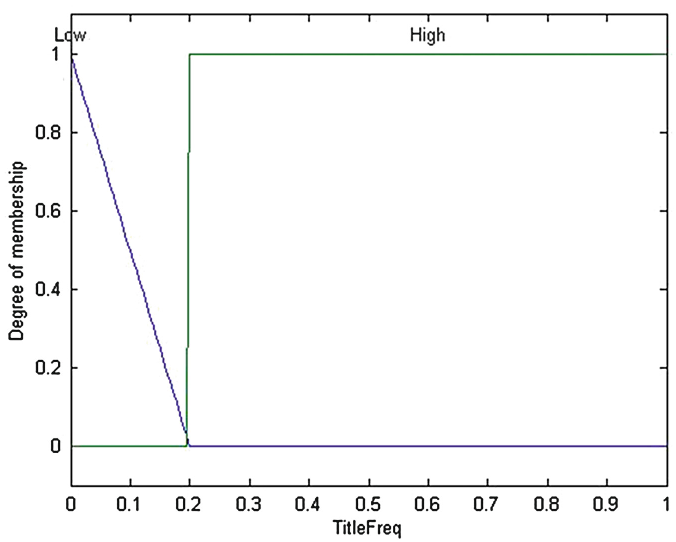
Instead of a hard score, these inputs are processed via Fuzzy Sets (Low, Medium, High). This allows the system to handle the inherent ambiguity of language.
3. XML Representation
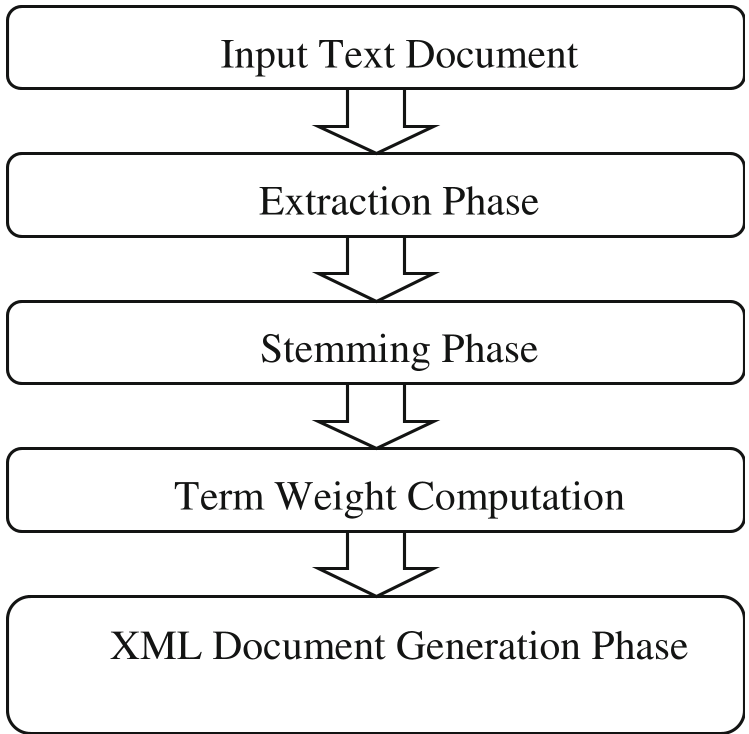
Once weighted, the document is transformed into a hierarchical XML. Unlike flat text, this XML mirrors the structure of the domain ontology, making the relationship between "Data Structures" and "Algorithms" explicit through parent-child nodes.
Experiments & Results: Precision through Semantics
The authors tested their approach on the InfoVis and DBLP datasets. The evaluation focused on whether the clustering matched the actual academic categories of the papers.
Performance Gains
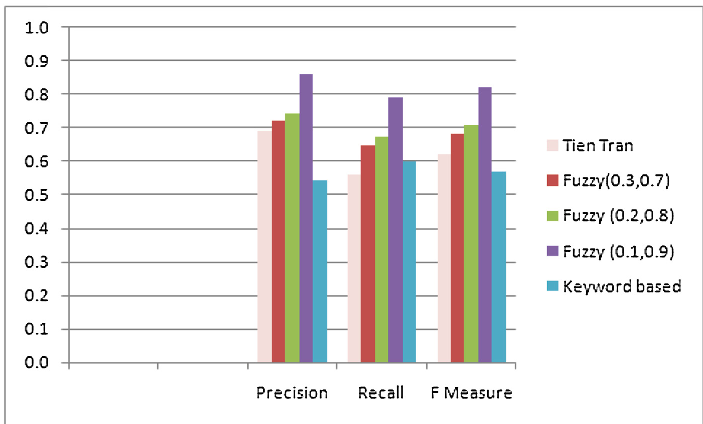
The results showed that the Fuzzy-XML approach consistently beat the "State-of-the-Art" keyword-based methods and earlier hybrid structural models.
Key findings included:
- Optimal Thresholds: Setting the membership functions for Fuzzy logic at specific intervals (α=0.1, β=0.9) maximized the retrieval accuracy.
- High Similarity Sensitivity: The system correctly identified high similarity (Sim=0.93) between documents even when the keywords were not identical, provided they mapped to the same ontological concepts.
Critical Analysis & Conclusion
Takeaway
The integration of Domain Ontology transforms raw text into structured knowledge. By using Fuzzy Logic, the authors successfully quantified the "vague" importance of keywords, bridging the gap between human intuition and machine processing.
Limitations & Future Work
- Static Ontology: The system relies on the ACM CCS. As Computer Science evolves (e.g., the rise of Prompt Engineering), the ontology must be manually updated or dynamically learned.
- Scalability: While effective on thousands of papers, the hierarchical clustering and LSI mapping might require significant optimization for millions of documents.
The authors aim to extend this to SKOS (Simple Knowledge Organization System) to further refine accuracy and move toward a truly Semantic Web-compatible retrieval engine.