
Beyond the Surface: Decoding Social Media Rumors via Implicit Feature Mining
Automatic detection of rumor on social network
This paper introduces an automatic rumor detection method for social networks by combining traditional "shallow" features with newly proposed "implicit" features. By utilizing a Support Vector Machine (SVM) classifier on Sina Weibo data, the approach achieves state-of-the-art performance in distinguishing false information from credible news.
TL;DR
To combat the explosive growth of misinformation, researchers from the Chinese Academy of Sciences have developed a rumor detection framework that moves beyond shallow metrics like follower counts or keywords. By introducing Implicit Features—such as historical consistency and sentiment intensity—their method achieves a significant performance leap, proving that the secret to spotting a lie lies in its deviation from established patterns.
Context & Motivation: Why Keywords Aren't Enough
In the early days of social media forensics, detecting a rumor was a "shallow" game. Systems looked for specific hashtags, the presence of URLs, or the sheer number of followers a user had. However, the sophisticated rumor-mongers of today have learned to fake these signals.
The authors argue that rumors possess a different "Implicit DNA." While a rumor might look like news on the surface, it often lacks internal consistency (the link doesn't match the text), exhibits extreme sentiment (alarmist language), or comes from a user whose historical interests have suddenly and inexplicably shifted. This paper seeks to quantify these subtle "tells."
Methodology: The Architecture of Truth
The researchers formulate rumor detection as a binary classification problem (Rumor vs. Non-rumor). The innovation lies in the feature engineering stage, where they define several high-dimensional implicit features:
1. Content-Based Implicit Features
- Popularity Orientation: Measures how closely a message clings to "hot topics." Rumors often hijack trending events to gain traction.
- Internal & External Consistency: A clever check that computes the Jaccard similarity between a tweet’s text and the metadata (title/description) of the URL it links to. If they don't match, it's a red flag.
- Sentiment Polarity (TF-FW): Unlike standard sentiment analysis, the authors proposed TF-FW (Term Frequency - Dictionary Weight). They assign different "levels" to words found in sensitive, emotional, or punctuation dictionaries to catch the exaggerated tone typical of rumors.
2. User-Based Implicit Features
- Social Influence: Goes beyond followers to look at "binary followers" (mutual followings), providing a more robust measure of genuine social standing.
- Match Degree of Messages: This uses topic modeling to see if a user's current post aligns with their historical posting history. A sudden jump from "cooking tips" to "political conspiracy" triggers a lower match score.
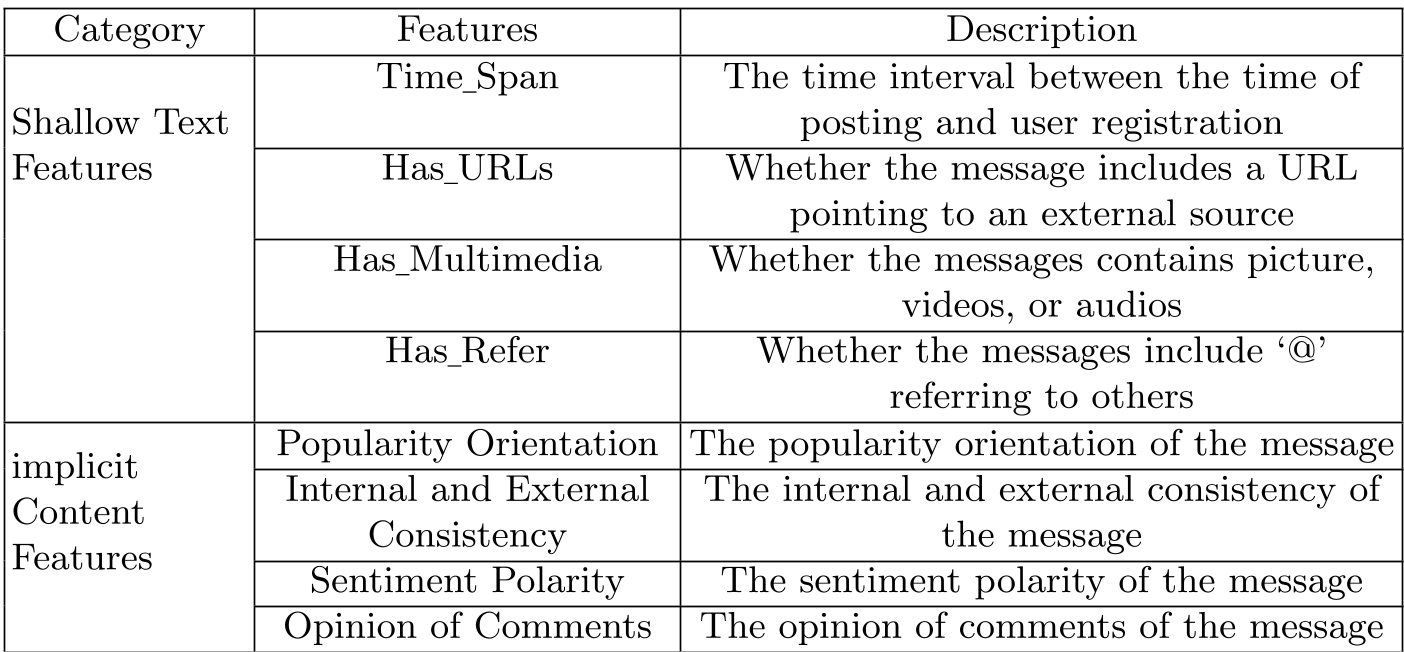 Table: Categorization of Shallow vs. Implicit Content Features.
Experiments & Performance
The model was tested on a dataset of ~15,000 Sina Weibo posts. The researchers compared the "Combined" model against a baseline and models using only partial feature sets.
Key Breakthroughs:
- Fusion Power: The combination of user and content features outperformed all single-category models, reaching a new SOTA in precision.
- Implicit vs. Shallow: Implicit content features showed a 10.5% precision boost over shallow ones, confirming that "how" a message is structured (intensity, consistency) is more important than "what" keywords it contains.
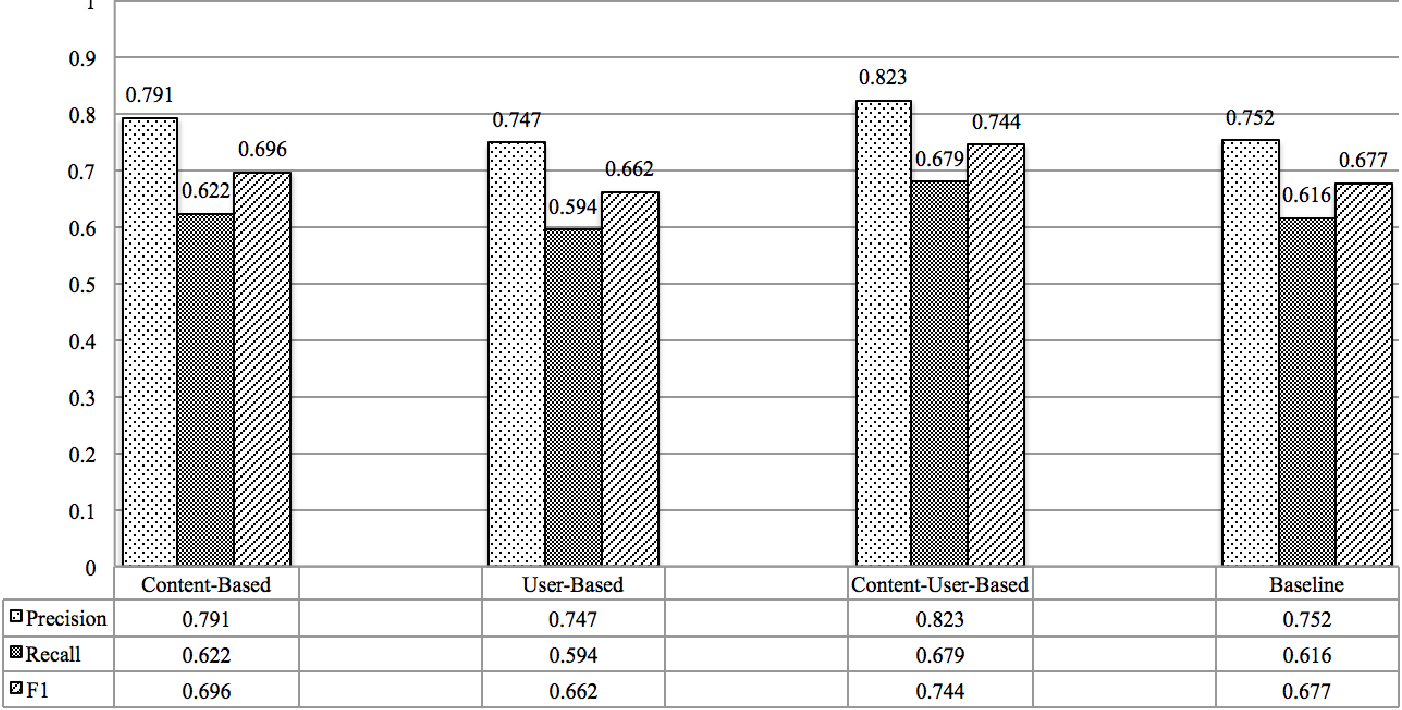 Figure: The significant performance gain when combining all feature types (last column) vs. the Baseline.
Critical Insight & Future Outlook
The core contribution of this work is the formalization of Consistency. By checking if a link actually supports the claim and if a user is acting "out of character," the model targets the fundamental instability of fabricated rumors.
Limitations: While powerful, these features rely on having access to a user's history and external link metadata, which can be limited by privacy settings or decaying link headers.
The Road Ahead: The authors suggest that future work should focus on User Credibility as a dynamic score. As LLMs begin to generate more "reasonable-looking" rumors, these implicit consistency checks—comparing a claim against external reality and historical behavior—will likely become the frontline of defense for social platforms.