
Detecting Speech Disorders in Children: Beyond Traditional ASR
The Automatic Detection of Speech Disorders in Children: Challenges, Opportunities, and Preliminary Results
This paper addresses the automated diagnosis of Speech Sound Disorders (SSD) in children by proposing three distinct technical frameworks: paralinguistic feature-based classification, anomaly detection for phoneme-level errors, and x-vector based speaker diarization. The authors achieve 87% subject-level classification accuracy and demonstrate that anomaly detection significantly outperforms traditional Goodness of Pronunciation (GOP) metrics in real-world scenarios.
TL;DR
Automating the detection of Speech Sound Disorders (SSD) in children is notoriously difficult due to a lack of data and the "noisy" nature of kids' voices. This paper presents a multi-pronged approach: using high-level paralinguistic features for diagnosis, treating mispronunciation as an "anomaly" to avoid needing disordered training data, and utilizing x-vector embeddings to separate child speech from therapists. The results show a high accuracy of 87% for subject classification and a superior F1 score for error detection compared to traditional methods.
The "Data Desert" and the Complexity of Child Speech
In the world of AI, data is king. However, in pediatric speech therapy, we face a "Data Desert." Collecting recordings of children with Speech Sound Disorders (SSD) is ethically sensitive, time-consuming, and expensive. Furthermore, human pathologists often disagree on transcriptions (inter-rater agreement can be as low as 70%), making "Ground Truth" labels shaky at best.
From a technical physics perspective, children’s speech is a moving target. Their shorter vocal tracts and smaller vocal folds result in higher fundamental frequencies () and formant positions. Most SOTA models are trained on adult "modal" speech; when applied to the high-pitched, variable, and often "atypical" speech of a child with Apraxia or Dysarthria, these models typically fail.
Methodology: A Strategy for Low-Resource Environments
The researchers tackled these challenges through three innovative lenses:
1. Paralinguistic Classification
Instead of trying to recognize every word (which is hard when speech is unintelligible), the authors used eGeMAPS (extended Geneva Minimalistic Acoustic Parameter Set). These are high-level descriptors of jitter, shimmer, and spectral energy.
- Why it works: It captures the "texture" and "quality" of the voice rather than the linguistic content, making it robust against transcription errors.
2. Anomaly Detection (The OCSVM Approach)
This is perhaps the most brilliant shift in the paper. Instead of training a model to recognize how children mispronounce words (which is infinite in variation), they trained a One-Class SVM only on correct pronunciations.
- The Intuition: Anything that deviates significantly from the "normal" manifold is flagged as an anomaly (a mispronunciation).
- Features: They used 26 Speech Attribute Features (place and manner of articulation) rather than raw MFCCs to ensure the model focuses on the mechanics of speech.
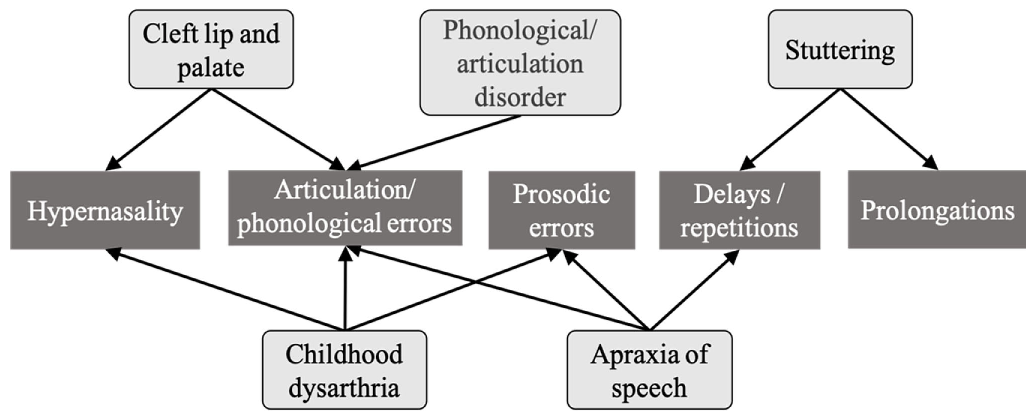 Figure 1: Diversity of SSD symptoms and the mapping to specific pronunciation errors.
3. x-vector Diarization
Therapy sessions are dialogues. To analyze the child, you must first ignore the therapist. The authors used x-vectors (deep neural network embeddings) to cluster speakers.
Experimental Battleground and Results
Performance in Diagnosis
Using a Support Vector Machine (SVM) on paralinguistic features, the system achieved spectacular results:
- Subject-level Accuracy: 87.5%.
- Key Insight: Even if a child with SSD says some words correctly (segment-level noise), the "majority vote" at the subject level remains highly accurate.
Breaking the GOP Standard
The industry standard for pronunciation is "Goodness of Pronunciation" (GOP). The authors' Anomaly Detection method outperformed the DNN-based GOP significantly on real disordered speech (CAS Corpus), achieving an F1 score of 0.83 vs. GOP’s 0.72.
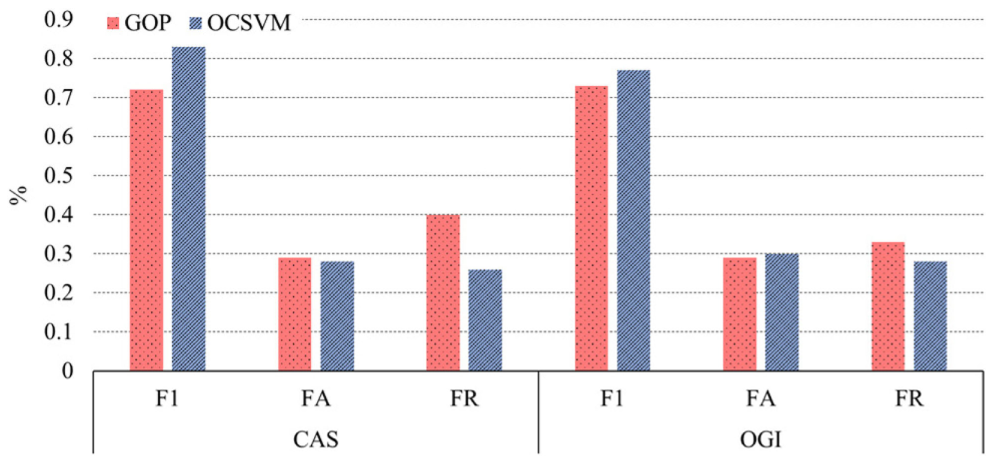 Figure 3: Graphical evidence showing the OCSVM (Anomaly Detection) superior F1 score and lower False Rejection rates.
Critical Analysis: What’s Next?
While the results are promising, there are inherent limitations:
- Vowel Overlap: The anomaly detection system still struggles with "neighboring" vowels (like /ih/ and /eh/) because their acoustic boundaries are naturally blurry.
- Diarization Environment: The 10% DER was achieved on clean clinical recordings. Real-world performance in noisy homes or classrooms remains an open question.
The Takeaway: This paper proves that we don't always need "Big Data" to solve complex clinical problems. By pivoting to Anomaly Detection and Paralinguistic Analysis, we can build diagnostic tools that are more resilient to the scarcity of medical data. For the next generation of Speech Therapy apps, the "Normal" model is the most powerful tool we have.