
Words Matter: Deciphering Teacher Questions in the Noise of Live Classrooms
Words maer: automatic detection of teacher questions in live classroom discourse using linguistics, acoustics, and context
This paper presents a fully automated system for detecting teacher questions in live, noisy classroom environments using audio from a single teacher-worn microphone. By integrating linguistic features from multiple Automatic Speech Recognition (ASR) engines with acoustic and context features, the researchers achieved a weighted F1 score of 0.69, providing a scalable solution for automated pedagogical feedback.
TL;DR
Researchers have developed a fully automated pipeline to detect teacher questions during live lessons using only teacher-worn microphone audio. By combining linguistic analysis from ASR transcripts with acoustic and contextual data, the system achieves a 0.69 weighted F1 score, moving us closer to providing teachers with instantaneous, data-driven feedback on their pedagogical strategies.
The "Scalability Wall" in Education
We know that dialogic instruction—specifically the way teachers ask "authentic" questions—is a primary driver of student achievement. However, analyzing these interactions currently requires trained human observers and hundreds of hours of manual coding. This creates a "scalability wall" where only elite or well-funded schools can benefit from deep pedagogical analysis.
The challenge in automating this is the classroom itself. It is a chaotic acoustic environment filled with desk-shuffling, muffled speech, and "non-standard" questions that often sound like statements.
Methodology: A Multi-Modal Approach
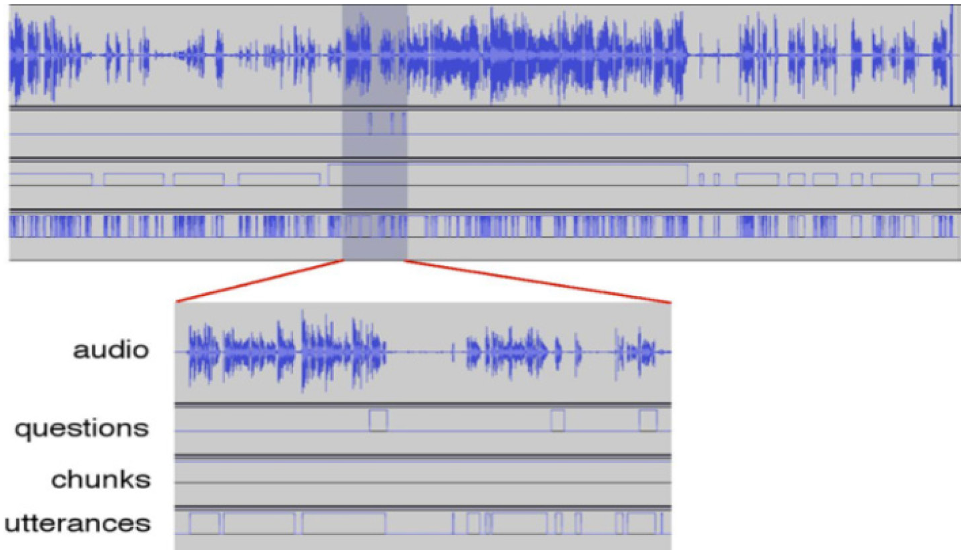
The authors break down the problem into a fully automated pipeline:
- Voice Activity Detection (VAD): Segmenting raw audio into teacher utterances.
- Multi-Engine ASR: Using Bing, Azure, and Watson ASRs simultaneously to mitigate the high Word Error Rate (WER) of noisy environments.
- Feature Extraction:
- Linguistic: Keywords (What, Why, How) and Part-of-Speech (POS) tags.
- Acoustic: Pitch, energy, and MFCCs via OpenSmile.
- Context: Utterance length and position in the class session.
Key Insight: Linguistic Dominance
The most striking finding of this research is that linguistic features are the MVP. While we often think of questions as having a specific "upward inflection" (prosody), the study found that the presence of specific words like "what" or "do...have" was significantly more predictive than any acoustic signal.
As shown in the comparison below, the linguistic model (NLP) significantly outperformed solo acoustic (Aco) or context (Con) models:
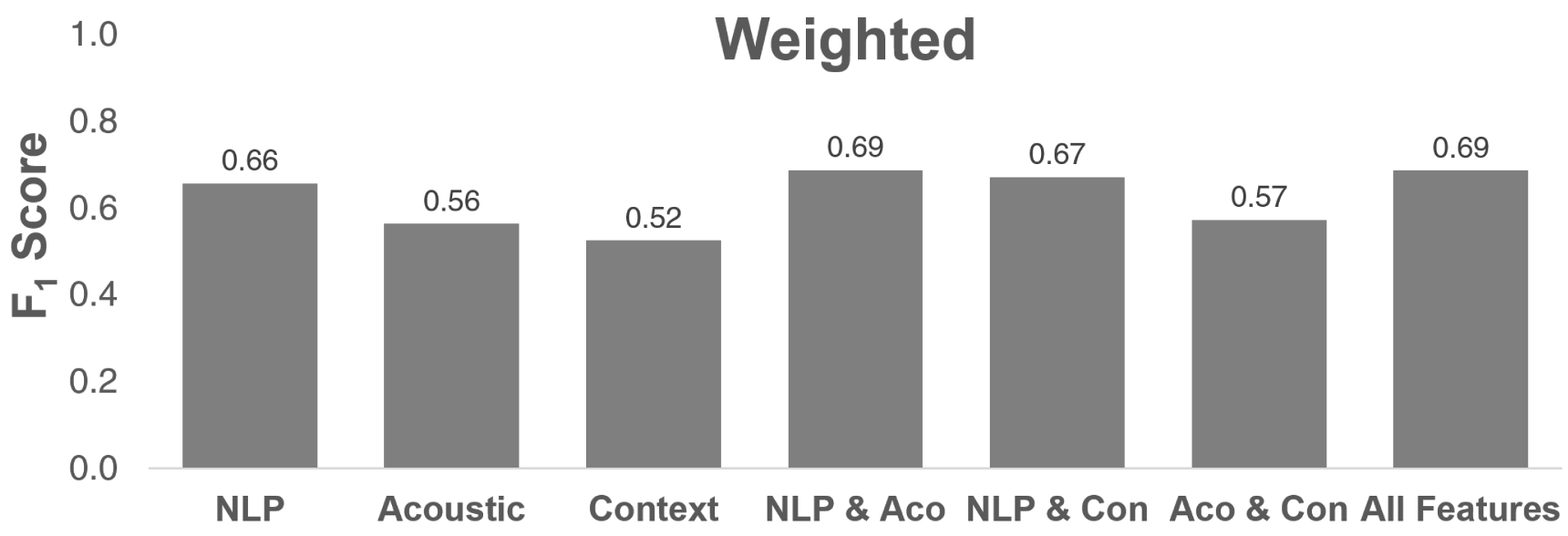
However, the fusion of all features provided a critical 5% boost in weighted F1. This improvement largely came from better identifying non-questions, which helps the system filter out the noise of lectures and administrative commands.
Experimental Results & Teacher Generalization
To ensure the system wasn't just learning one teacher's verbal tics, the team used leave-one-teacher-out cross-validation. The model's success across 11 different teachers and 37 class sessions proves its potential for generalizability.
| Feature Type | Top Feature Examples | Weighted F1 |
|---|---|---|
| Linguistic | Presence of "what", "be", and pronouns | 0.66 |
| Combined | All 218 features (NLP + Aco + Con) | 0.69 |
One notable limitation is the "proportionality bias": the model performed significantly better in classrooms where questions were more frequent (Correlation r = 0.76), suggesting it may struggle in lecture-heavy settings.
Critical Perspective: Beyond "What" to "Why"
This work acts as a foundational "detector," but the authors rightly note that not all questions are equal. Future research must distinguish between procedural questions ("Did you bring your books?") and authentic dialogic questions ("Why do you think the character made that choice?").
The current reliance on a single microphone also misses the student side of the conversation—the "uptake." Integrating student-side audio could be the key to unlocking the full context of these "dialogic spells."
Conclusion
This paper demonstrates that despite the noise of a real-world classroom, automated speech technology is now robust enough to identify key pedagogical moments. For educational researchers and school administrators, this marks a shift from expensive manual observation toward automated, scalable professional development tools.