
OntoMLA: Bridging Fuzzy Ontology and Machine Learning for Context-Aware Summarization
An Automatic Document Summarization Approach based on Fuzzy Ontology and Machine Learning
This paper introduces OntoMLA, an automatic document summarization approach that combines Fuzzy Ontology with machine learning. By integrating citation counts, publication time, and author interests through an improved TF-IDF and LDA framework, it achieves superior performance over traditional baselines on academic literature datasets.
TL;DR
Current summarization tools often fail to capture the "academic ecosystem" surrounding a paper. OntoMLA changes this by modeling documents using a Fuzzy Ontology that accounts for citations and temporal shifts in author interests. By combining an augmented TF-IDF model with Latent Dirichlet Allocation (LDA), it produces abstracts that are statistically robust and contextually relevant.
The Motivation: Why Standard NLP Fails Academic Text
Traditional extractive summarization methods (like basic TF-IDF) suffer from a "flat" perspective. They treat every word's importance as a function of its frequency within a static corpus. However, in the scientific world, a word’s value is dynamic:
- Domain Authority: Words appearing in highly-cited papers should carry more weight.
- Temporal Relevance: An author's research interest in 2024 is more relevant to their latest abstract than what they wrote in 2010.
- The Context Void: Most models ignore who wrote the paper and what they previously published.
Methodology: The Three Pillars of Fuzzy Membership
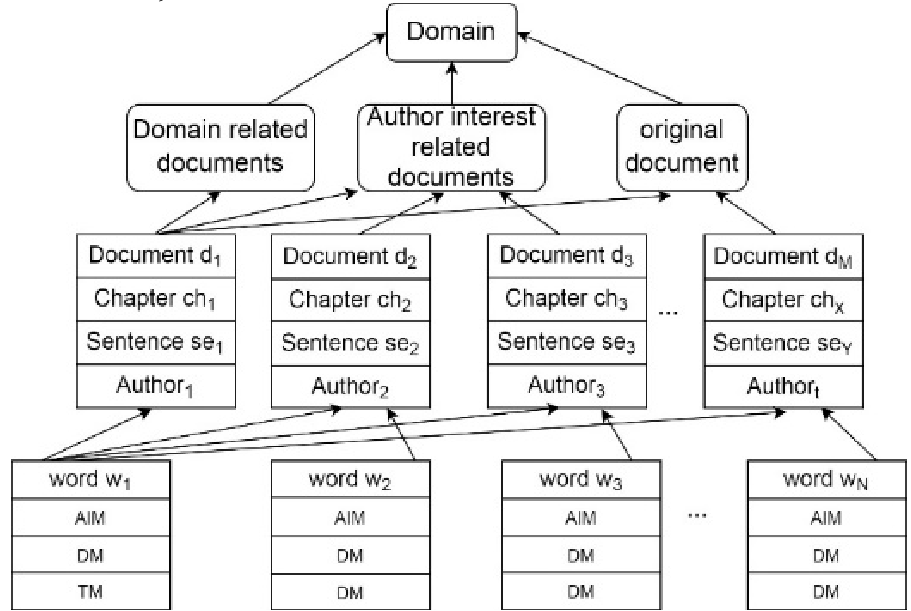
The core innovation of this paper is the transformation of a standard domain ontology into a Fuzzy Ontology. Instead of a binary "is/is not" relationship, every word is assigned a membership degree based on three specific dimensions:
1. Domain Membership (DM)
The authors improve the TF-IDF model by introducing a citation weight (). A term's frequency (DTF) is amplified if it appears in documents that the academic community has "voted" for via citations.
2. Author Interest Membership (AIM)
Recognizing that research interests evolve, the model introduces a time-decay factor. Terms from recent historical publications are weighted more heavily than older ones, allowing the summarizer to align with the author's current trajectory.
3. Topic Membership (TM)
Using Latent Dirichlet Allocation (LDA), the model calculates the probability of a word belonging to the document's latent topics. This ensures the final summary captures the "aboutness" of the text, not just high-frequency noise.
Sentence Selection: The Clustering Logic
Once the fuzzy scores are calculated, the model doesn't just pick the highest-scoring words. It looks for clusters. If important keywords appear close to each other (within a threshold of 4 words), that sentence segment is deemed "dense" with information. The importance of a sentence is calculated as:
Experimental Results
The authors evaluated OntoMLA against standard TF-IDF and LDA using 1,000 articles from the CNKI database. Across all ROUGE metrics (1, 2, and L), OntoMLA showed a significant performance margin.
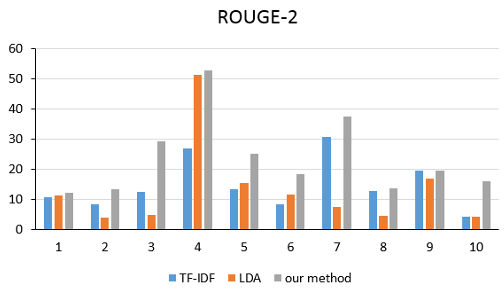 Figure: ROUGE-1 scores demonstrating the stability and superiority of OntoMLA over baseline statistical models.
By incorporating the citation count and temporal weights, the model successfully filtered out generic academic jargon in favor of specific keywords that define the research contribution.
Critical Analysis & Takeaways
Strengths:
- Contextual Intelligence: Moving beyond the local document to look at citation networks and author history.
- Hybrid Approach: Successfully bridges the gap between structured Knowledge Representation (Ontology) and probabilistic Machine Learning (LDA).
Limitations:
- Cold Start Problem: For new authors with no publication history or new papers with zero citations, the model's "Fuzzy" advantages might revert to standard TF-IDF.
- Scalability: Building and updating a fuzzy ontology for millions of documents can be computationally expensive compared to modern neural end-to-end models.
Future Outlook: The logic of "Fuzzy Membership" for citations and time is exactly what is missing in current RAG (Retrieval-Augmented Generation) systems. Integrating such ontology-based weights into the ranking stage of an LLM pipeline could significantly improve the quality of generated scientific syntheses.