
Bridging the Scholarly Gap: Automatically Embedding Social Links into Knowledge Graphs
Automatic Embedding of Social Network Profile Links into Knowledge Graphs
The paper introduces a novel framework for Knowledge Graph Completion (KGC) that automatically embeds Online Social Network (OSN) profile links (Facebook and Twitter) into existing KGs like Wikidata. It specifically targets the scientific community, utilizing personal data from Google Scholar and scholarly publications to match entities with high-confidence social links.
TL;DR
Researchers have developed an automated pipeline to solve the "missing link" problem in Knowledge Graphs (KGs). By mining scholarly data from Google Scholar and PDF biographies, and matching them against Facebook and Twitter profiles using life events and semantic descriptions, they achieved up to 97% precision in identifying social profiles for researchers—dramatically outperforming the coverage of Wikidata and YAGO.
Contextual Positioning
In the ecosystem of Knowledge Representation, KGs like Wikidata are the "gold standard" but suffer from significant sparsity in the academic domain. While an actor's Twitter handle is likely present, a world-class physicist’s profile is often missing. This paper acts as a SOTA bridge, connecting structured academic repositories with the unstructured, dynamic world of Online Social Networks (OSNs).
The Core Challenge: The "John Smith" Problem
The primary hurdle in profile matching is ambiguity. With over 75,000 "John Smiths" on Facebook, simple string matching on names is futile. Prior work relied on static attributes (location, workplace), but these are often private or outdated.
The authors' Research Intuition was twofold:
- Scholarly Mining: Information hidden in the "About the Author" section of academic PDFs is highly unique.
- Temporal Signatures: "Life events" (e.g., starting a new job, attending a specific conference) act as a temporal fingerprint that is much harder to duplicate than a name or city.
Methodology: The F-Link and T-Link Pipeline
The framework utilizes a multi-stage approach, combining Syntactic Similarity (JaroWinkler, N-Grams) for names and Semantic Similarity (LDA, Cosine Similarity) for content-heavy attributes.
1. Knowledge Base Construction
First, the system merges Wikidata triples with Google Scholar data. Crucially, it uses the GATE (General Architecture for Text Engineering) tool to extract biographies from the author's publication PDFs.
2. Hierarchical Matching
The system employs a "Bottom-Up" Machine Learning paradigm:
- F-Link: Matches the KB with Facebook profiles via public attributes.
- T-Link: Uses the matched Facebook data to pivot and find the corresponding Twitter profile.
- The Classifier: For each candidate profile, the system generates a feature vector. It uses unsupervised clustering to filter out low-confidence groups, followed by supervised classification (Naive Bayes, SVM, or J48) to confirm the final match.
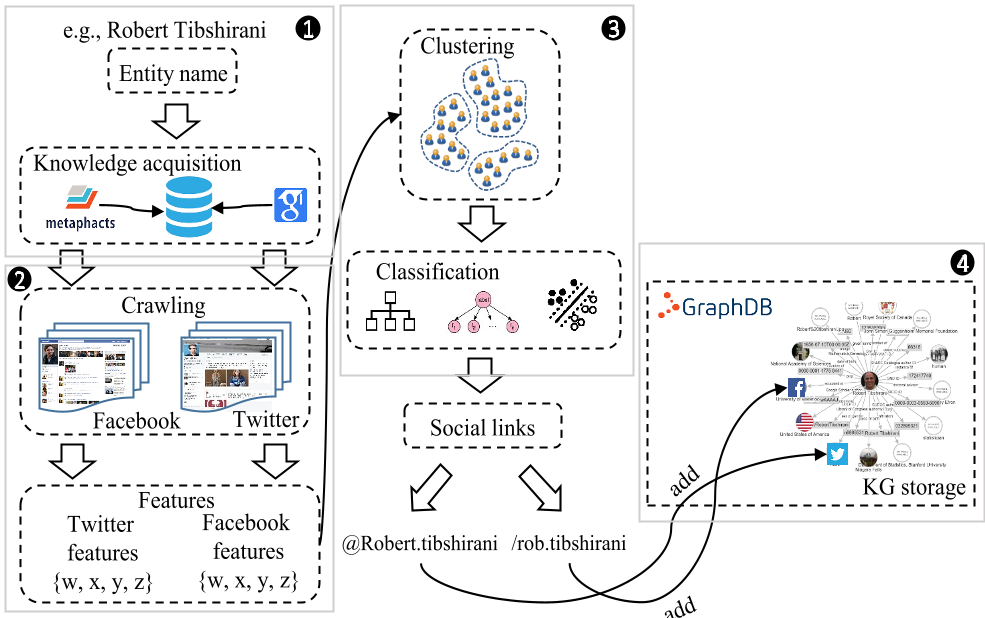 Figure: The four-stage framework: Acquisition, Matching, ML Classification, and Enrichment.
Experimental Breakthroughs
The results highlight a massive disparity between automated refinement and manual curation.
- Coverage Expansion: In the domain of Physics, while YAGO had 0 Facebook profile links for the test set, this system correctly identified 130.
- Feature Vitality: The study proved that "Auxiliary Attributes" (biographies and life events) significantly boosted both precision and recall compared to using "Essential Attributes" alone.
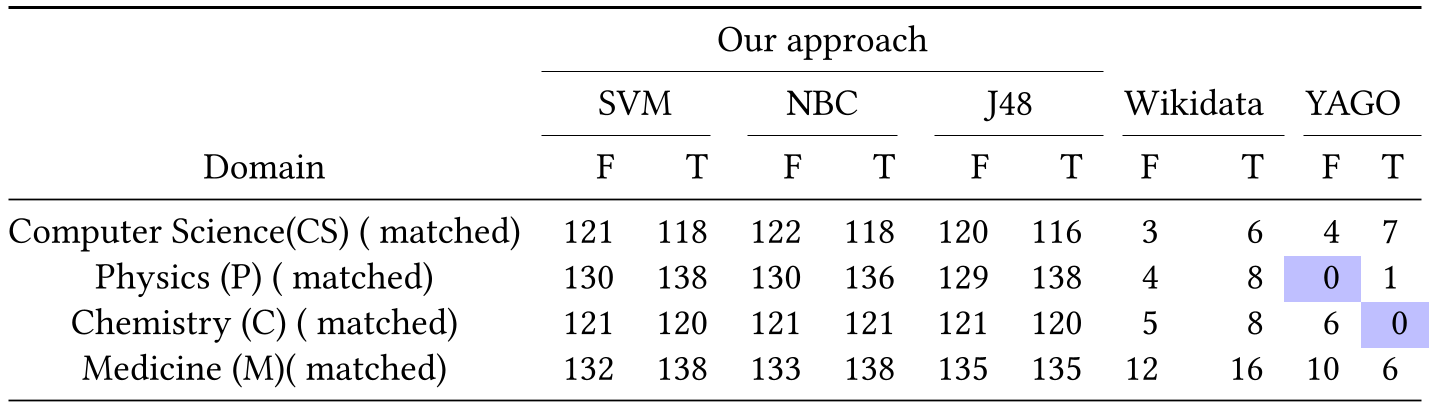 Table: Our approach vs. Wikidata and YAGO across Computer Science, Physics, Chemistry, and Medicine.
Critical Insight & Limitations
The most striking takeaway is the effectiveness of the Naive Bayesian Classifier (NBC) in this context, which consistently yielded the highest precision. By treating profile linkage as a probabilistic inference problem based on sparse features, the authors managed to overcome the noise inherent in social media data.
Limitations:
- Privacy Sensitivity: The method relies on "Public" information. As platforms like Facebook move toward stricter privacy defaults, the availability of "Life Events" may decrease.
- Domain Specificity: While highly effective for "Academic Persons," the reliance on publication biographies means this specific pipeline wouldn't directly translate to non-scholarly entities without finding a similar "biographic" proxy (e.g., LinkedIn or press releases).
Conclusion
This research provides a robust blueprint for keeping Knowledge Graphs "alive" by tethering them to the real-time activity of OSNs. By looking beyond simple metadata and into the narrative biography of an entity, the authors have turned unstructured social "noise" into structured, verifiable knowledge.