
Beyond Pitch and Power: Why Spectral Features Rule Speech Emotion Recognition
8351_Feature Analysis and Evaluation for Automatic Emotion Identification in Speech.
Summary
Problem
Method
Results
Takeaways
Abstract
This paper provides a systematic analysis of acoustic features for automatic speech emotion identification, evaluating prosody, spectral envelope, and voice quality. By comparing early and late fusion techniques, the authors demonstrate that spectral envelope statistics significantly outperform traditional prosodic features, achieving up to 78.3% accuracy on the Berlin database.
## TL;DR
While common intuition suggests that "how we speak" (prosody) is the key to emotion, this study proves that "what the vocal tract does" (spectral envelope) is a far more powerful discriminator for AI. By moving from simple feature concatenation (early fusion) to a sophisticated multi-classifier approach (late fusion), the authors achieved a 78.3% accuracy and a 20% error reduction in emotion identification.
## The Prosody Paradox
For decades, the field of Speech Emotion Recognition (SER) has been dominated by the Darwinian view: emotions trigger physiological changes that primarily affect intonation, intensity, and tempo. However, systems built solely on these **prosodic features** often hit a "glass ceiling"—they can separate high-excitement emotions from low-excitement ones, but they fail to distinguish between anger and happiness.
The authors argue that the vocal tract—the physical shape of our throat and mouth—is just as sensitive to emotion as our vocal folds. This shift in focus from the source (prosody) to the filter (spectrum) is the core motivation behind this work.
## Methodology: Deep Feature Analysis
The study breaks down features into two temporal categories:
1. **Segmental**: Frame-by-frame data (every 10ms) capturing transient changes.
2. **Suprasegmental**: Long-term statistics (mean, variance, skewness) calculated over an entire utterance.
### The Heavyweight Champion: Spectral Envelope
Instead of the standard MFCCs, the authors used **Log-Filter Power Coefficients (LFPC)**. To prove their effectiveness, they used the $J_1$ criterion (a measure of class separability). The results were startling: spectral features outscored prosodic features by a factor of five.
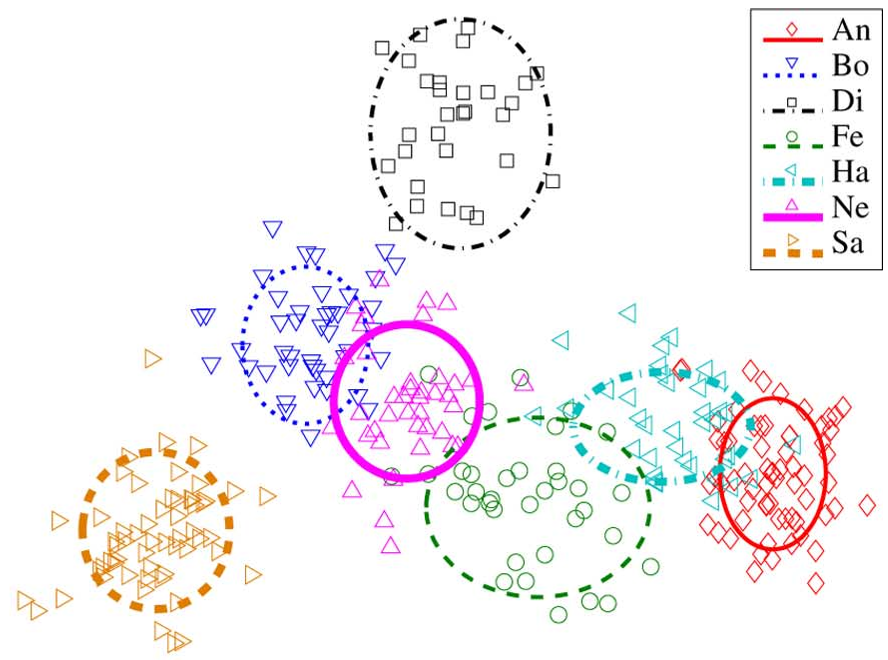
*Figure 1: LDA plots show that spectral features (right) create much tighter, more distinct clusters for different emotions compared to prosodic features (left).*
## Architecture of the Fusion System
The paper explores two ways to combine data:
* **Early Fusion**: Concatenating all numbers into one giant vector.
* **Late Fusion**: Training separate experts (classifiers) for pitch, volume, and spectrum, and then using a "Master" SVM to decide the final result based on the experts' scores.
Late fusion proved superior because it effectively handles the different "clocks" of the signal—some features are meaningful at the millisecond level, while others require the context of a whole sentence.
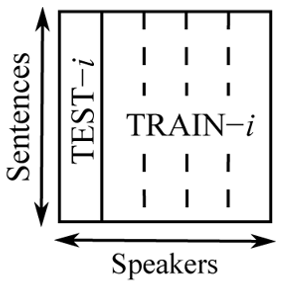
*Figure 2: The nested double cross-validation framework used to ensure results were speaker-independent.*
## Experimental Insights
The tests on the Berlin Emotional Speech Database revealed several critical "black swan" findings:
1. **Voice Quality is "Noisy"**: Despite its theoretical importance, automatic extraction of voice quality (jitter/shimmer) is still too error-prone to lead the charge in identifying emotions.
2. **The Dominance of Spectral Stats**: Long-term spectral statistics achieved 70.5% accuracy alone, outperforming almost every combination that excluded them.
3. **The Complexity-Accuracy Trade-off**: While using all 7 classifiers yielded the best result (78.3%), a simpler system using only spectral statistics and frame-wise LFPC reached nearly 77%, offering a much more efficient path for real-world applications.
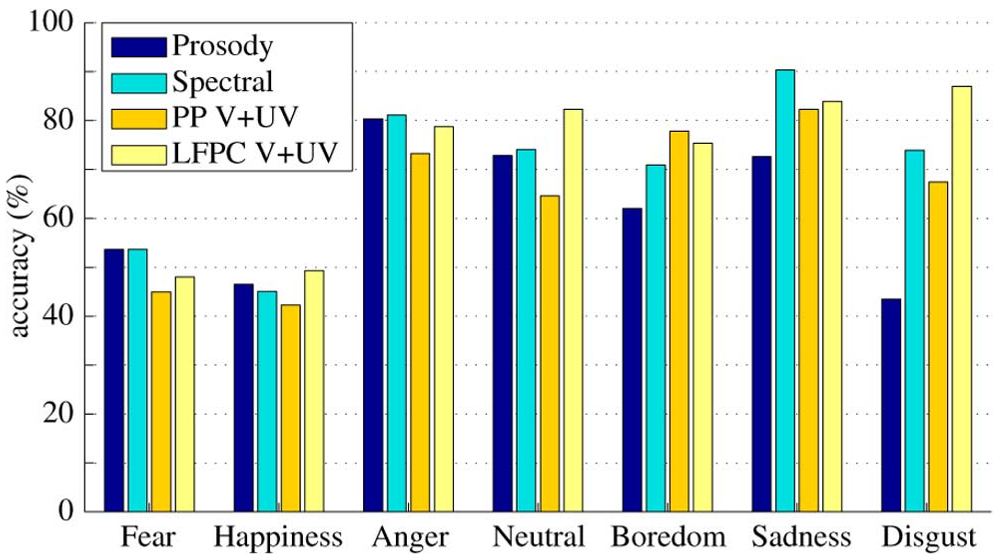
*Figure 3: Emotion-specific accuracy comparison showing spectral features' consistent lead, particularly in difficult categories like 'Disgust'.*
## Critical Analysis & Conclusion
This research provides a refreshing reality check for the SER community. It suggests that our current mathematical representations of prosody are insufficient. Humans can identify emotion from pitch perfectly, yet our AI models find more signal in the spectral "hiss" and "resonance" of the vocal tract.
**Takeaway for Developers**: If you are building an emotion-aware AI, don't just calculate pitch and volume. Prioritize spectral envelope statistics and use late-fusion architectures to let different acoustic modalities "vote" on the final emotional state.
**Limitations**: The study used acted speech (Berlin DB). While high-quality, acted emotions can be more stereotypical than the messy, subtle emotions found in "in-the-wild" recordings. Future work must bridge this gap using spontaneous datasets.