
Beyond 2D: Robust Emotion Detection via Consumer-Grade Depth Sensing
Automatic Detection of Emotion Valence on Faces Using Consumer Depth Cameras
This paper introduces the first practical system for 3D facial emotion valence detection using low-cost consumer depth cameras (e.g., Kinect). It proposes a robust point-cloud-based pipeline utilizing novel surface approximation and curvature descriptors, achieving a high accuracy of 89.4% through 3D and luminance data fusion.
TL;DR
Determining whether a person feels "positive" or "negative" (Emotion Valence) is a cornerstone of Human-Computer Interaction (HCI). While 2D cameras struggle with shadows and head tilts, and professional 3D scanners are too expensive, this paper presents a breakthrough: a fully automatic system that uses affordable consumer depth cameras (like the Kinect) to recognize emotions. By shifting from traditional "mesh" processing to a robust "point-cloud" methodology, the authors achieved an impressive 89.4% accuracy in detecting facial valence.
The "Low-Fidelity" Dilemma
In the world of computer vision, 3D data is a "holy grail" for facial analysis because it is physically invariant to lighting and head rotation. However, consumer-grade depth sensors are notoriously "noisy." Previous 3D research relied on high-resolution scanners producing clean meshes, which fail when applied to the jittery, low-resolution output of a $100 sensor.
The researchers identified a critical gap: How do we extract meaningful geometric signals (like the subtle curve of a smile) from data that looks more like a chaotic cloud of points than a smooth surface?
Methodology: The Power of Geometry
The paper bypasses the computationally expensive step of creating a triangular "mesh." Instead, they treat the face as a Point-Based Surface.
1. Robust Surface Approximation
Using an algorithm called MSAC (M-estimator Sample and Consensus), the system fits tangent planes to local point clusters. This is crucial because it ignores "outliers" (noise spikes) that would otherwise distort the facial features. It simultaneously smooths the data and reduces the point count for faster processing.
2. Normal Section Curvature
Rather than looking at raw depth, the authors look at Mean Curvature. Curvature is rotation-invariant, meaning the system understands the shape of a frown regardless of whether the user is looking straight at the camera or slightly away.
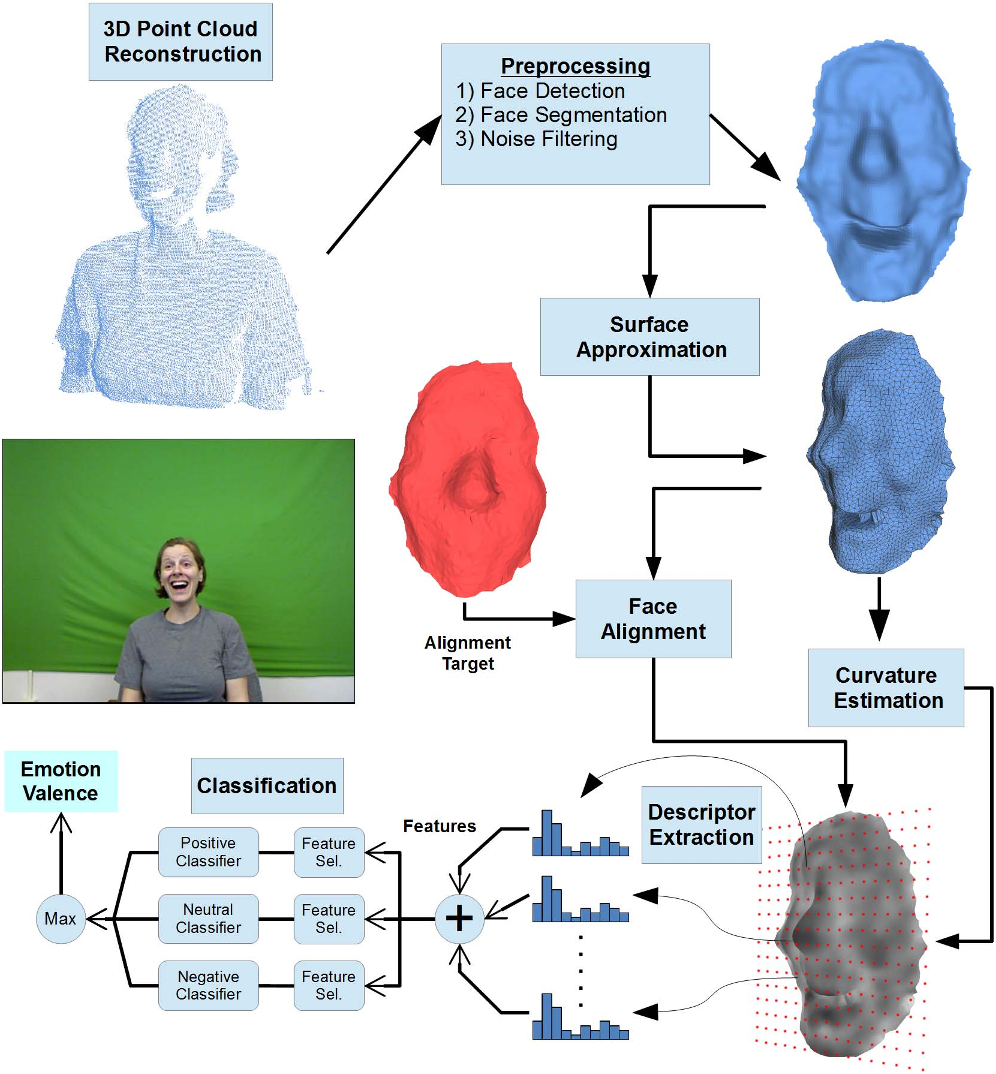 Figure 1: The fully automatic pipeline, from raw depth capture to SVM classification.
Experiments and Results
The authors curated the SBIA RGB-D Affect Database, featuring 707 segments of semi-spontaneous expressions across 20 subjects.
Key Findings:
- 3D is more robust than 2D in noise: Using only 3D data, the system reached 77.4% accuracy. While lower than 2D in perfect lighting, 3D remains functional in total darkness where 2D cameras fail.
- The Power of Fusion: By combining 3D curvature with 2D luminance, the accuracy jumped to 89.4%.
- Efficiency: The point-cloud descriptor uses only 8,192 features—significantly fewer than the 184,320 features required by traditional Gabor wavelet methods—without sacrificing performance.
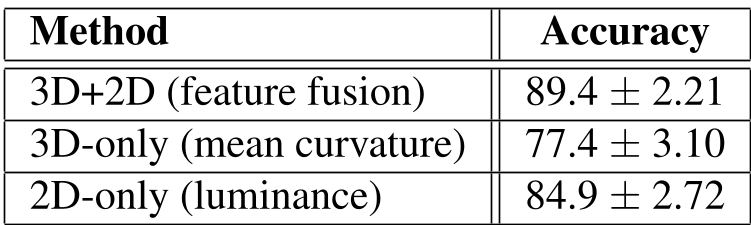 Table 1: Accuracy comparison showing the significant boost provided by 3D+2D feature fusion.
Critical Insight: Why This Matters
The most profound takeaway is the validation of Curvature Estimation as a primary feature for emotion. While many researchers try to solve "low-quality data" problems by adding more data (Deep Learning), this paper proves that better mathematical modeling of the geometry (using Euler formulas for curvature and MSAC for robustness) can extract high-level semantic meaning from low-quality hardware.
Conclusion & Future Work
This work sits at the intersection of geometry and psychology. It proves that practical, low-cost 3D emotion recognition is not just possible but superior when lighting conditions are less than ideal. Looking forward, the researchers suggest incorporating temporal information (how the curvature changes over time) to distinguish even more subtle micro-expressions, potentially bridging the gap between positive/negative detection and full discrete emotion classification (e.g., distinguishing between fear and anger).
Senior Editor's Note: This paper is a masterclass in "doing more with less." In an era of massive models, it reminds us that robust feature engineering—rooted in differential geometry—remains a powerful tool for real-time edge computing.