
MOP: Harvesting the "Anti-Dictionary" through Metalinguistic Extraction
Automatic Extraction of Non-standard Lexical Data for a Metalinguistic Information Database
The paper introduces the Metalinguistic Operation Processor (MOP), a specialized information extraction system designed to identify and extract "Explicit Metalinguistic Operations" (EMOs) from technical corpora. It aims to populate a Metalinguistic Information Database (MID) that captures how terms are defined, negotiated, or modified in context, moving beyond static dictionary definitions.
TL;DR
While traditional NLP relies on static dictionaries, scientific knowledge is often "negotiated" within the text itself. This paper presents the Metalinguistic Operation Processor (MOP), a system that extracts Explicit Metalinguistic Operations (EMOs)—those specific moments where an author defines, coins, or restricts a term. By capturing these fleeting linguistic negotiations, the authors build a Metalinguistic Information Database (MID) that acts as a dynamic supplement to traditional ontologies.
The Problem: The Rigidity of Traditional Lexicons
Most AI systems and terminological databases operate on a "default" assumption: that the meaning of a word is fixed and universally agreed upon within a domain. However, in technical writing, language is fluid. Experts frequently:
- Propose new terms (e.g., "coining" a phrase).
- Modify existing definitions to suit a specific experiment.
- Discuss the validity of a particular label.
Traditional Information Extraction (IE) ignores these "meta" conversations, focusing only on factual data points. This leaves a gap in "unorthodox" information—the exceptions and specific usages that define cutting-edge research.
The Insight: Explicit Metalinguistic Operations (EMOs)
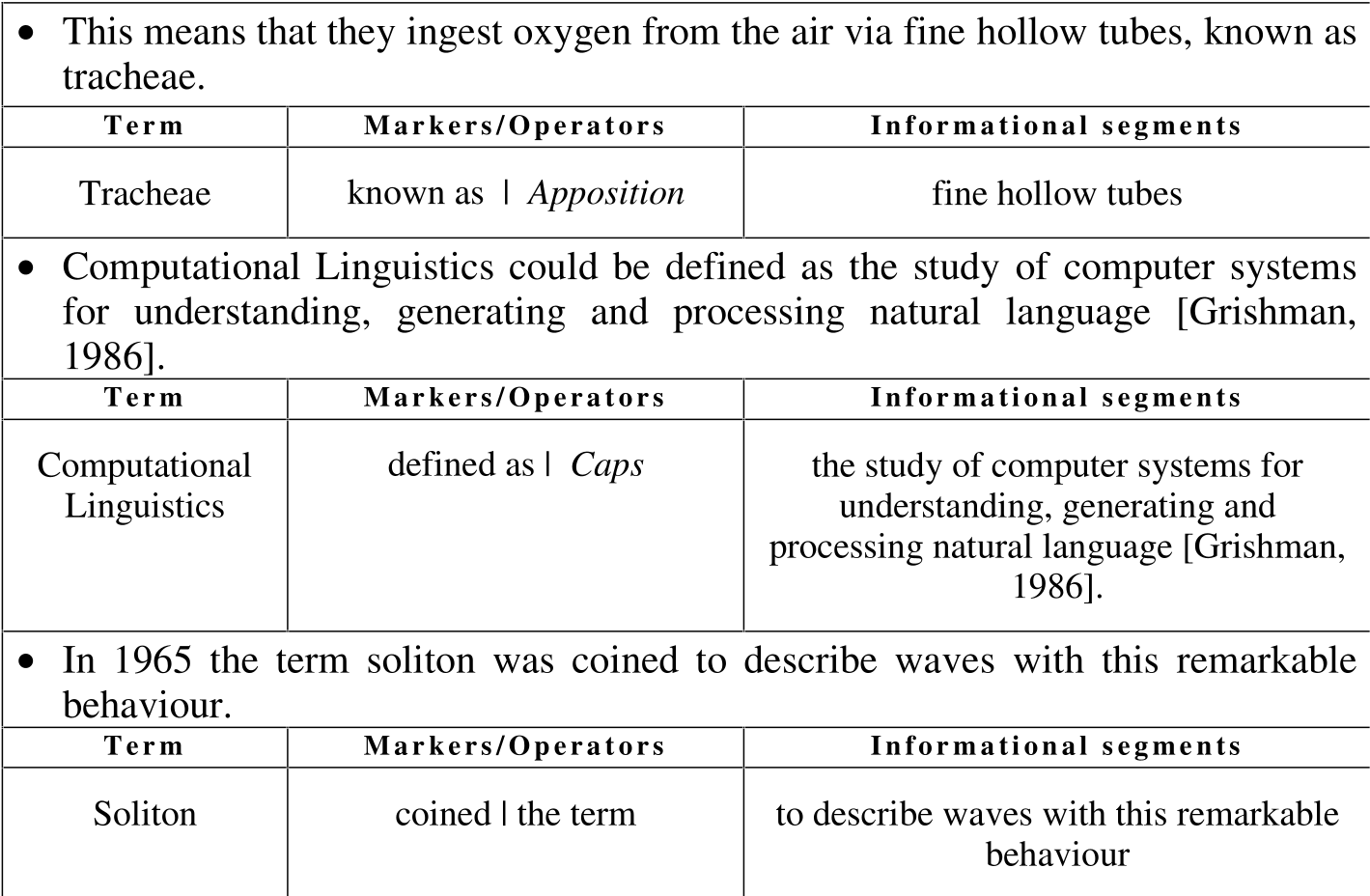
The authors identify a unique category of textual segments called EMOs. An EMO is essentially the "API documentation" of a natural language sentence. For example, in the sentence "In 1965 the term soliton was coined to describe...", the word "soliton" isn't just used; it is being introduced.
To extract these, the MOP system treats terms as autonyms (words naming themselves) and employs a tripartite structural analysis:
- The Term: The logical subject being defined.
- Markers/Operators: Linguistic flags like "known as," "defined as," or even typography (Caps, Italics).
- Informational Segments: The actual descriptive payload.
Methodology: Beyond Domain-Specific Extraction
Unlike typical IE systems from the DARPA Message Understanding Conferences (MUC) which are often bound to a single domain (e.g., "corporate management changes"), metalinguistic extraction is domain-agnostic. Because scholars in every field—from sociology to physics—use similar linguistic patterns to define their terms, MOP’s hand-coded heuristics have high portability.
The MOP workflow involves:
- Preprocessing: Standard tokenization and tagging.
- Heuristic Matching: Identifying "Markers" that signal a meta-discussion is happening.
- XML Structuring: Storing extracted EMOs in a portable, transparent format that allows AI systems to query contextual meanings rather than just default ones.
Results & The "Anti-Dictionary"
The system was tested on specialized corpora, successfully extracting complex definitions across disciplines. The ultimate output, the Metalinguistic Information Database (MID), is described by the authors as a "veritable anti-dictionary."
Why? Because instead of providing the average meaning of a word, it stores the exceptions and specific negotiations. This allows an AI system to:
- Override global defaults when a specific paper defines a term differently.
- Enrich lexicons with context-specific constraints.
- Trace the genealogy of a concept as it is defined and redefined over time.
Critical Insight: The Challenge of Formalization
The authors conclude with a sobering observation: the difficulty isn't in finding these segments, but in formalizing them. Linguistic information is heterogeneous. How do you reconcile a definition from 1965 with one from 2024? The MID must integrate conflicting representation systems, a task that remains a core challenge for knowledge engineering.
Summary
This work highlights a critical frontier in NLP: moving from "understanding language" to "understanding how language is built." By treating every technical text as a site of linguistic negotiation, MOP provides a roadmap for building AI that is as terminologically flexible as the human experts it seeks to augment.
Note: For more technical details and the original prototype, users are encouraged to visit the project's repository and the experimental URL provided in the paper (http://iling.iingen.unam.mx/MOP).