
Personality Extraction from Text: A Reality Check on Machine Learning’s Limits
Automatic Extraction of Personality from Text: Challenges and Opportunities
This study investigates the feasibility of extracting Big Five personality traits from Swedish text using Support Vector Regression (SVR) and ULMFiT language models. By comparing datasets of varying annotation quality, the authors demonstrate that high-reliability data is superior for training, yet even the best models fail to outperform random baselines when tested "in the wild."
TL;DR
Can AI really "know" who you are just by reading your tweets or blog posts? While many academic papers claim high accuracy in personality detection, this study from Uppsala University reveals a sobering truth: models that look brilliant in the lab often collapse when faced with the "wild" diversity of real-world text. By comparing high-quality manual annotations with large-scale noisy data, the researchers highlight that data reliability and domain generalizability remain the two biggest hurdles in computational psychology.
Background: The Big Five and the Digital Trace
The study centers on the Five Factor Model (OCEAN): Openness, Conscientiousness, Extraversion, Agreeableness, and Emotional Stability. For decades, these were measured via self-report questionnaires. In the era of social media, the "digital trace"—the way we write—has been touted as a mirror to our souls. However, following the Cambridge Analytica scandal, the ethics and actual technical efficacy of these systems have come under intense scrutiny.
The Core Challenge: Quality vs. Quantity
The researchers identified a fundamental tension in machine learning: is it better to have a massive dataset with "noisy" labels, or a tiny dataset where every label is double-checked by experts?
They created two Swedish datasets:
- DLR (Lower Reliability): ~40,000 texts, mostly annotated by a single person.
- DHR (Higher Reliability): ~2,800 texts, where each sample was vetted by multiple psychology students.
Methodology & Architecture
The team tested two primary approaches:
- Support Vector Regression (SVR): Using traditional TF-IDF (n-grams) to find statistical patterns in word frequencies.
- ULMFiT (Language Model): A transfer learning approach where a model first learns the structure of the Swedish language (using Wikipedia and forums) and is then "fine-tuned" to recognize personality.
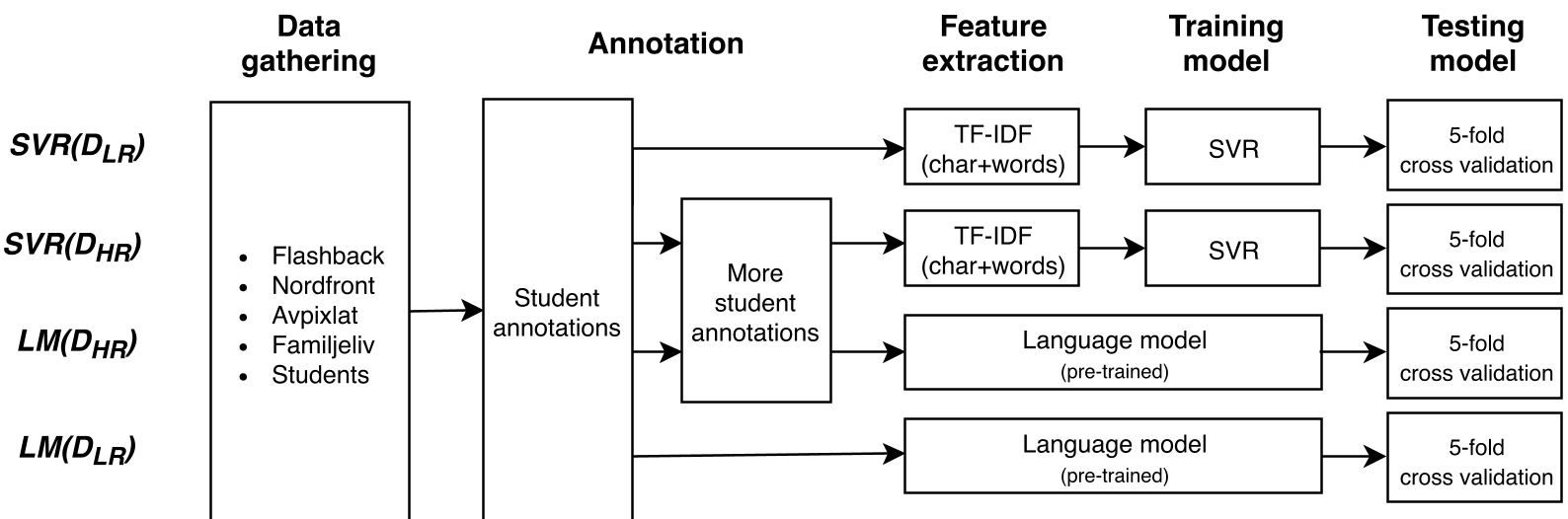 Figure 1: The workflow from data crawling to model evaluation.
Key Finding 1: The Reliability Paradox
The results were clear: Reliability beats Scale. The models trained on the smaller, high-quality DHR dataset performed substantially better in cross-validation experiments. For instance, the Language Model (LM) attained an of 0.75 for Agreeableness on the high-reliability set, compared to near-zero performance on the larger, noisier set.
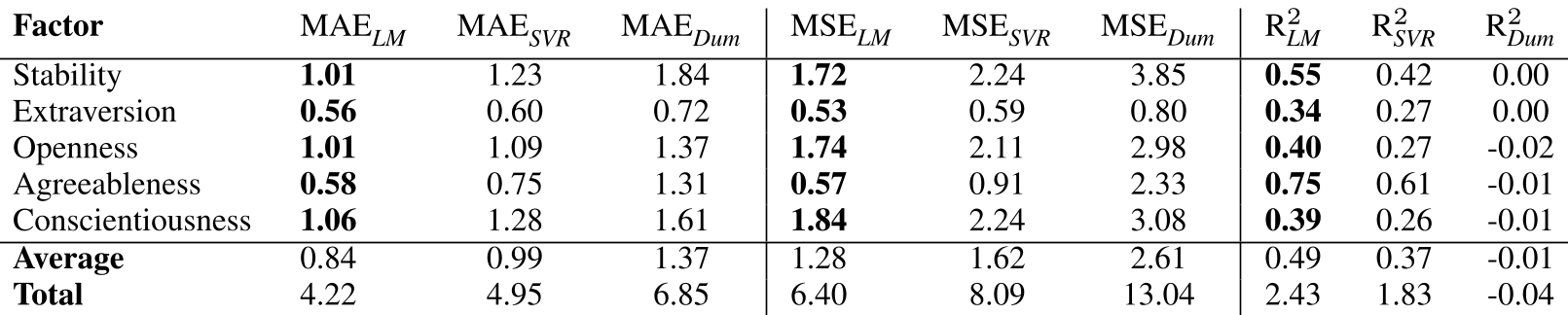 Table IV: Performance of models on the High-Reliability (DHR) dataset. Note the superior R² scores for the Language Model.
Key Finding 2: The "In the Wild" Collapse
This is where the optimism ends. The researchers took their "best" model—the one that looked like a star in lab tests—and applied it to two new datasets: Cover Letters and Self-Descriptions.
The result? Complete failure.
- The scores dropped below zero for every single trait.
- The model was less accurate than a "Dummy Regressor" (a simple script that just guesses the average score every time).
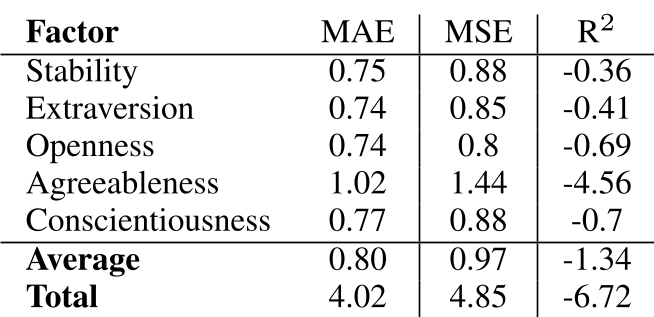 Table VII: The model's failure when applied to Cover Letters, showing negative R² across the board.
Why Did it Fail?
The authors suggest that personality is expressed differently depending on the context. A person's "Agreeableness" looks different in a heated political forum (the training data) than it does in a professional cover letter (the test data). Machine learning models struggle with this domain shift because they often pick up on "stylistic noise" rather than deep psychological signals.
Critical Insight & Future Outlook
This paper serves as a vital cautionary tale for the AI community.
- Stop Relying on Internal Validation: Accuracy within a single dataset is a "mirage" of success. Models must be tested on entirely different domains to prove utility.
- The Content Problem: Short, context-less texts often contain zero personality signals. Forcing a model (or even a human annotator) to extract "OCEAN" traits from a sentence about the weather leads to noisy data that poisons the learning process.
Conclusion
Automated personality extraction is not "solved." While language models like ULMFiT can capture nuances better than old-school statistical methods, they are still far from being robust psychometric tools. For developers and researchers, the message is clear: focus on annotation reliability and cross-domain robustness, or your model will remain a laboratory curiosity.