
UTNA: Balancing Social Unfamiliarity and Support via Noah’s Ark Principle
On Automatic Formation of Effective Therapy Groups in Social Networks
This paper introduces the Unfamiliarity-Aware Therapy Group Selection with Noah’s Ark Principle (UTNA) problem, aimed at automating the formation of effective therapy groups in social networks. The authors propose TEGD (for tree structures) and ETD (for general graphs) algorithms, achieving optimal solutions in linear time for trees and significantly outperforming baselines in both efficiency and group quality.
TL;DR
Forming a therapy group is a delicate balancing act: you want enough people for support, but they shouldn't know each other (to protect privacy) and no one should feel "different" (to avoid isolation). This paper introduces UTNA, a computational framework that automates this process using social network data, outperforming human experts in both speed and adherence to clinical principles.
Background: The Complexity of Group Therapy
Group therapy is highly effective for treating disorders like depression and addiction, but psychiatrists usually form these groups manually. This process is plagued by three major bottlenecks:
- Isolation Avoidance: Known as the Noah's Ark Principle, which mandates that no patient attribute (like gender or income level) should exist in isolation. You don't want to be the "only" one of your kind in a room.
- Unfamiliarity: Patients are more likely to share private experiences if they don't have pre-existing social ties with other members.
- Group Size: Larger groups generally provide a more diverse support system.
Methodology: Bridging Graph Theory and Psychology
The authors define the Unfamiliarity-Aware Therapy Group Selection (UTNA) problem as maximizing the vertex set such that induced edges and all features in are paired.
1. The Tree-based Approach (TEGD)
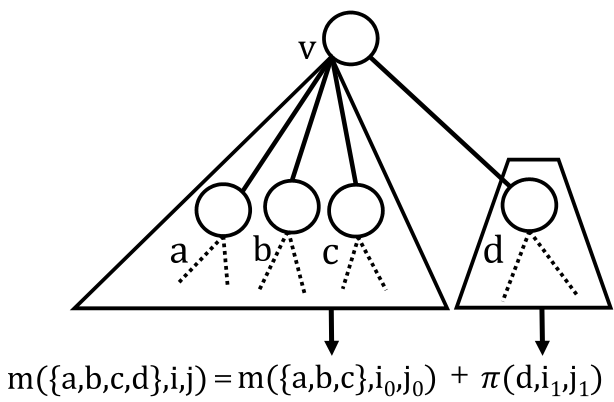
For hierarchical or organizational social structures, the authors provide TEGD, a dynamic programming algorithm. It uses a 9-state transition matrix for each node to track whether features are absent, single, or paired across subtrees.
2. General Graph Strategy (ETD)
For complex social networks, the algorithm uses a scoring function based on:
- Hubness: Prioritizing high-degree nodes for removal to clear edges faster.
- Neighbor Purity: Removing nodes whose neighbors have diverse features to simplify pairing.
- Tailoring (Bulk Removal): A final pass that "trims" the group to ensure the Noah's Ark Principle is maintained after density constraints are met.
Experiments and Expert Validation
The paper doesn't just rely on synthetic benchmarks. The authors invited 10 professional psychiatrists to evaluate the results.
- Expert Consensus: 100% of experts found the algorithm helpful.
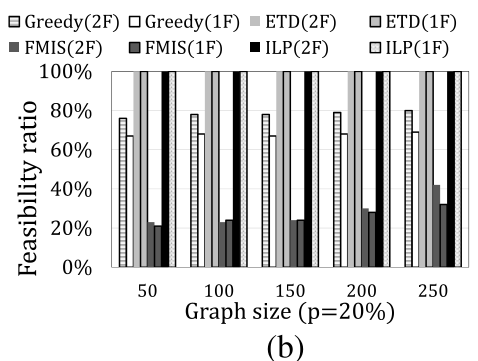
- Superior Quality: Humans often failed to meet the strict "Noah's Ark" pairing in their manual attempts, whereas ETD achieved 100% feasibility.
- Scalability: ETD processed graphs with 200k vertices in minutes, a task impossible for manual intervention.
Critical Insight: Why This Matters
The core achievement here isn't just the NP-hardness proof; it’s the translation of a qualitative psychological heuristic (Noah's Ark Principle) into a quantitative constraint for graph pruning. In an era where online support groups are exploding, such algorithms could be the backbone of safer, more effective digital mental health platforms.
Challenges and Future Work
While the algorithm is robust, it treats features as static. Future research could explore dynamic features (e.g., patient progress levels) or weighted social ties (where some relationships are more "familiar" than others). Furthermore, extending this to a "multi-group" partition problem remains an open challenge.