
UTNA: Automating Effective Therapy Group Formation via Social Network Analysis
On Automatic Formation of Effective Therapy Groups in Social Networks
The paper introduces the Unfamiliarity-Aware Therapy Group Selection with Noah’s Ark Principle (UTNA) problem, aimed at automating the selection of mental health therapy groups. It proposes two main algorithms: TEGD for tree-structured networks and ETD for general graphs, achieving competitive group quality compared to manual clinical configurations.
TL;DR
Forming a therapy group isn't just about picking people with the same condition; it's a delicate balancing act of social distance and identity redundancy. This paper formalizes the UTNA problem—selecting a group that maximizes size while ensuring members don't know each other (unfamiliarity) and no one feels like the "odd one out" (Noah’s Ark Principle). The authors provide a suite of algorithms (TEGD and ETD) that outperform human experts in both speed and clinical adherence.
Problem & Motivation: The Psychiatrist’s Dilemma
In clinical settings, group therapy is a powerful tool for treating addiction and depression. However, psychiatrists face a combinatorial nightmare when selecting members:
- Isolation (Noah's Ark Principle): If a group has only one female or only one person with a high income, that individual often feels isolated and stops sharing. The rule: every feature must be shared by at least two people.
- Unfamiliarity: If patients are friends, they fear their secrets will leak into their social circles. Privacy requires a "sparse" social subgraph.
- Group Size: Larger groups provide more diverse support, but increase the risk of violating the first two rules.
Current manual selection is slow and biased. The authors prove that finding the optimal group under these constraints is NP-hard and even hard to approximate, necessitating sophisticated algorithmic interventions.
Methodology: Balancing Hubs and Purity
The paper treats the patient pool as a social graph where represents features (Gender, Major, Income).
1. The Tree-based Approach (TEGD)
For hierarchical social structures, the authors propose TEGD. It uses a 9-state dynamic programming table for each vertex to track whether features are absent, singular, or paired. It achieves the optimal solution in linear time .
2. General Graph Strategy (ETD)
On general graphs, where the problem is most difficult, the ETD (Effective Therapy Group Discovery) algorithm combines a greedy scoring function with a "tailoring" procedure:
- Hubness: Removes high-degree nodes first to quickly satisfy the unfamiliarity constraint.
- Neighbor Purity: Prioritizes removing nodes whose neighbors have diverse features, which simplifies the remaining "pairing" problem.
- Tailoring (Bulk Removal): A final pass that iteratively prunes individuals with unpaired features until the group satisfies the Noah's Ark Principle.
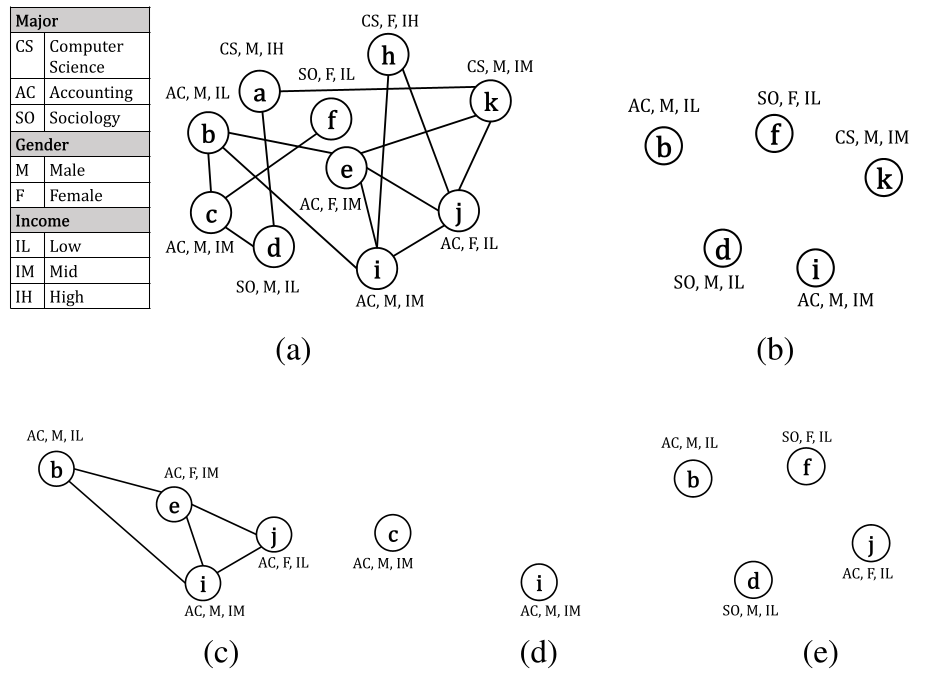 Figure 1: Comparison of different selection strategies: (b) satisfies unfamiliarity but fails Noah's Ark; (c) satisfies Noah's Ark but fails unfamiliarity; (e) represents the optimal UTNA balance.
Experiments & Expert Validation
The authors didn't just test on datasets; they invited 10 clinical psychologists to a head-to-head challenge.
Key Findings:
- Expert Consensus: 100% of the experts found the UTNA formulation "helpful," and 42% admitted the algorithm's groups were better than their own.
- Efficiency: Humans took significantly longer as the network size increased, whereas ETD processed 200k nodes in roughly 3 minutes.
- Feasibility: Traditional graph algorithms (like Maximum Independent Set) often failed the Noah's Ark constraint, while ETD maintained 100% feasibility across tests.
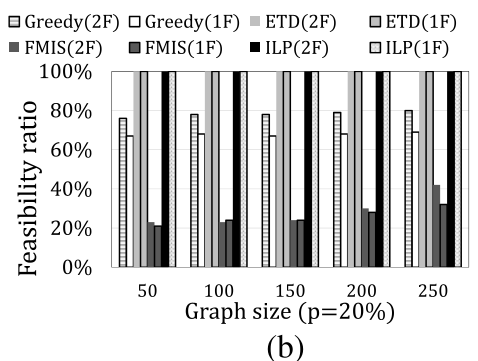 Figure 2: Computation time and objective quality on DBLP and Pokec datasets, demonstrating scalability.
Critical Analysis & Conclusion
Takeaway
The UTNA problem is a brilliant example of transforming high-level psychological principles into concrete graph-theoretic constraints. By utilizing a "Bulk Removal" strategy, the authors found a way to bridge the gap between simple social tenuity (sparse graphs) and complex demographic requirements.
Limitations
The current model treats all features with equal weight. In reality, a psychiatrist might prioritize "Gender" pairing over "University Major" pairing. Furthermore, the unfamiliarity constraint is binary; future work could incorporate "strength of relationship" (weighted edges) to allow for more nuanced group dynamics.
Future Outlook
As mental health services move toward digital platforms, automated group formation like ETD could enable the rapid deployment of support groups for millions, ensuring that every participant feels both private and represented.