
Beyond Hard Constraints: Mining the Web for High-Precision Anaphora Resolution
Automatic Acquisition of Gender Information for Anaphora Resolution
The paper introduces a statistical framework for the Automatic Acquisition of Gender Information to enhance pronominal anaphora resolution. It utilizes a novel combination of lexico-syntactic patterns mined from parsed corpora and web-scale data, achieving a 96% accuracy in gender classification and significantly boosting pronoun resolution performance.
TL;DR
Researchers have long struggled with "gender mismatch" in pronoun resolution—mistaking a "he" for a "she" simply because the computer doesn't know the gender of a noun like "doctor" or "Alex." This paper presents a breakthrough by using Bayesian modeling to mine gender probabilities from 6GB of text and the entire Web, achieving 96% gender accuracy and raising the bar for coreference resolution by over 10%.
Contextualizing the Problem: The Gender Gap in NLP
Anaphora resolution is the engine behind understanding who or what a pronoun refers to. While we've mastered syntactic rules, we often stumble on lexical gender.
Previous systems relied on:
- Hard Constraints: If a dictionary doesn't list "doctor" as masculine/feminine, the system ignores gender entirely.
- Surface Clues: Over-reliance on titles (Mr./Mrs.) which are often missing.
The authors argue that gender is not a binary switch but a statistical preference. A name like "Alex" might be 80% masculine and 20% feminine; a "neutral" company name like "Google" should have a near-zero probability of being masculine or feminine.
Methodology: Bayesian Learning from the Web
The core innovation lies in how the system learns. Instead of just "counting" occurrences, the authors use five specific lexico-syntactic "hooks" that reveal gender:
- Reflexives: "John explained himself." (Strong link between John and masculine).
- Possessives: "John bought his car."
- Predicates: "He is a father."
The Bayesian Edge
To handle the noise of the web and the "small count" problem, the authors adopt Beta Distributions. This allows the model to calculate both the mean (the most likely gender probability) and the variance (how certain we are). A word seen 5,000 times has a much lower variance (higher certainty) than a word seen 5 times, even if the ratio is the same.
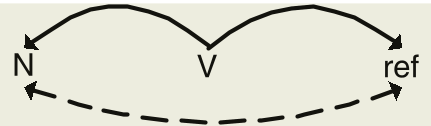 The model extracts noun-pronoun pairs by identifying specific dependency relationships in parsed text.
Experimental Results: Outperforming Humans
The results were striking. In a blind test (identifying gender without sentence context), the system scored 96% accuracy. Crucially, it outperformed native English-speaking graduate students, who averaged only 88.8%.
Why? Humans rely on context to resolve ambiguity, whereas this system has "memorized" the statistical distributions of millions of nouns across the entire internet.
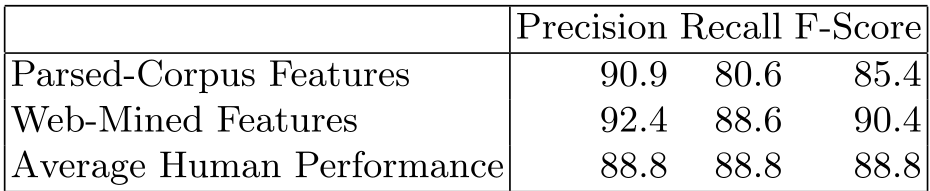 Web-mined features significantly outperformed parsed corpus features due to superior coverage.
In the actual task of Pronoun Resolution, the impact was immediate:
- Baseline (No Gender): 26.0%
- Knowledge-Rich System (Standard Gender): 63.2%
- Full System (+ Statistical Gender): 73.3%
Critical Analysis & Takeaways
The paper proves that quantity has a quality of its own. Even though the web is "noisy" (filled with ungrammatical text and parser errors), the sheer volume of data allows the Bayesian model to filter out the noise and find the underlying truth.
Limitations:
- The system still struggles with the feminine class (lower recall), largely because English historically defaults to masculine pronouns in generic contexts (the "generic he").
- It is a "snapshot" of gender distribution; names and language use evolve over time, requiring periodic re-crawling of the web.
Future Outlook: This methodology serves as a precursor to how modern Large Language Models (LLMs) implicitly learn world knowledge. However, by making these probabilities explicit and using an SVM to weigh them, the authors provide a level of interpretability that modern "black box" models often lack.
Conclusion
By treating gender as a probabilistic feature derived from web-scale data, this research successfully turned a "hard constraint" into a robust statistical advantage, significantly advancing the state-of-the-art in anaphora resolution.