
Beyond the Pen: Surpassing Human Accuracy in Handwriting-Based Gender Classification
Automatic Gender Classification from Handwritten Images: A Case Study
This paper presents a comprehensive study on automatic gender classification from offline handwritten images using deep convolutional neural networks (CNNs). The authors evaluate ten state-of-the-art architectures, such as Xception and EfficientNet, utilizing transfer learning from ImageNet across English, Arabic, and a newly introduced Hebrew (HHD gender) dataset, achieving SOTA results that surpass human performance.
TL;DR
Is gender "written" in our handwriting? This study demonstrates that it is. By leveraging deep learning models like Xception and EfficientNet, researchers have developed a system that classifies the gender of a writer from offline images with up to 85% accuracy. Most notably, these AI models have officially surpassed the accuracy of non-expert humans, marking a milestone for forensic document analysis.
Background: The Biological Signature of Script
Psychological and forensic studies have long suggested that male and female handwritings exhibit distinct "signatures." While female script is often characterized by greater circularity and uniformity, male script tends to be more slanted and irregular. Traditionally, identifying these required a graphology expert. This paper transitions that expertise into the realm of Computer Vision, tackling the "black box" of handwriting styles through Deep Neural Networks (DNNs).
The Core Challenge: Feature Engineering vs. Feature Learning
The primary bottleneck in previous SOTA systems was Manual Feature Selection. Researchers had to identify specific geometric or textural attributes (like the "Hinge" or "COLD" features) before a classifier could work.
The authors of this study argue that this "Expert-in-the-loop" requirement limits scalability and accuracy. Instead, they propose a Transfer Learning approach:
- Pre-training: Start with weights from ImageNet (general objects).
- Fine-tuning: Adapt the models to recognize the nuanced patterns of handwritten strokes.
- Patch-based Processing: Instead of feeding the whole page, the system looks at 400x400 pixel patches, capturing the local flow of the script.
Methodology: A Multi-Script Case Study
The researchers evaluated the approach on three languages: English, Arabic, and a brand-new, publicly available Hebrew (HHD gender) dataset.
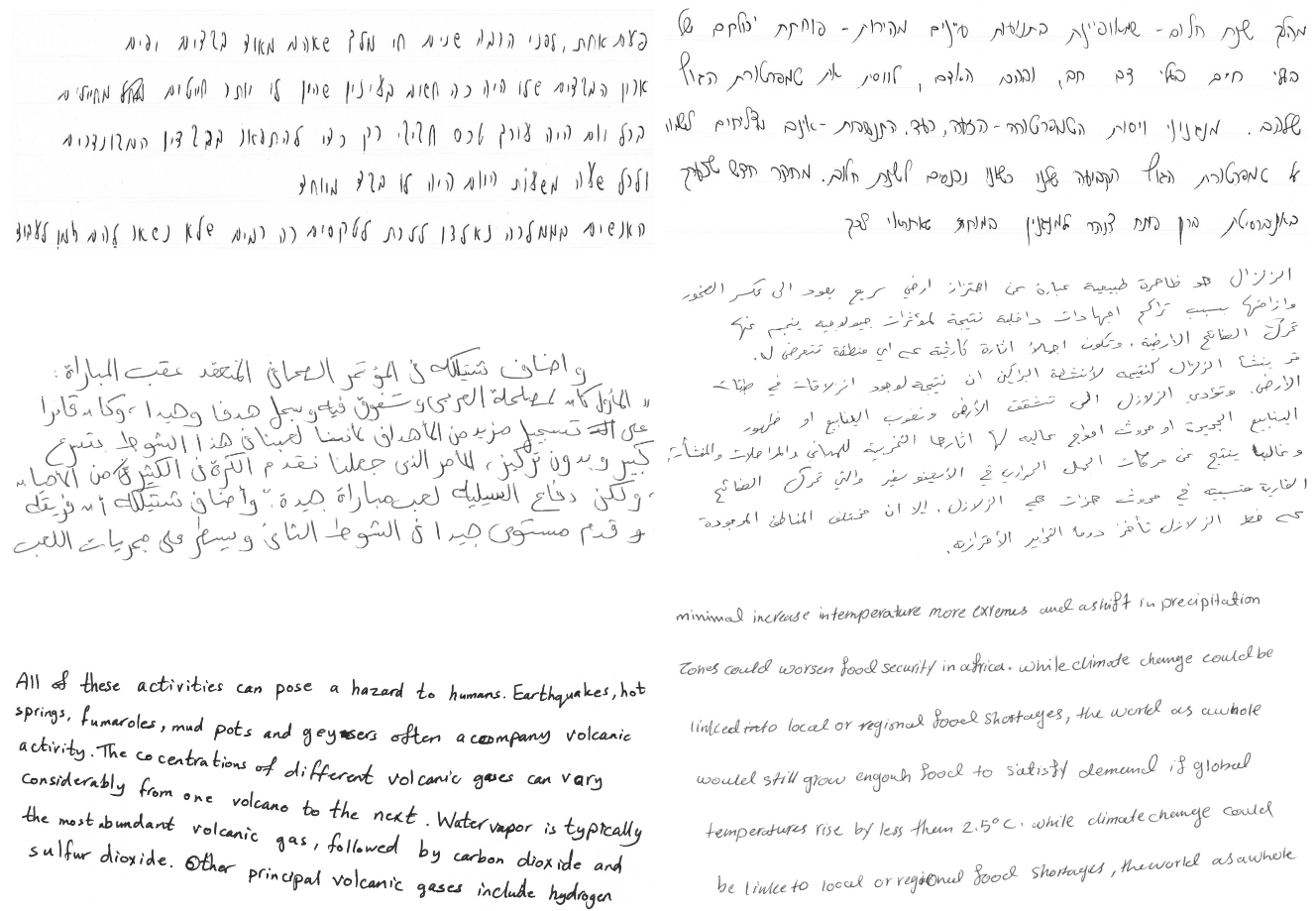 Figure 1: Comparison of scripts across Hebrew (top), Arabic (middle), and English (bottom).
The methodology relied on Majority Voting. Multiple patches from a single document are classified individually, and the final verdict is determined by the consensus. This suppresses the noise of "neutral" handwriting patches that don't clearly exhibit gender traits.
Experimental Battleground: AI vs. Human
How does the machine compare to us? The authors conducted a survey with over 400 human participants. The results were telling:
- Average Human Accuracy: ~67.5%
- AI (Xception/EfficientNet) Accuracy: 75% - 85%
The AI didn't just win; it dominated in cross-script scenarios where humans typically struggle.
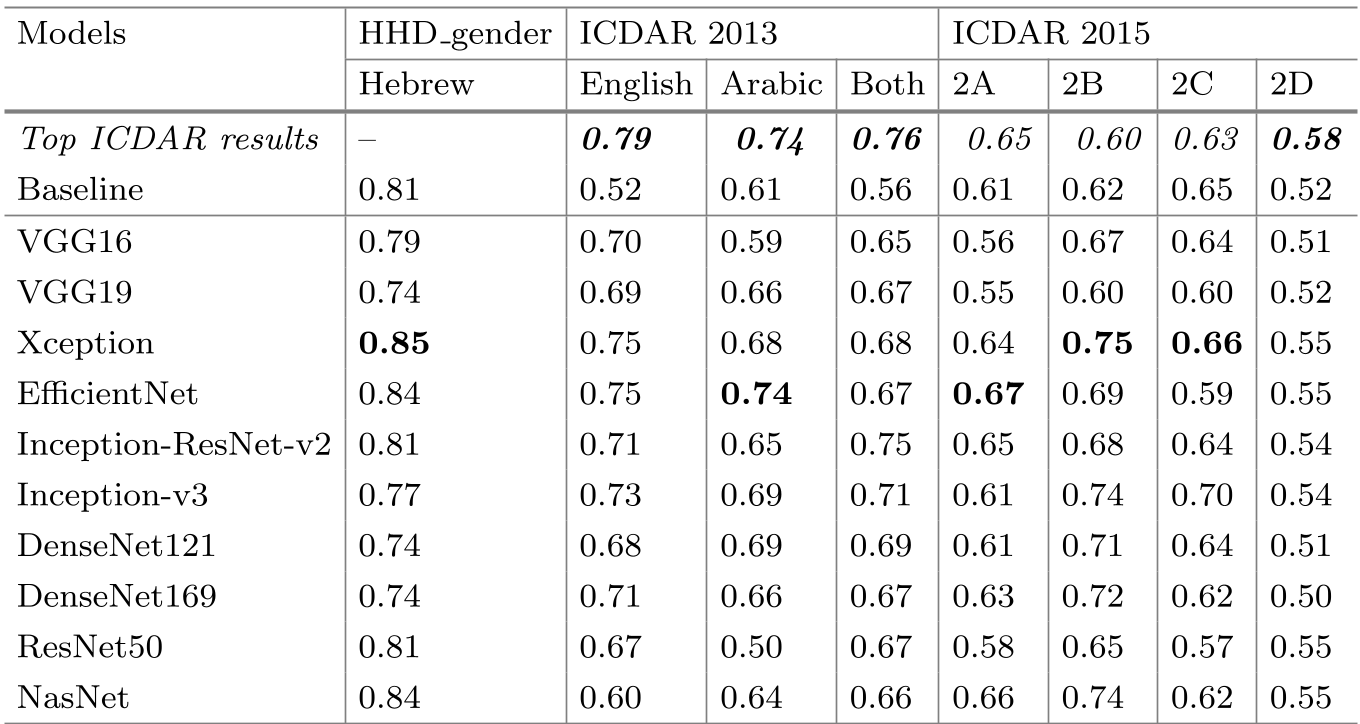 Table 1: Accuracy results across different DNN architectures and competition benchmarks.
Key Insight: Why Xception and EfficientNet?
- Xception: Utilizes depthwise separable convolutions, allowing it to map spatial correlations and cross-channel correlations independently. This is highly effective for detecting the intricate textures of ink on paper.
- EfficientNet: Uses "Compound Scaling" to balance depth, width, and resolution. This makes it efficient at picking up both micro-details (pen pressure/stroke width) and macro-details (slant/letter spacing).
Critical Analysis & Conclusion
Takeaway
The success of ImageNet pre-training for handwriting tasks is non-trivial. It suggests that the low-level features (edges, curves, gradients) learned from millions of general images are highly transferable to the domain of document analysis. The release of the HHD gender dataset is a significant contribution to the community, providing a new benchmark for non-Latin scripts.
Limitations & Future Work
While the AI outperformed non-experts, the study has yet to pit these models against professional forensic graphologists. Furthermore, the models sometimes struggle with the same "ambiguous" handwriting samples that confuse humans, suggesting a ceiling defined by the inherent variability of human writing.
In the future, we can expect these models to be integrated into forensic software, assisting in historical document cataloging and criminal investigations where identifying the demographic of a writer is a critical lead.
Reference
Irina R., et al. "Automatic Gender Classification from Handwritten Images: A Case Study." Shamoon College of Engineering.