
Unmasking the Digital Masquerade: Gender Identification in Russian Texts Under Deception
Automatic gender identification of author of Russian text by machine learning and neural net algorithms in case of gender deception
This paper explores automatic gender identification of authors in Russian texts specifically under conditions of "gender deception" (authors intentionally masking their true gender). The authors evaluate various approaches ranging from Support Vector Machines (SVM) and Gradient Boosting to Deep Learning models (CNN, LSTM), achieving a state-of-the-art F1 score of 64% using Gradient Boosting with character-level n-grams.
TL;DR
Identifiying an author's gender is common in NLP, but what happens when the author is actively trying to lie to you? This paper investigates gender deception in Russian texts. By moving away from obvious morphological markers and using robust statistical models like Gradient Boosting on character n-grams, researchers achieved an F1 score of 64%, outperforming baseline guesses by 14% and proving that subconscious "fingerprints" remain in text even during intentional imitation.
Background & Positioning
In the realm of digital forensics and security, knowing the true identity of a text's author is crucial. Most existing gender classifiers for the Russian language rely on explicit grammatical genders. However, in "deception" scenarios—where a man writes as a woman or vice versa—these explicit signals become Trojan horses. This work positions itself as a pioneering study in the Russian Gender Imitation niche, shifting the focus from "what is said" to the underlying "structure of how it is written."
The Core Challenge: Why Deception is Hard
Automatic gender identification is usually treated as a high-accuracy task. But deception introduces a catastrophic drop in performance for standard models.
- Morphological Masking: In Russian, past tense verbs often indicate gender. A deceiver can easily change these.
- Data Scarcity: There are very few corpora where authors are explicitly instructed to "fake" their identity for research purposes.
- Subconscious Persistence: The challenge lies in finding features that the author cannot easily control, such as the frequency of specific function words or character-level patterns (n-grams).
Methodology: Insights and Architectures
The authors didn't just look at words; they looked at the "DNA" of the text using several feature extraction methods:
- Character n-grams (3-8 chars): Capturing subtle rhythmic and structural patterns.
- GRM-1 & GRM-2: Morphological property vectors that summarize the grammatical "shape" of words.
- LIWC: A psychosocial dictionary that connects word choice to psychological profiles.
Model Selection
They tested two distinct paths:
- Conventional ML: SVM, Decision Trees, and Gradient Boosting.
- Neural Networks: A Multi-layered CNN (Model 1) and a Stacked Bidirectional LSTM (Model 2).
Experiments & Key Results
The study revealed a surprising "Occam’s Razor" effect: Complexity did not equal performance.
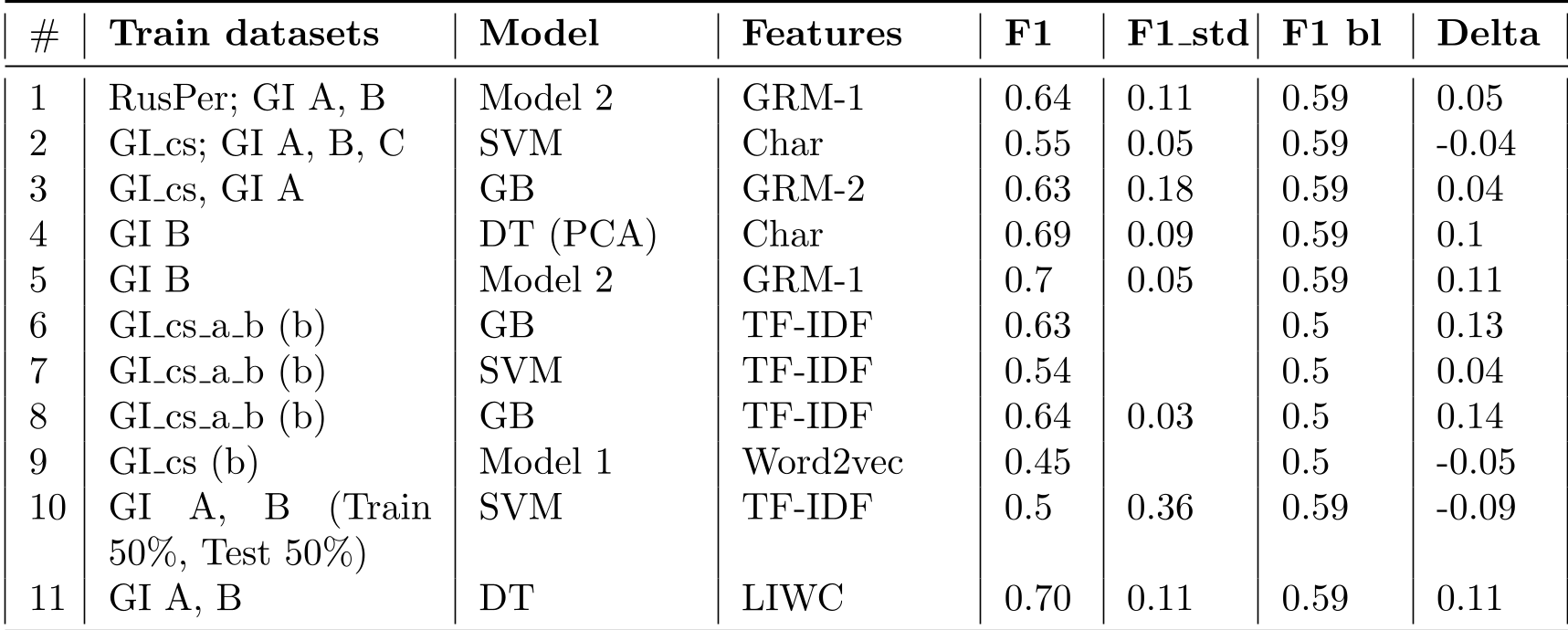
- SOTA Achievement: The Gradient Boosting model using TF-IDF of character n-grams became the milestone setter with an F1 of 0.64.
- The Neural Network Gap: Deep learning models (CNN/LSTM) struggled. The authors attribute this to the "insufficiency of training dataset." Deep models require massive data to find subtle deceptive cues, whereas Gradient Boosting was more robust on the smaller, specific "Gender Imitation" corpus.
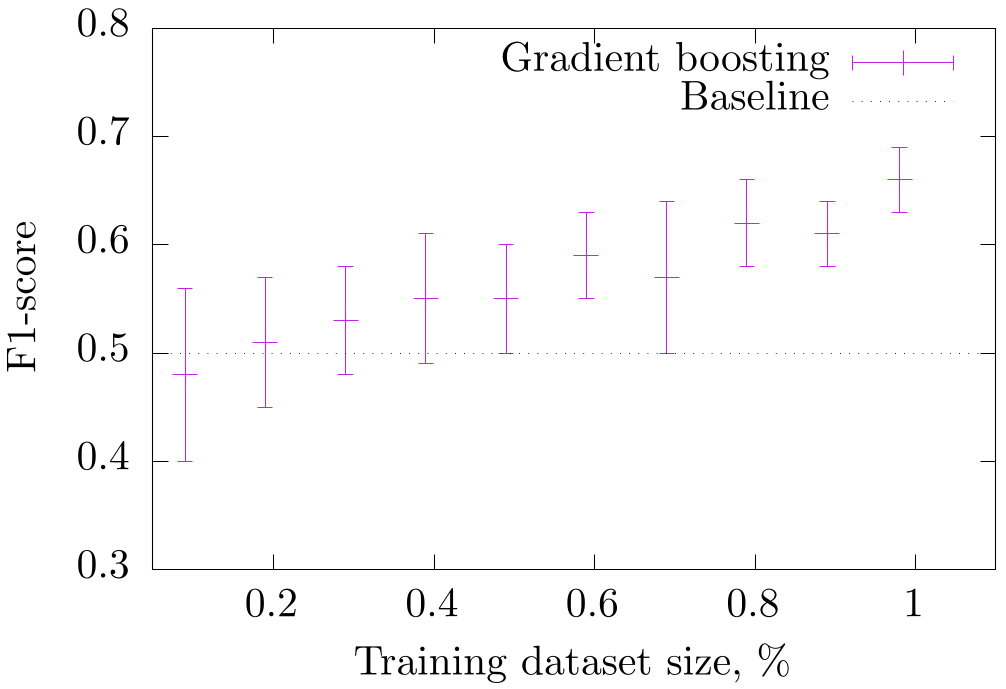
- The Power of Scale: Performance significantly improved as the training data size increased, suggesting that the current limit is data-bound rather than algorithm-bound.
Critical Analysis & Conclusion
Takeaway
The research confirms that while an author can change their "mask" (explicit morphology), they struggle to change their "voice" (character-level distributions). The 14% improvement over the baseline is a significant victory for forensic linguistics in the Russian language.
Limitations & Future Work
The primary bottleneck remains the corpus size. Deception is a high-variance human behavior, and the models still exhibit a standard deviation (std) of around 0.03-0.05. Future work must focus on Structural Features at the sentence and document level. As we move into an era of AI-generated text, understanding how humans "fake" identity will be a critical baseline for distinguishing human deception from machine-generated personas.
Conclusion
If you are trying to hide your gender in Russian text, changing your verb endings might not be enough. The statistical patterns of your character usage are likely already giving you away.