
Bridging the Gap: Automating Core Concept Identification in Science Education
Towards automatic identification of core concepts in educational resources
The paper presents a supervised machine learning framework for the automatic identification of "core concepts" in educational science resources. By leveraging Semantic Textual Similarity (STS) between resource sentences and expert-defined domain standards (AAAS/NRC), the authors achieve high-accuracy classification of sentence "coreness."
TL;DR
Researchers have developed a fully automated system to identify the most educationally significant sentences in science resources. By measuring the Semantic Textual Similarity (STS) between a sentence and national science standards, the model can predict "coreness" with 81% accuracy, significantly outperforming prior human-in-the-loop and heuristic-based systems.
Context: The Search for "Big Ideas"
In science education, not all sentences are created equal. Some provide trivial details, while others encapsulate "big ideas"—the core concepts essential for deep domain understanding. Historically, identifying these "core" sentences in digital libraries required experts to manually map resources to standards like those from the AAAS.
The authors of this paper argue that this process can be automated by shifting the focus from where a sentence is in a document to what it means in the context of domain-wide knowledge.
Methodology: Semantic Alignment as a Metric
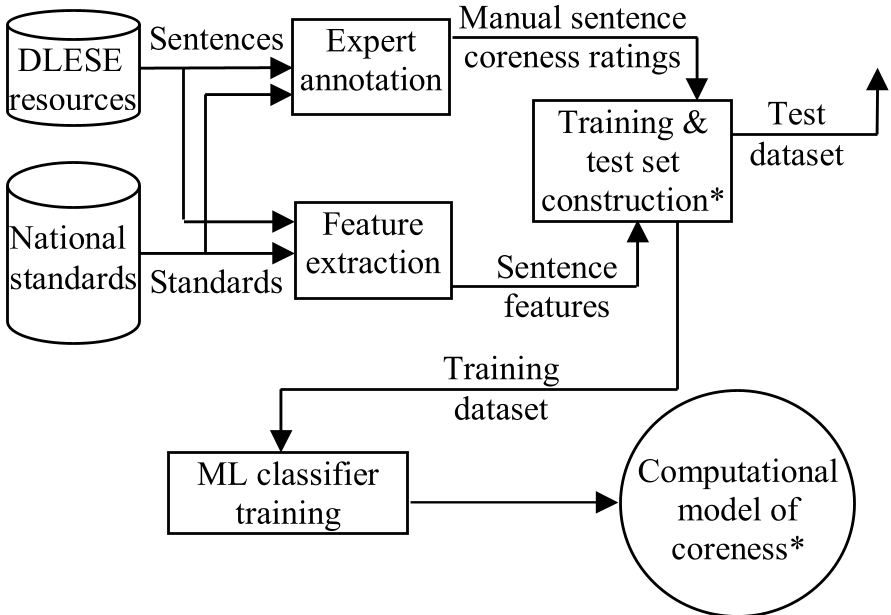
The core methodology rests on the hypothesis that the more semantically similar a sentence is to a curated domain standard, the higher its coreness.
1. The Multi-Layered Feature Set
The system extracts features across four dimensions:
- String & N-Gram Overlap: Capturing surface-level similarities.
- Semantic Similarity: Using ConceptNet and Wikipedia Miner to find relationships like synonymy or factual relatedness (e.g., relating "Einstein" to "Relativity").
- Information Content (IC) Weighting: Giving more "credit" to rare, domain-specific words (like "tectonic") than common words.
- Generative Probabilistic Models: Calculating the likelihood that a domain's vocabulary would "generate" a specific resource sentence.
2. Experimental Framework
The authors utilized a consensus dataset where experts agreed on coreness ratings. They employed an SVM classifier with an RBF kernel, preceded by a rigorous attribute selection filter to ensure only the most predictive features were used.
Results: Surpassing the State-of-the-Art
The performance gains were substantial. The model achieved an 81% F1 Score, a massive leap over COGENT (35% F1), which is a specialized educational summarizer.
| System | Accuracy (%) | F1 Score (%) |
|---|---|---|
| Majority Class Baseline | 44 | 27 |
| COGENT (Previous SOTA) | 37 | 35 |
| Foster et al. (Semi-Auto) | 68 | 67 |
| Our Model (Fully Auto) | 81 | 81 |
Why did it work?
A key finding was the "Ablation-style" comparison: the authors tested if general-purpose STS engines (like Ebiquity) could do the job. While these engines performed well, the authors' custom-tuned features (especially the Generative Model) provided the edge by incorporating domain-specific knowledge distributions.
Critical Insight: Semantic over Structural
The failure of COGENT (which actually performed worse than the majority baseline in accuracy) is telling. COGENT relies heavily on document structure (HTML tags, sentence position). This paper proves that for educational value, structural importance does not equate to conceptual importance. Semantic alignment with external knowledge (standards) is a much more robust indicator.
Future Outlook and Limitations
While the results are impressive, the study is limited by a small, high-consensus dataset. Real-world educational data is often messy, with low agreement between teachers on what is "core."
Furthermore, this model currently requires a "seed" alignment—it knows which standard a sentence is supposed to support. The next frontier, according to the authors, is Automated Alignment: a system that can take any random webpage and automatically map its sentences to the relevant national standards without human guidance.
Conclusion
This work translates the cognitive task of "pedagogical assessment" into a computable semantic similarity problem. It provides a blueprint for digital libraries to automatically organize themselves around learning goals, making high-quality science education more accessible and structured for learners worldwide.