
Deciphering the Digital Heartbeat: Auto-Identifying E-Learner Emotions via Fuzzy Logic
Automatic Method to Identify E-Learner Emotions Using Behavioral Cues
This paper introduces a non-intrusive, fuzzy logic-based method to identify e-learner emotions using behavioral cues from Learning Management Systems (LMS). By leveraging Control Value Theory (CVT), the authors developed the ELEMOTICIPATOR system, which predicts prospective outcome emotions like "hopelessness" and "anticipatory joy" with high accuracy (up to 97%) without relying on traditional self-report surveys.
TL;DR
Researchers have developed ELEMOTICIPATOR, a system that predicts student emotions (like anxiety or joy) with up to 97% accuracy by analyzing simple behaviors in online learning platforms (LMS). By moving away from intrusive cameras and unreliable surveys, this method uses Fuzzy Logic to turn "clickstream" data into psychological insights based on the Control Value Theory.
The Problem: The "Honesty" and "Hardware" Gap
In modern e-learning, understanding a student's emotional state is the "Holy Grail" of personalization. However, current solutions are flawed:
- Sensors (The Hardware Gap): Using webcams or heart-rate monitors is expensive and often perceived as a privacy violation.
- Surveys (The Honesty Gap): Asking students "How do you feel?" is disruptive and plagued by subjective bias or "survey fatigue."
The authors of this paper ask: Can we hear what the student isn't saying just by looking at how they interact with the course?
The Theoretical Engine: Control Value Theory (CVT)
The study isn't just "data mining"; it’s grounded in Control Value Theory. According to CVT, achievement emotions stem from two roots:
- Academic Self-Efficacy (ASE): The student's belief in their ability to succeed.
- Task Value: How much the student actually cares about the subject.
If you can measure these two drivers, you can predict the emotion. For example, High Value + Low Control = Anxiety.
Methodology: From Clicks to Concepts
The authors built two primary fuzzy systems: ASEMEL (to measure Self-Efficacy) and TAVAMEL (to measure Task Value).
1. The Input: Behavioral Cues
Instead of raw data, they looked at 14 specific behaviors, verified by experts:
- Delay in homework submission (DHS): A negative indicator for self-efficacy.
- Participation in forums: An indicator of school interaction.
- Time allocated to the course: A proxy for task value.
2. The Logic: Fuzzy Inference
Since human behavior is "fuzzy" (what counts as a "long" delay?), they used fuzzy sets (Low, Medium, High).
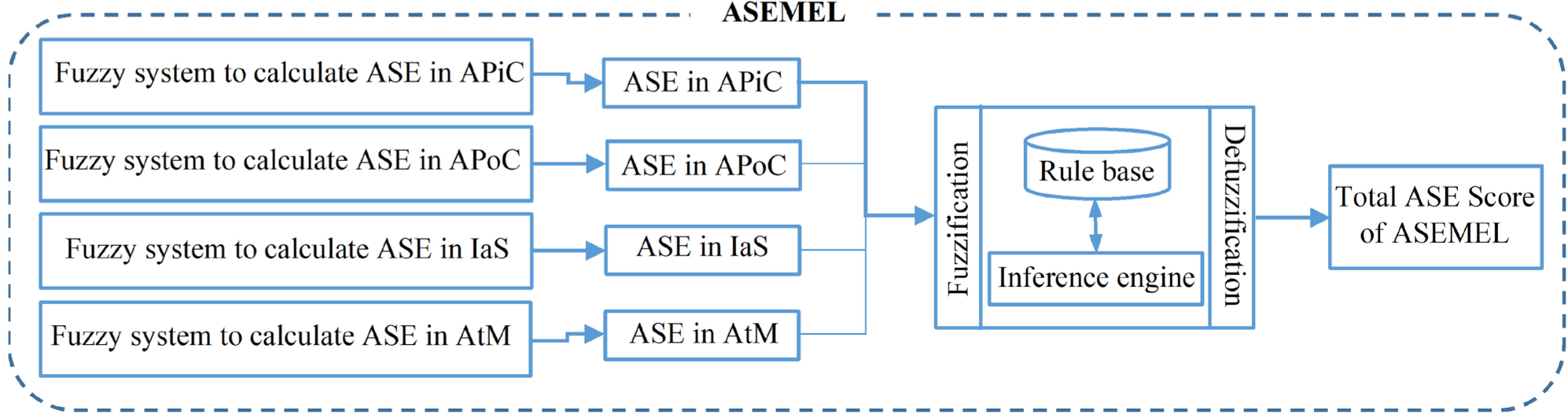 Figure 1: The architecture of the ASEMEL system, showing how behavioral inputs are processed through fuzzy rule bases to determine Self-Efficacy.
Experiments & Results: Precision Performance
The experiment involved 30 students in a "Microsoft Access" online course. The results were compared against validated psychological instruments (ASEBQ and MSLQ).
| Emotion Type | Accuracy | Precision |
|---|---|---|
| Hopelessness | 97% | 0.67 |
| Anticipatory Relief | 97% | 1.00 |
| Anticipatory Joy | 87% | 0.78 |
| Hope/Anxiety | 83% | 1.00 |
 Figure 2: The underlying CVT framework used to map Control/Value levels to specific emotions.
Key Insight: The Power of "No Emotion"
Interestingly, the system was highly accurate (97%) at identifying when a student felt "No Emotion." In educational psychology, this usually occurs when the Task Value is Low. Identifying apathy is just as important as identifying anxiety, as both require different teaching interventions.
Critical Analysis & Future Outlook
Why it works: The study bridges the gap between high-level psychological theory (CVT) and low-level system logs. It handles the "noise" of LMS data through fuzzy membership functions, which are more resilient than rigid "if-then" thresholds.
Limitations:
- Course Nature: The study used a non-compulsory certificate course. In a mandatory, high-stakes university environment, the "anxiety" and "frustration" cues might look very different.
- Log Availability: Not all LMS platforms track the same depth of data (e.g., "understanding learning material" is hard to track without specific interactive quizzes).
The Future: This work paves the way for Affective Tutoring Systems (ITS) that don't need to "see" the student to "feel" for them. Future systems could automatically offer extra resources to a student identified as "Hopeless" or increase the challenge for one in "Anticipatory Joy."
Final Takeaway
Your behavior in an LMS is a window into your mind. By applying fuzzy logic to behavioral cues, educators can finally build learning environments that respond not just to what a student knows, but to how they feel.