
A Reality Check on Automatic Linguistic Induction: Why More Accuracy Isn't Always Better
A Closer Look at the Automatic Induction of Linguistic Knowledge
This seminal paper critically examines the automatic induction of linguistic knowledge, specifically targeting POS tagging and NP chunking. It challenges the blind pursuit of test set accuracy and demonstrates that manual rule induction can rival automated machine learning (ML) in speed and performance.
TL;DR
In this classic critique, Eric Brill (Microsoft Research) pulls back the curtain on the "Corpus-based Learning" paradigm. He argues that the marginal gains we chase in NLP often reflect the quirks of specific human annotators rather than true linguistic mastery. Furthermore, he proves that humans, given the right tools, can build competitive rule-based systems in hours, challenging the "ML-only" approach to portability.
The "Gold Standard" Illusion
In machine learning, we treat the "Gold Standard" corpus (like the Penn Treebank) as objective truth. Brill argues it is anything but. Because these corpora are annotated by different individuals, they are riddled with Annotator Bias.
For example, if "Annotator A" thinks the word about is always an adverb in "about 20 dollars," but "Annotator B" thinks it's a preposition, a "highly accurate" model might just be learning to mimic which person happened to grade that specific file.
Methodology: Probing the Annotator Effect
To prove this, Brill modified his famous Transformation-Based Tagger. He added a simple feature: Which human annotated this word?
- Hypothesis: If the corpus was perfectly consistent, the "Annotator ID" should be useless.
- Reality: The tagger with annotator info achieved a 6% relative error reduction. It literally learned that one person (Maryann) had different linguistic preferences than others.
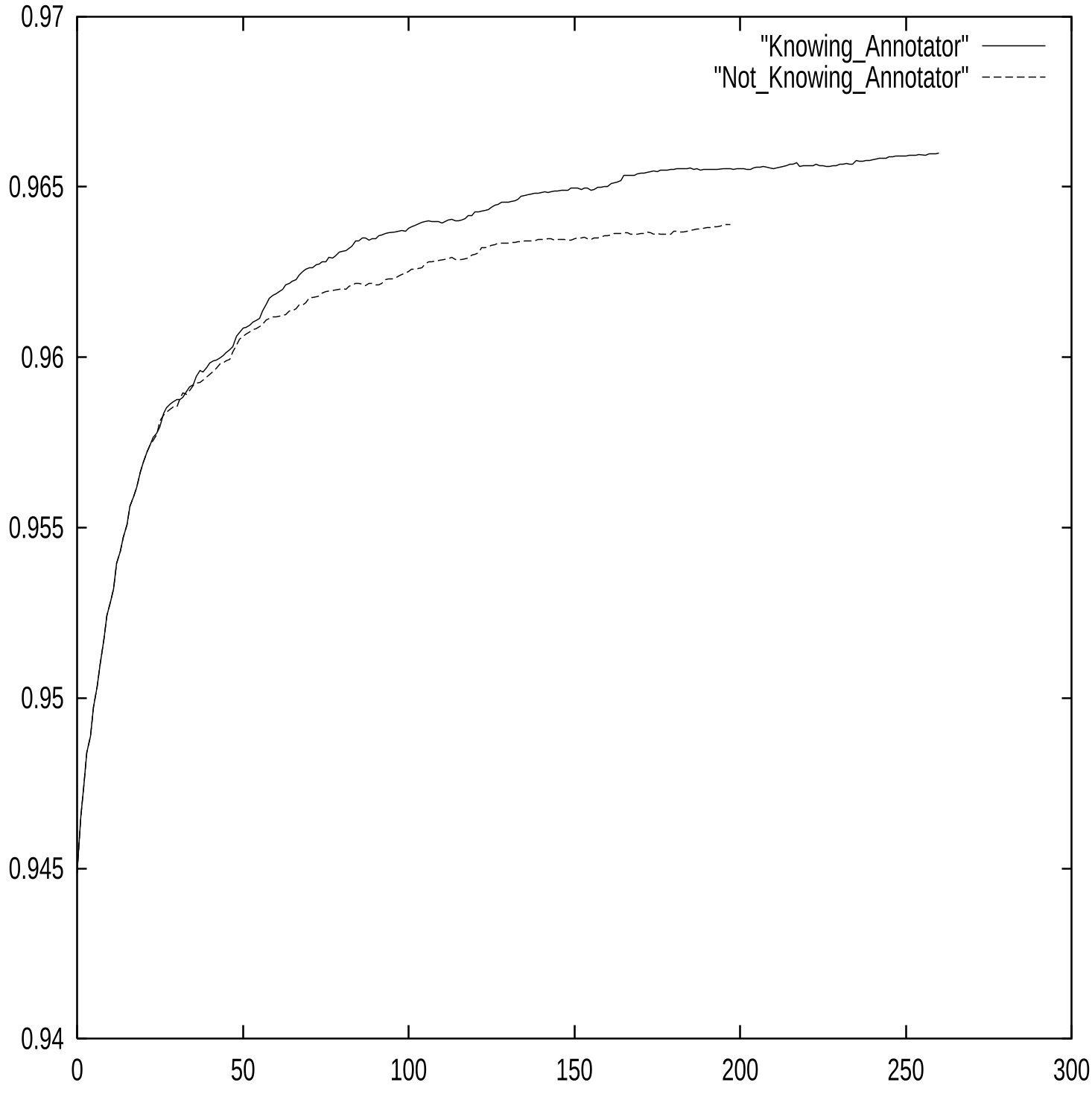 Figure 1: Comparison of learning with and without annotator ID. The jump in accuracy proves the model is over-indexing on individual human style.
Man vs. Machine: The Portability Myth
A common argument for ML is Portability: "I can't hire a linguist for a month to port a system to French, but I can run a training script in a day."
Brill challenged this by asking: What can a human do in one day for $40? He gave students 5 hours to write rules for Base Noun Phrase (NP) chunking. The results were startling.
| System | Precision | Recall | F-Measure |
|---|---|---|---|
| Ramshaw & Marcus (SOTA ML) | 88.7 | 89.3 | 89.0 |
| Top Student Rule-Writer | 88.0 | 88.8 | 88.4 |
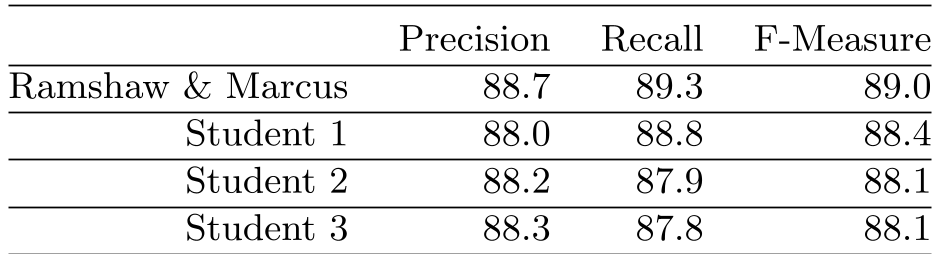
The takeaway? Humans are incredible at generalizing from small data. While ML excels at memorizing the "Long Tail" of Zipf's Law if given millions of words, humans can capture the core logic of a language almost instantly.
Deep Insight: The Diminishing Returns of Naive ML
Brill posits that both "Shallow ML" and "Rapid Human Rule-Writing" hit a ceiling quickly because of Zipf's Law. The high-frequency patterns are easy for both to catch. The "incremental improvements" we see in many NLP papers (0.1% gains) are often just the model better-fitting the noise or the specific biases of the training set.
Conclusion & Future Outlook
This paper serves as a vital reminder that:
- Metric Obsession is Dangerous: Improvement on a flawed test set doesn't mean a better product.
- Hybrid is the Hero: The holy grail isn't replacing humans with machines, but finding how machines can help humans write better rules or how humans can guide machine learning in data-sparse environments.
As we move into the era of Large Language Models (LLMs), Brill's introspection is more relevant than ever. Are we building better language models, or just better mimics of the internet's collective noise?