
SAT-Powered Plant Synthesis: Bridging the Gap in Closed-Loop Model Checking
Automatic Inference of Finite-State Plant Models From Traces and Temporal Properties
The paper introduces an automated method for synthesizing discrete plant models as nondeterministic Moore automata using a combination of execution traces and Linear Temporal Logic (LTL) properties. By translating the synthesis problem into a Boolean Satisfiability (SAT) problem, the method generates formal models suitable for closed-loop model checking in industrial automation.
Executive Summary
In the world of industrial automation, verifying control software in "open-loop" (without a model of the physical plant) is akin to testing a car's autopilot while the car is suspended in mid-air—it ignores gravity, road friction, and mechanical limits. However, creating "closed-loop" models manually is an engineering bottleneck.
This paper presents a robust framework for automatically inferring Finite-State Plant Models from two sources: execution traces (what the plant has done) and LTL properties (what the plant must or must not do). By leveraging the efficiency of modern incremental SAT solvers, the authors transform the "black art" of plant modeling into a systematic, automated optimization problem.
The Core Motivation: Why Traces Aren't Enough
Purely data-driven models (learning from traces) often fail to capture edge cases or safety invariants not present in the training data. Conversely, pure logic-based models (Synthesis from LTL) are often too abstract.
The authors identify a critical gap: engineers need a way to combine the physical reality captured in simulations (traces) with the design requirements (temporal logic). Traditional state-merging algorithms often result in "bloated" models that satisfy the data but violate the logic, or vice-versa.
Methodology: The SAT-Based Architecture
The researchers represent the plant as a nondeterministic Moore automaton. Nondeterminism is key here—it allows the model to account for human intervention, measurement rounding errors, and unmodeled physical variables.
1. The Translation Pipeline
The problem is encoded into Boolean variables representing:
- State Mapping (): Which state in the automaton corresponds to a specific point in a trace.
- Transitions (): Existence of paths between states given a controller input.
- Outputs (): The sensor values associated with each state.
2. Incremental Refinement via Counterexamples
Instead of encoding complex LTL formulas directly into SAT (which is computationally expensive), the authors use an incremental loop:
- Generate a model based on traces.
- Check the model against LTL properties.
- If a property is violated, the verifier provides a counterexample (a "negative trace").
- This negative trace is added as a new constraint to the SAT solver, and the process repeats.
 Figure 1: Overview of the synthesis and verification loop.
Experimental Validation: From Cylinders to Nuclear Reactors
The method was tested across three increasingly complex scenarios:
- Pneumatic Cylinder: A smoke test verifying basic command-response logic (Extend/Retract).
- Water Level Control: Synthesized an 80-state model that accurately captured complex nonlinear filling/emptying behaviors.
- Nuclear Power Plant (PWR): Using 16 hours of simulated trace data from the Apros environment, the tool synthesized a compact 12-state model that allowed for formal verification of emergency pump activation logic.
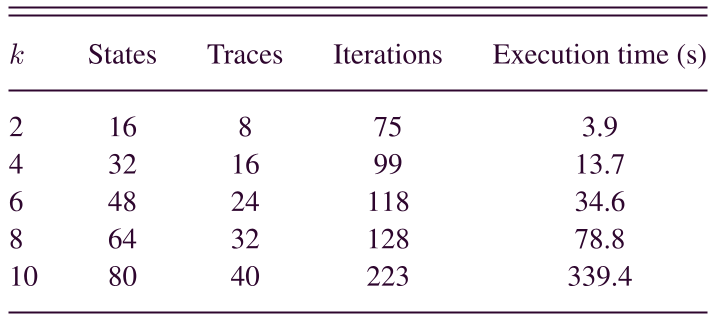 Table 1: Performance metrics showing scalable execution times for increasing state counts.
Critical Analysis & Depth
The true value of this work lies in its minimality. By explicitly seeking the minimum number of states () that satisfy the requirements, the authors ensure that the resulting plant model doesn't overwhelm the model checker during the subsequent software verification phase.
Limitations observed:
- Discretization Sensitivity: The method relies on the user to discretize continuous signals (e.g., water level) effectively. Poor discretization can lead to models that are either too coarse to be useful or too large to solve.
- Complexity Scaling: While 80 states is impressive for SAT-based synthesis, "real-world" industrial plants with dozens of interacting components might still require a modular decomposition approach (modeling components individually) rather than a monolithic one.
Final Takeaway
Buzhinsky and Vyatkin have demonstrated that the "Formal Methods" versus "Data Science" divide is a false dichotomy. By using SAT as the reasoning engine to reconcile simulation traces with temporal logic, they provide a path toward fully automated, reliable digital twins for the next generation of industrial cyber-physical systems.