
Decoding Children's Prosody: Automated Intonation Assessment in Clinical Diagnosis
Automatic Intonation Recognition for the Prosodic Assessment of Language-Impaired Children
This study introduces an automatic system for assessing prosodic skills in language-impaired children (LIC) by evaluating sentence modality imitation. It employs a hybrid classification approach combining static statistical measures and dynamic Hidden Markov Models (HMM) to differentiate between Autistic Disorder (AD), PDD-NOS, SLI, and typically developing (TD) children.
Executive Summary
TL;DR: This paper presents a breakthrough in objective clinical assessment by using a hybrid machine learning system to evaluate how children with language impairments (AD, PDD-NOS, and SLI) imitate speech intonation. The findings reveal that while all impaired children struggle with speech timing, only those with Autism spectrum disorders show significant failure in "Rising" (pragmatic) intonation—providing a clear computational marker for differential diagnosis.
Background: Positioned at the intersection of speech signal processing and child psychiatry, this work moves beyond subjective human "scoring" towards a robust, algorithmic framework for quantifying prosodic deficits.
Problem & Motivation: The Subjectivity Gap
Prosody—the rhythm, stress, and intonation of speech—is a critical bridge for social interaction. For children with Autism or Specific Language Impairment (SLI), this bridge is often broken. However, diagnosing these issues has historically relied on "expert ears," which are inherently subjective.
The authors identify two major gaps:
- Feature Complexity: Pitch and energy variations are too high-dimensional for humans to categorize reliably into discrete scores (e.g., "good/fair/poor").
- Clinical Differentiation: Does a child with Autism sound different from a child with SLI because of a general language delay, or a specific social-communication (pragmatic) deficit?
Methodology: The Static-Dynamic Hybrid
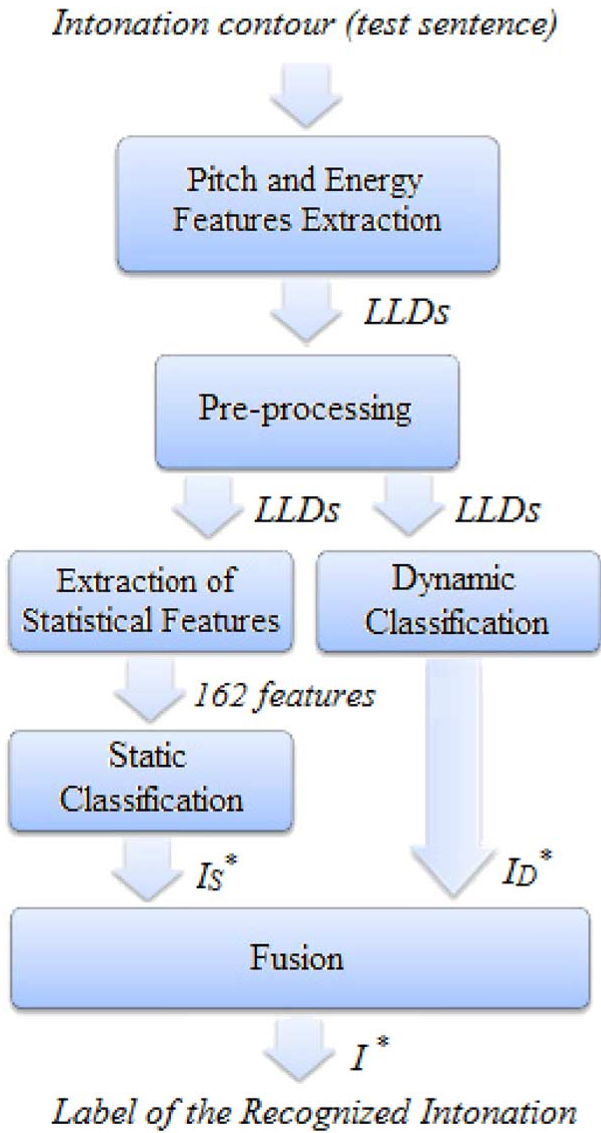
The core innovation lies in the Fusion Classification System. The authors argue that intonation is both a "snapshot" of statistical distributions and a "movie" of dynamic transitions.
1. The Processing Pipeline
The system extracts Low-Level Descriptors (LLDs) including fundamental frequency (F0) and Energy.
2. Dual Classification Paths
- Static Approach: Extracts 162 features (Max/Min pitch, Jitter, Shimmer, etc.) and uses a k-Nearest Neighbor (k-NN) classifier. This captures the global characteristics of the voice.
- Dynamic Approach: Uses Hidden Markov Models (HMMs) to track the trajectory of the pitch. By modeling the sequence of prosodic "states," it mimics how the human ear perceives a melody over time.
Experiments & Results: Identifying the "Rising" Marker
The study compared 35 language-impaired children against 73 typically developing (TD) peers.
Key Result 1: The Lengthening Phenomenon
All language-impaired groups showed massive increases in sentence duration. For "Rising" questions, the duration was over 60% longer than TD children. This indicates a profound difficulty in motor planning and prosodic execution across all impairment types.
Key Result 2: The Pragmatic Divide
The most striking finding appeared in the "Rising" intonation (typically used for short questions).
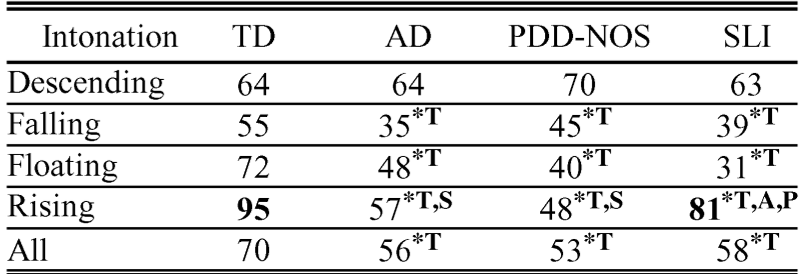
- SLI Children: Achieved recognition scores near TD levels (81% vs 95%).
- AD/PDD-NOS Children: Scores plummeted to 57% and 48%.
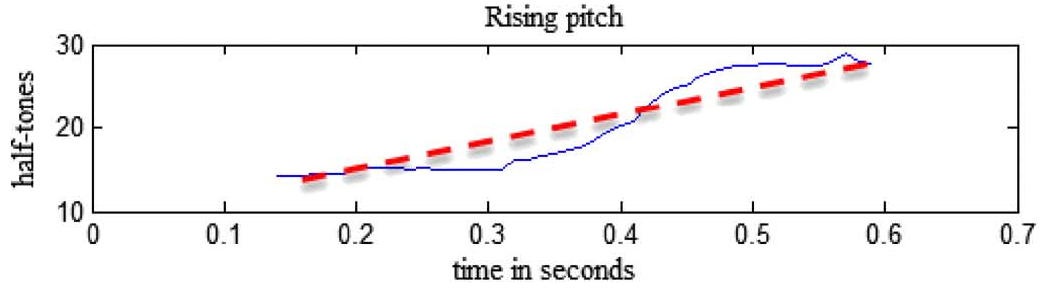 Fig: Pitch contour prototypes. Solid lines show estimated pitch; dashed lines show the intended prototype.
Key Result 3: Fusion Performance
While the static model worked best for normal children, Dynamic HMM modeling was far superior for analyzing impaired speech, as it could better handle the high variability and abnormal transitions found in LIC voices.
Deep Insight & Conclusion
This research confirms that prosody is a "window" into the nature of a child's disability.
- Language vs. Social: SLI children have "pure" language issues but understand the social intent of a question (they can do "Rising" intonation).
- Autism's Unique Signature: Children with AD/PDD-NOS specifically fail at "Rising" intonation, suggesting their impairment isn't just about vocalizing—it's about the pragmatic failure to grasp the communicative value of the contour.
Future Outlook: The integration of this HMM-based system into speech therapy tools (like the SPECO system) could allow therapists to provide real-time, objective visual feedback to children, turning prosody from an abstract concept into a visible, improvable skill.