
Automated Social Mapping: Decoding Presidential Power via Large-Scale News Mining
Automatic Mapping of Social Networks of Political Actors from Large Collections of News Stories
This paper introduces an automated methodology for mapping social networks of political actors using the WORDij 3.0 semantic analysis tool. By mining large collections of news stories from the New York Times and Washington Post, the authors successfully reconstructed the cabinet dynamics of U.S. presidential administrations from Nixon to G.W. Bush.
TL;DR
Researchers at the University of Illinois at Chicago have pioneered an automated pipeline to map the hidden social structures of US Presidential Cabinets. By treating names as semantic nodes and analyzing their co-occurrence within 100-word windows across decades of New York Times and Washington Post archives, they’ve transformed raw text into actionable intelligence on political influence.
Background: Beyond the "Bag of Words"
In the landscape of information retrieval, the common "bag of words" approach is a blunt instrument—it knows which words are in a document but ignores how they relate. For social network analysis (SNA), this is fatal. If the goal is to understand how power flows between political actors, we need to know who is mentioned together and in what proximity.
The authors argue that "Names are a type of word." By leveraging WORDij 3.0, they treat the proximity of names as a proxy for social connection, allowing for the "engineering of culture" by understanding semantic systems at scale.
Methodology: The Proximity-Based Pipeline
The workflow follows a rigorous technical sequence:
- Corpus Assembly: Mining Lexis/Nexis for every story mentioning cabinet members from Nixon to G.W. Bush.
- Entity Resolution: Using "String Replacement" lists to ensure "Dick Cheney," "Vice President," and "Cheney" are treated as a single node (
dick_cheney). - Proximity Indexing: Unlike standard semantic networks that use a 3-word window, the authors found a 100-word window (200 words total width) is the "sweet spot" for social actors in news journalism.
- Centrality Computation: Exporting data to UCINET to calculate Eigenvector Centrality. This is crucial because it accounts for link strength (weight) rather than just binary connections.
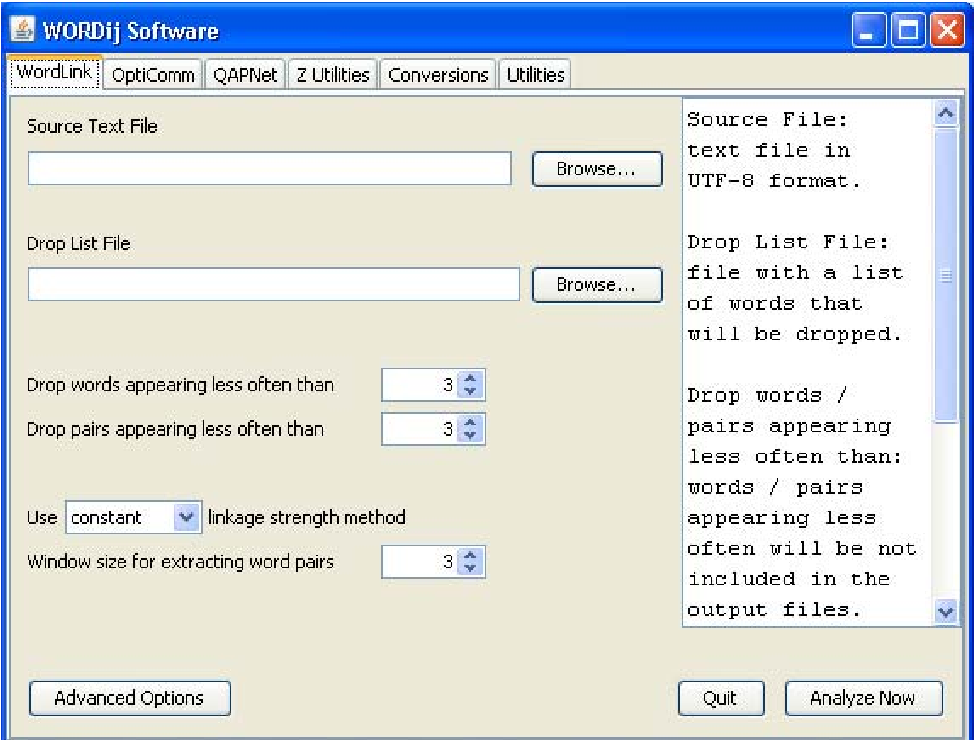 Figure 1: The WORDij 3.0 interface used for crawling and proximity mapping.
Discovery: Visualizing the Power Triad
The results provide a striking visual and statistical confirmation of political history.
- The Clinton Cabinet: Dominated by the duo of Bill Clinton (99.2) and Al Gore (82.7). The network shows a radial structure where most other members are significant "outsiders" in media representation.
- The G.W. Bush Cabinet: Reveals a highly concentrated "core" consisting of Bush, Dick Cheney, and Condoleezza Rice. Most notably, Cheney’s centrality (96.7) is nearly equal to the President’s, statistically validating the common historical perception of his unprecedented influence as Vice President.
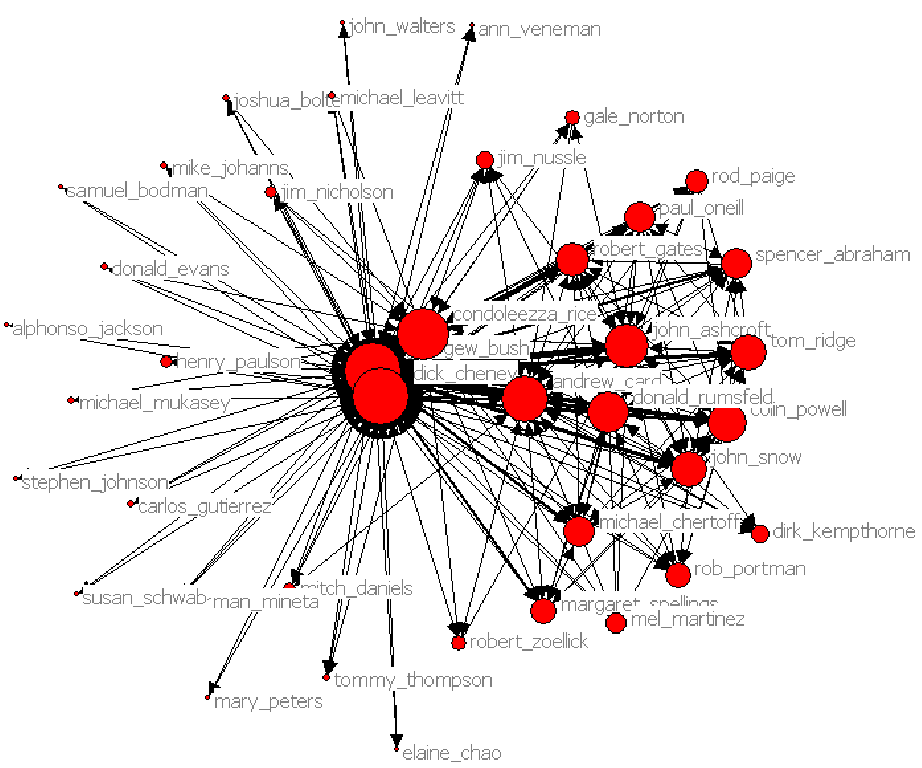 Figure 2: Visualization of the G.W. Bush administration, highlighting the dominance of the Bush-Cheney-Rice triad.
Quantitative Evidence
The study highlights that while the Clinton administration had 24 members and Bush had 40, their core/periphery structures were remarkably similar statistically (p < 0.69). This suggests that regardless of cabinet size, media narratives tend to focus on a small, hyper-centralized elite.
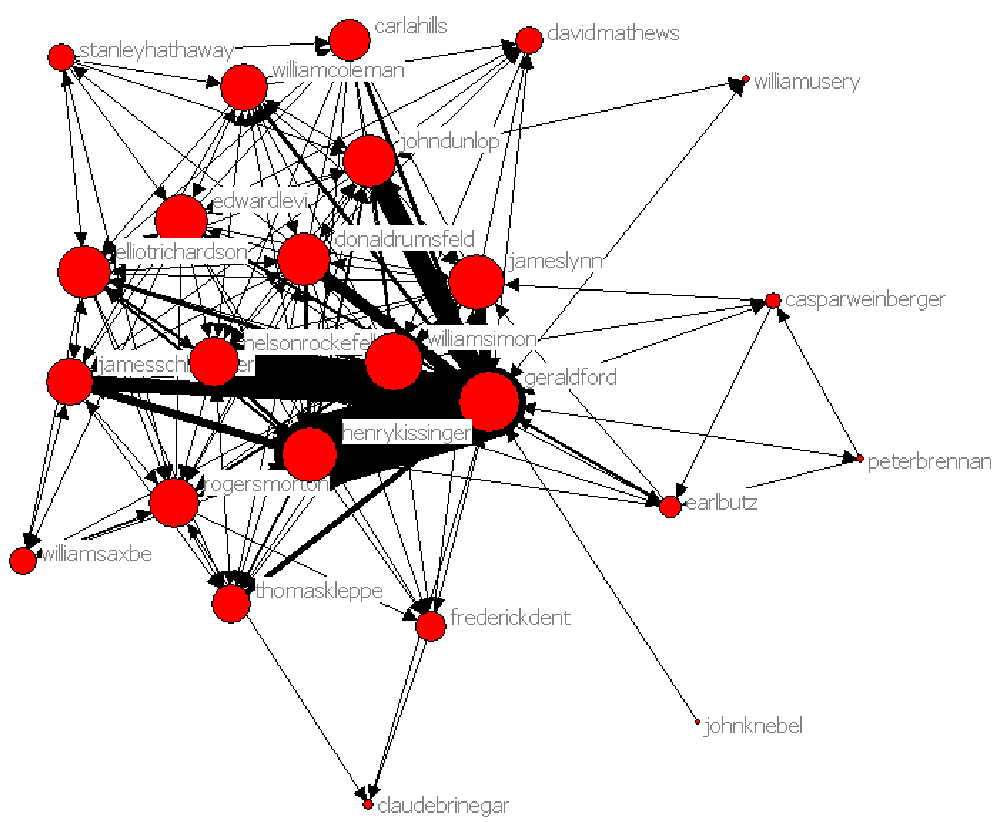 Figure 3: Comparative centrality results for the G.H.W. Bush cabinet.
Critical Insight & Future Directions
The true value of this work lies in its scalability. The authors processed over 1GB of text across different eras in less than 90 minutes.
Limitations: The "100-word window" is a heuristic based on intuition. While it has "face validity" (meaning it looks right to experts), it lacks a rigorous mathematical optimization for different genres of writing (e.g., social media vs. formal news).
The Future: The authors propose moving toward Actor-Network Theory (ANT), where people, organizations, locations, and even abstract concepts (like "Climate Change" or "War") are mapped in the same network. This would allow researchers to see not just who is connected, but what ideas are being brokered by those connections.
In an era of misinformation and fragmented media, automated tools like WORDij 3.0 offer a vital lens to objectively map the landscape of public discourse and political influence.