
AAMR: Protecting Children via Deep Learning-Based Automatic App Maturity Rating
Protecting Your Children from Inappropriate Content in Mobile Apps: An Automatic Maturity Rating Framework
The paper introduces AAMR (Automatic App Maturity Rating), a framework that utilizes deep learning and multi-label SVMs to automatically predict maturity levels and identify mature content in mobile apps. It achieves 85% precision in predicting content and 79% in rating levels using only app descriptions, significantly outperforming manual developer reports and keyword-based baselines.
TL;DR
With over 20,000 new apps hitting stores monthly, manual maturity rating is no longer sustainable. Researchers have developed AAMR (Automatic App Maturity Rating), a framework that leverages word2vec and multi-label SVMs to analyze app descriptions. It doesn't just give a rating (4+, 12+, etc.); it explains why by accurately identifying mature content like violence or drug use with 85% precision.
Background: The Scalability vs. Accuracy Crisis
In the digital age, parents rely on maturity ratings to shield children from inappropriate content. However, the two dominant industry models are broken:
- The Apple Model (Curation): High accuracy but requires human reviewers. It is expensive and slow.
- The Google Model (Self-Reporting): Scalable but unreliable. The study found that 45% of developer-rated apps on Google Play were incorrectly labeled, often "underrating" maturity to attract a broader audience.
Traditional automated attempts used simple keyword matching (e.g., looking for the word "kill"). These fail because they miss synonyms (like "battle") or misinterpret context.
Methodology: The AAMR Framework
The researchers treated maturity rating as a two-stage multi-label classification problem.
1. Feature Engineering with "Deep" Intuition
Instead of simple keywords, AAMR uses three layers of features:
- Sensitive Words: Direct matches from rating policies.
- Augmented Features (word2vec): Using deep learning to find semantically similar words. For instance, if "sex" is a sensitive word, the system learns that "flirt" and "adult" are related in an unsupervised way.
- Bag-of-Words (TF-IDF): To provide the global context of the description.
2. Capturing Label Correlations
Mature themes don't exist in isolation. Violence often correlates with horror; suggestive themes correlate with profanity. AAMR adapts the Support Vector Machine (SVM) to account for these correlations using Pearson correlation coefficients. This allows the model to "know" that if it finds strong evidence of one mature theme, others are likely (or unlikely) to be present.
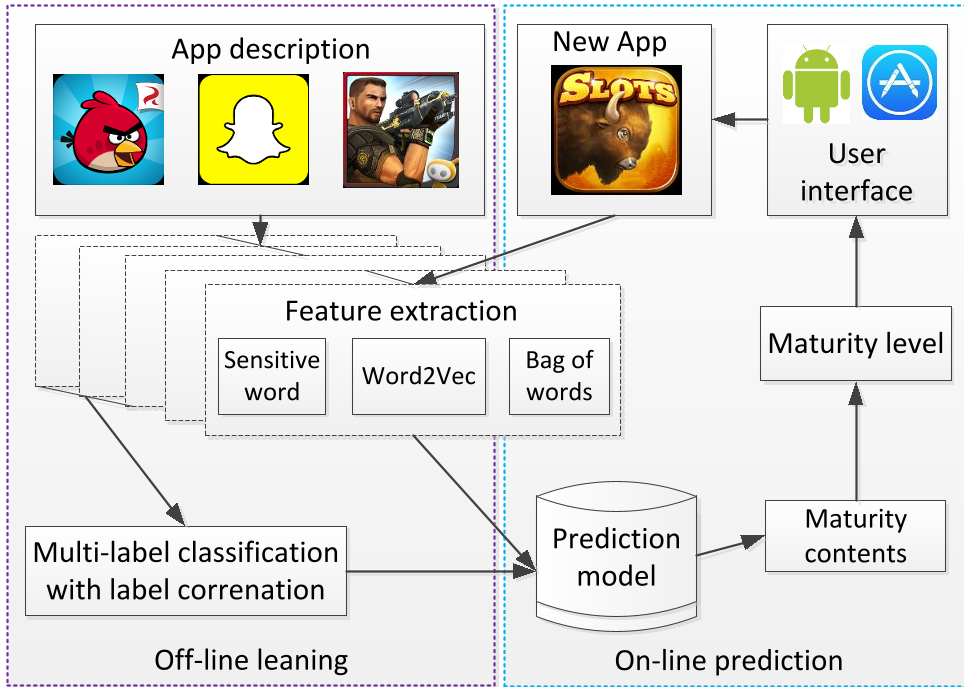 Figure: The AAMR workflow, transitioning from raw descriptions to multi-label content prediction and final maturity rating.
Experiments: Surpassing Human Accuracy
The model was tested on a massive dataset of over 224,000 apps from both the App Store and Google Play.
Key Findings:
- Precision: The system achieved 85% precision for predicting specific mature content.
- Consistency: AAMR significantly outperformed "Developer Reports" (DR) and even "Human Labelers" (HL) who were colleagues asked to rate apps.
- The "Underrating" Bias: The data confirmed that app developers are incentivized to underrate their apps; 80% of incorrect developer labels were geared toward making mature apps look "safe" for younger kids.
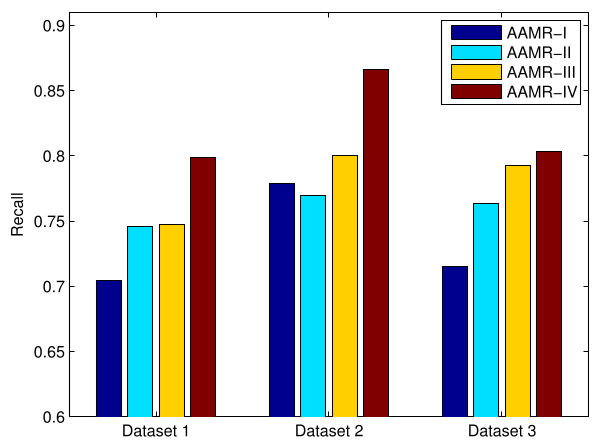 Figure: The incremental benefit of adding word2vec feature augmentation and label correlation to the AAMR framework.
Critical Insight & Conclusion
The brilliance of AAMR lies in its Two-Stage Architecture. By first predicting the reasons (mature content) and then using a policy-based logic to determine the rating, the system provides transparency. A developer can see exactly why their app was rated "17+" (e.g., "Frequent Realistic Violence") and adjust the content if they want a lower rating.
Limitations: Currently, AAMR relies solely on app descriptions. Malicious developers could "obfuscate" descriptions to hide mature themes. Future iterations will need to look at UI screenshots and dynamic code analysis (analyzing how the app behaves while running) to become truly tamper-proof.
This research marks a significant step toward a safer, automated pipeline for digital safety in the ever-expanding mobile ecosystem.