
Automatic Multilingual Tagging: Harnessing the Wisdom of Medical Social Networks
Automatic medical image multilingual annotation via a medical social network
The paper proposes a mixed statistical-semantic method for the automatic multilingual annotation of medical images shared on specialized social networks. By leveraging a terms-based extraction process and the MeSH thesaurus within the UMLS framework, the system indexes images based on physician comments in multiple languages (English, French, German, Italian, and Spanish).
TL;DR
This paper introduces a robust framework for indexing medical images by automatically analyzing the diagnostic comments left by specialists on social networks. By combining statistical frequency analysis (TF-IDF/MI) with the MeSH multilingual thesaurus, the system identifies key medical concepts across five languages without needing complex, language-specific linguistic software.
Background & Motivation
Medical social networks (like Sermo or Carenity) have become vital hubs for "collaborative diagnostics." However, the sheer volume of images and multilingual comments—often written in the physician's native tongue—makes searching and retrieving specific clinical cases nearly impossible.
The authors' core insight is that we don't need heavy linguistic parsers for every language. Instead, they hypothesize that a purely statistical approach, if anchored by a high-quality global medical ontology (UMLS/MeSH), can provide equivalent or superior indexing quality while maintaining universal applicability.
Methodology: The Mixed Statistical-Semantic Pipeline
The system follows a four-stage process to transform raw comments into structured image metadata:
- Pre-processing & Lemmatization: Text is cleaned of punctuation and emoticons. A modified Porter Stemmer is used to reduce words (English, French, and German) to their roots (e.g., "Operating" to "Operate").
- Simple Term Extraction: Uses TF-IDF (Term Frequency-Inverse Document Frequency) to identify words that are uniquely significant to a specific image's discussion.
- Compound Term Extraction: Uses Mutual Information (MI) to identify technical collocations (e.g., "cranial scan") where words appear together more often than by chance.
- Semantic Mapping: The final and most critical step. Extracted terms are projected onto the MeSH (Medical Subject Headings) thesaurus. If a term exists in the thesaurus, it is validated as a "medical concept" and used to index the image.
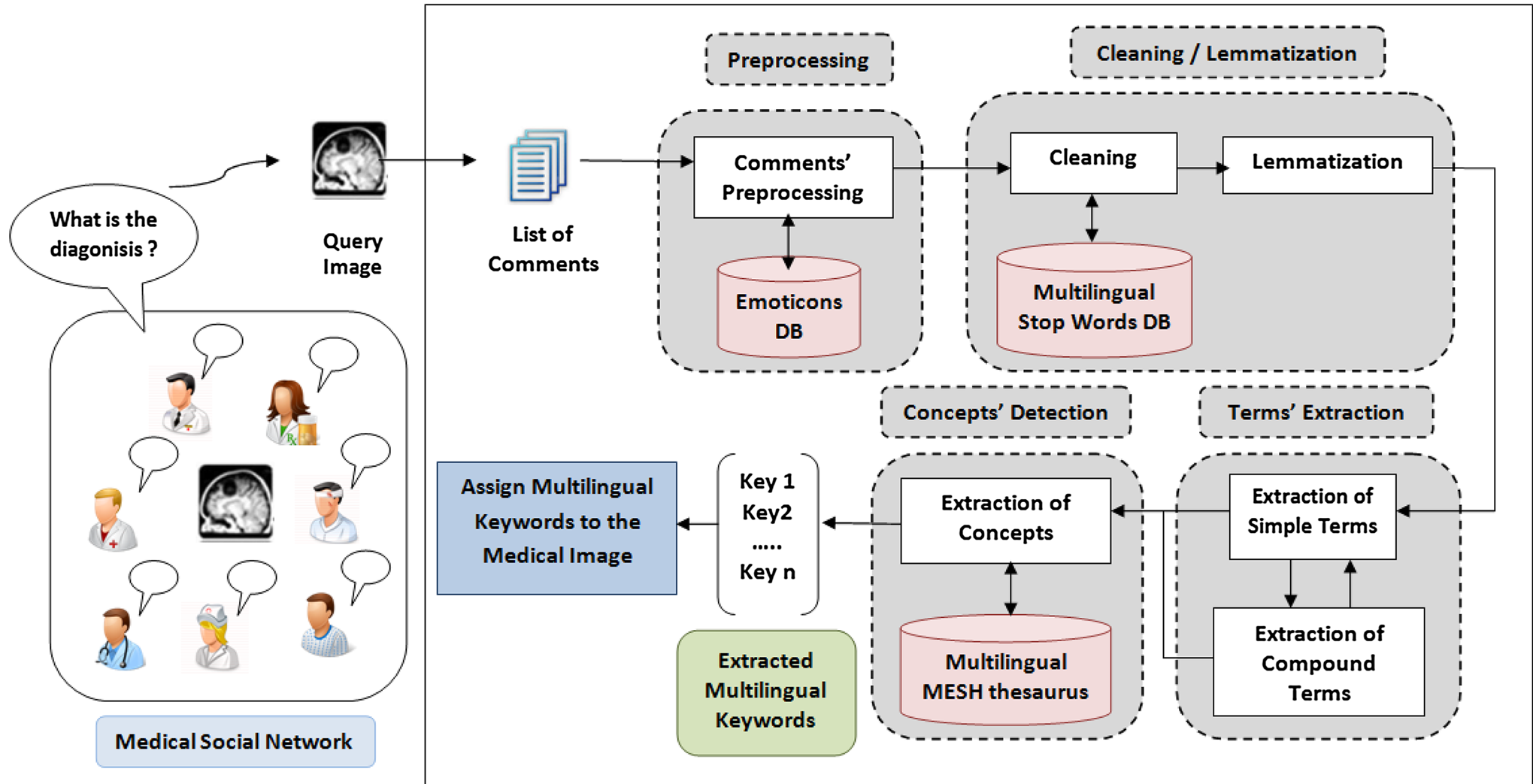 Figure 1: The conceptual architecture of the multilingual indexing pipeline.
Experimental Validation
The system was tested on two datasets:
- A custom collection of 200 images from Charles Nicolle Hospital.
- The large-scale ImageCLEF 2013 benchmark (45,000+ articles).
SOTA Comparison
The authors compared their statistical approach against established linguistic tools like MetaMap and TreeTagger.
| System | Precision | Recall | MAP |
|---|---|---|---|
| MetaMap | 0.64 | 0.56 | 0.246 |
| TreeTagger | 0.70 | 0.61 | 0.258 |
| Proposed System | 0.78 | 0.69 | 0.272 |
 Figure 2: Comparative Mean Average Precision (MAP) across different systems.
The results confirmed that the statistical method actually outperformed linguistic parsers. The precision-recall curves further indicated that the system is most effective in English, simply because the underlying UMLS meta-thesaurus has more extensive English vocabulary coverage (68%) compared to French or German.
Critical Insight: Why it Works
The "Mixed Approach" succeeds because medical terminology is highly standardized. While everyday language varies wildly, clinical terms (like Hemorrhage or Computed Tomography) have direct mappings across languages in formal ontologies. By using these ontologies as a "ground truth," the system avoids the errors typically introduced by grammatic analysis or machine translation.
Conclusions & Perspective
This work provides a blueprint for turning "social noise" into "structured knowledge."
- Takeaway: Effective medical AI doesn't always require deep learning; sometimes, clever statistical weighting combined with expert-curated ontologies is enough to beat complex pipelines.
- Limit: The system's performance is hard-capped by the quality of the external thesaurus. Languages poorly represented in UMLS will suffer lower precision.
- Future: The next step involves adding auto-correction features to handle typos and medical shorthand frequently found in informal social media comments.