
Decoupling Human Nature: The Automatic Modeling of Personality States
Automatic modeling of personality states in small group interactions
This paper introduces a novel approach for the automatic recognition of "personality states"—momentary behavioral manifestations of traits—within small group meeting scenarios. Using the Mission Survival corpus, the authors employ multimodal features (vocal and social gaze) and machine learning models like HMMs and SVMs to achieve significant recognition accuracy, particularly for Extraversion and Neuroticism.
TL;DR
Current AI often views personality as a fixed label—you are either an "Extravert" or an "Introvert." This paper challenges that static view, introducing Personality States: the idea that our behavior fluctuates minute-by-minute. By analyzing vocal energy and social gaze in small group meetings, the researchers successfully trained models (specifically HMMs) to "see" these shifts in real-time, achieving high accuracy in detecting Extraversion and Neuroticism states.
The Problem: The "Person Perspective" Fallacy
In the realm of affective computing, most researchers treat personality as a static constant. If a dataset labels a participant as "Extraverted," the model expects every audio-video slice of that person to exhibit loud, social behavior.
However, social psychology suggests this is flawed. Even the most extreme extravert has reflexive, quiet moments, and introverts can be the life of the party when motivated. Previous SOTA methods ignored these fluctuations, treating them as statistical noise. This paper argues that these "noises" are actually the data points we should be modeling to truly understand human social dynamics.
Methodology: Beyond Traits to Density Distributions
The authors propose that personality is not a single point, but a density distribution over states.
1. Data Collection & Annotation
Using the Mission Survival Corpus, 16 participants were recorded during a consensus-building task. Their behavior was sliced into 5-minute intervals. Crucially, 30 annotators rated the behavior shown in that specific slice, not the person's overall character.
2. Multimodal Feature Engineering
The study extracted 37 features categorized into:
- Acoustic Activity & Emphasis: Z-scored speaking time, pitch variation, and spectral entropy.
- Social Attention: This is the "secret sauce." Using a Cylindrical Head Model, they tracked Attention Given vs. Attention Received, specifically identifying if someone was looking at others while speaking or while listening.
3. Captured Dynamics
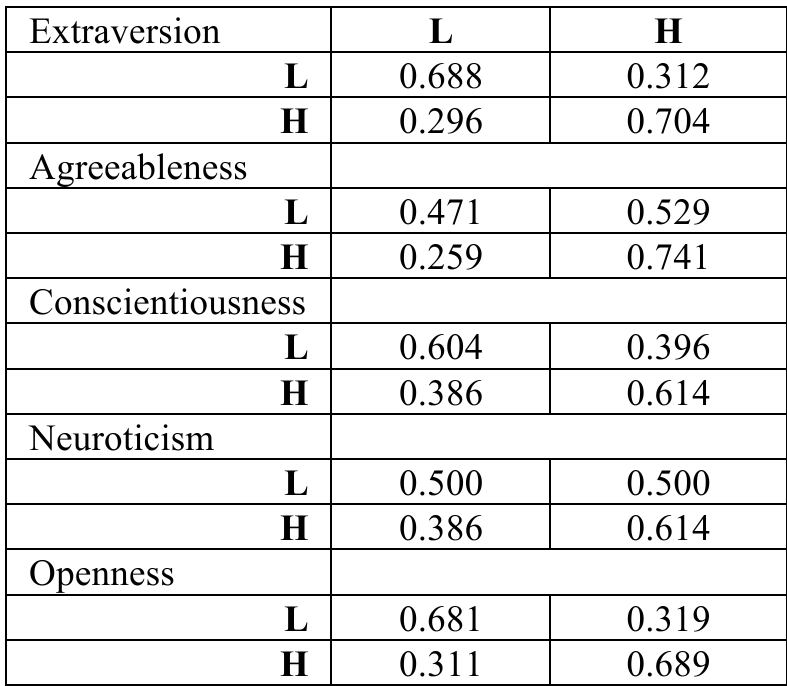
As shown in the transition probability table below, personality states exhibit a "stickiness"—if you are acting extravertedly at time t, you are roughly 70% likely to continue doing so at t+1.
Experiments & Results: The Power of Sequence
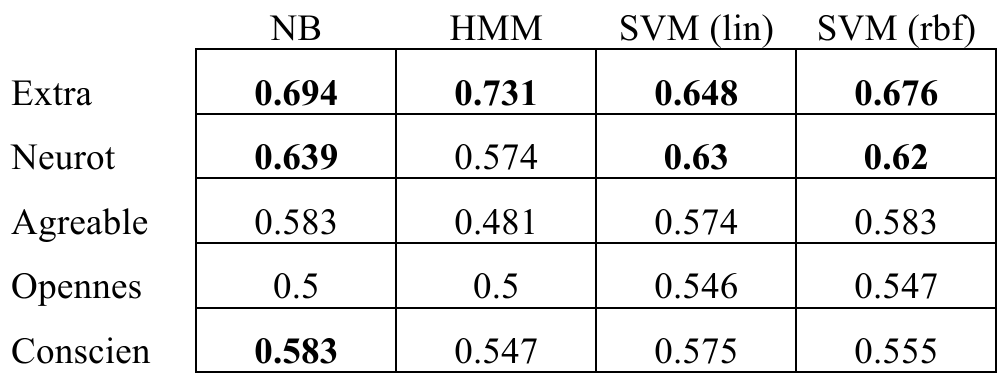
The researchers compared Naive Bayes (NB), Support Vector Machines (SVM), and Hidden Markov Models (HMM).
- Extraversion SOTA: The HMM reached 73.1% accuracy, proving that temporal context (the transition between states) is vital for identifying social boldness.
- The Neuroticism Surprise: Neurotic (or anxious) states were recognized with 63.9% accuracy using a single feature: the time derivative of speech energy. This confirms that vocal "shakiness" or intensity shifts are primary markers of negative affect.
Critical Analysis & Conclusion
The core contribution of this work is the validation of Personality States as a computational target. While Openness and Conscientiousness proved harder to detect (likely needing linguistic/textual analysis over just prosody), the results for Extraversion and Neuroticism are robust.
Takeaway
For developers of social robots, meeting assistants, or tutoring systems, the lesson is clear: Don't profile the user; profile the moment. By focusing on the "density distribution" of a user's behavior, AI can provide much more nuanced and adaptive social support.
Limitations
The study relies on a small sample (16 subjects) and lab-controlled settings. Future work should explore if these "states" remain as detectable in high-stakes, real-world environments where people might mask their natural behavioral fluctuations.