
Beyond Information Overload: Curating the Social Stream on Your Device
Automatic on-device filtering of social networking feeds
This paper presents LinkedUI, an on-device automatic filtering system for social networking feeds (Facebook, Twitter, Flickr) on mobile devices. Using an ensemble predictor combining Personalized PageRank and Naïve Bayes, the system predicts user click probability to filter out irrelevant content, achieving high user acceptance in a 40-participant field study.
TL;DR
As social media feeds became a dominant mobile activity, the "firehose" of updates turned into a burden. This Nokia Research study introduces an on-device filtering system that learns your preferences—without sending your private clicks to a server—to suggest the top 24% of most relevant posts. It proves that a mix of graph theory (PageRank) and simple machine learning (Naïve Bayes) can significantly reduce user stress while increasing their sense of control over their digital lives.
Background: The Mobile Triage Problem
By 2012, users were already drowning in status updates. The challenge is "triaging": quickly deciding what to read and what to skip during a 30-second micro-break. Most solutions at the time relied on centralized servers (Collaborative Filtering), but social media is deeply personal. Your interest in a post is subjective and tied to your specific relationship with the author. The authors argue that filtering should happen on-device, preserving privacy and catering to the "n=1" dataset of a single user.
Methodology: Graph Intuition meets Probability
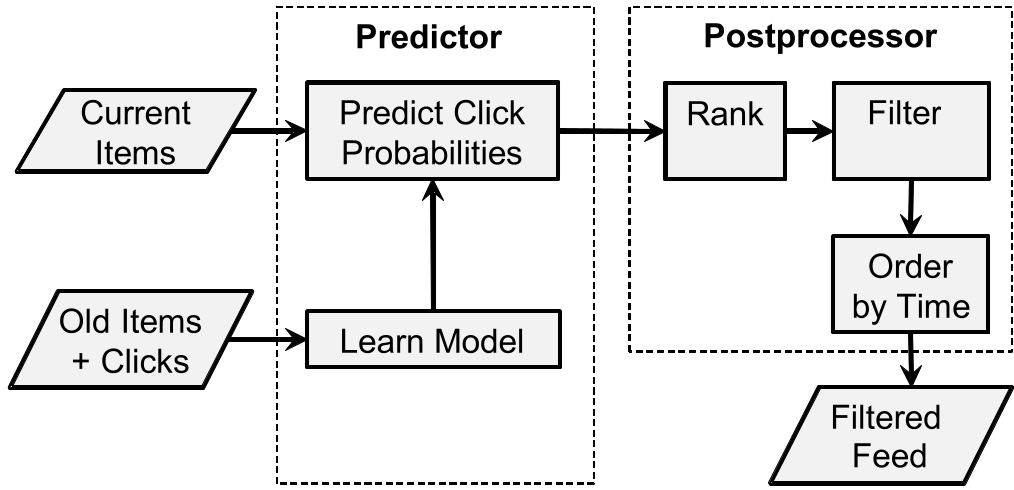
The researchers developed LinkedUI, a social aggregator. Its engine uses a two-pronged approach to guess what you'll click:
- Personalized PageRank: It treats your social world as a graph. Contacts, messages, and services are nodes. If you frequently click a specific person, their "node" gains weight, which then flows to their new posts via a "revisiting random surfer" model.
- Bayesian Predictor: This treats every post as a bundle of features (Who sent it? What time is it? Is it a photo or a tweet?). It uses Naïve Bayes to calculate the probability of a click based on your past patterns.
The Secret Sauce: The Ensemble Predictor. By feeding the PageRank score into the Bayesian model as an extra feature, the system captures both the "social importance" and the "content/context patterns" simultaneously.
Experimental Results: Control through Limitation
The study evaluated 40 users over four weeks. Key findings included:
- The "Person" Factor: The identity of the author was the single most powerful predictor of whether a user would click.
- The Recency Bias: There is a heavy "top-of-list" bias. Users often click the first few items regardless of content, which the researchers had to account for using an "Ambiguity of Recency" analysis.
- Psychological Impact: Counter-intuitively, users with fewer items (the filtered group) felt more in control. Information overload creates a feeling of "missing out" or being overwhelmed; by narrowing the field to a "Suggested" tab, users felt the UI was finally working for them.

Deep Insight: The Value of "Smart" Restraint
The most profound takeaway is that accuracy isn't everything. Users accepted the filter even when it wasn't perfect because the cost of missing a casual Facebook update is low, while the benefit of a clean, manageable feed is high.
However, the study also reveals a segment of "control freaks" (approx. 20% of users) who reject automated help a priori. For these users, the system must remain "glass-box"—allowing them to see exactly what was filtered and why, or providing manual "hand-picking" tools.
Conclusion
LinkedUI demonstrates that on-device intelligence can effectively bridge the gap between "Big Data" social streams and "Small Screen" mobile constraints. By focusing on implicit actions (clicks) rather than forcing users to provide explicit ratings, the system provides a seamless, stress-reducing experience that respects both user privacy and cognitive limits.