
From Pixels to Paper: Automatically Crafting Photo Books from the Social Web
8651_Automatic creation of photo books from stories in social media.
This paper introduces a system for the automatic creation of physical photo books from social media "stories" by leveraging the rich semantic metadata found in social networks. The core method utilizes an Expectation-Maximization (EM) algorithm to cluster photos into events and intelligently rank them for layout composition, bridging the gap between digital social media and tangible souvenirs.
TL;DR
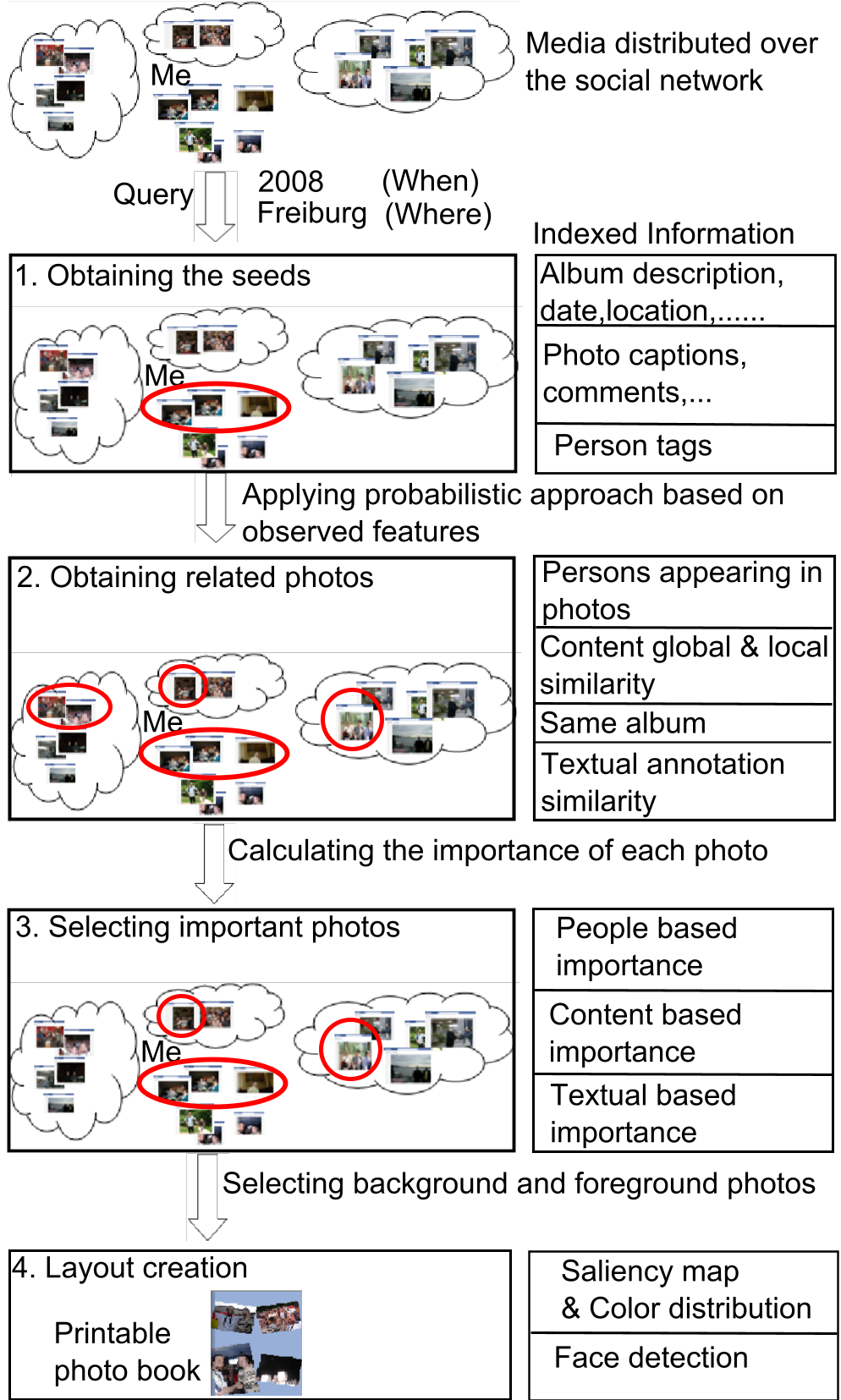
Despite the billions of photos shared on social media, creating a physical photo book remains a manual, exhausting task. This paper presents an end-to-end system that automatically crawls a user's social network (specifically Facebook), identifies related photos across multiple friends' accounts using a probabilistic EM algorithm, and applies aesthetic design principles to generate a printable photo book.
The Motivation: The "Fragmented Memory" Problem
We live in an era of "digital abundance but physical scarcity." While Facebook and Flickr host our life stories, those stories are often fragmented. A single birthday party might result in photos scattered across five different friends' albums, some tagged, some not, and many labeled with nothing more than "IMG_0042."
The authors identify a critical bottleneck: Manual selection is the death of the photo book. Most people start a photo book but never finish it because the task of finding, filtering, and formatting photos is too high a cognitive load.
Methodology: The "Socially-Aware" Search Engine
The paper's technical core lies in how it finds the "Related Photos" that aren't explicitly tagged with your search term.
1. The Probabilistic Event Cluster
Instead of relying on simple keyword matching, the system treats event detection as a latent variable problem. It uses 10 distinct features to determine if two photos belong to the same event:
- Social Connectivity: Uses a custom metric called
PDist(Pairwise Together Appearance) to see how often two people appear together. - Visual Local Similarity: A clever "clothing" heuristic. Since people rarely change clothes during a single event, the system extracts a visual window below a face tag to compare textures and colors.
- Global Visuals: Standard color and edge histograms.
- Textual Context: Analyzing captions and comments as a "bag of words."
2. The PeopleRank Algorithm
Not all photos are created equal. The authors argue that a photo's value is directly tied to the "social importance" of the people within it. They created PeopleRank, which calculates the frequency of shared photos between the user and their friends. If a photo contains your best friend (high PeopleRank), it is prioritized for a larger slot in the layout.
Designing the Layout: The Genetic Approach
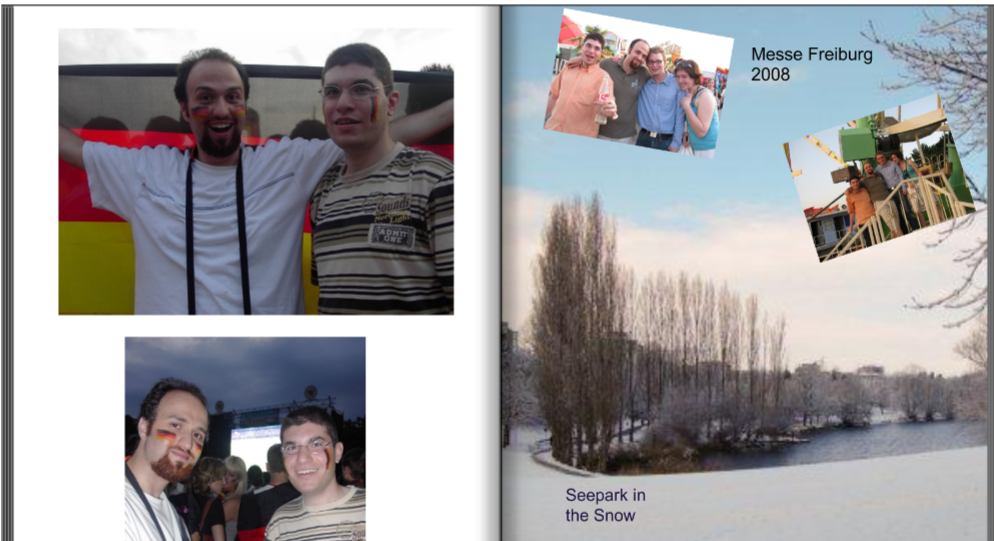
Once the photos are selected, the system doesn't just toss them onto a page. It uses a Genetic Algorithm to optimize the layout based on:
- Saliency Mapping: Finding areas of an image that aren't "busy" to use as page backgrounds.
- Design Heuristics: Implementing the Golden Ratio and symmetry.
- Content Balance: Ensuring a proper ratio of text (comments/captions) to images.
Deep Insight: Why This Works
The genius of this approach in 2010 (and its relevance today) is the realization that social networks are decentralized databases of our lives. The authors found that 40% of users have over 80% of their photos added by third parties.
By using the EM algorithm to bridge these accounts, the system acts as a "Social Detective," piecing together a narrative that no single user actually owns in its entirety. It transforms a "network graph" into a "linear story."
Critical Analysis & Future Outlook
Strengths:
- The "clothing heuristic" (Local Similarity) is a brilliant way to handle the lack of GPS/Exif data on social platforms.
- Integration with real-world social API (Facebook) proves the practical feasibility.
Limitations:
- The system relies heavily on the presence of face tags. In an era of increasing privacy concerns and automated "opt-outs" for tagging, this dependency might face challenges today.
- Computational overhead: Pairwise probability calculation for every photo in a social graph could be expensive at scale.
Conclusion
This research effectively demonstrates that the future of personal media isn't just about better storage, but better curation. By leveraging the "Social Context" of our photos, we can move away from static galleries toward dynamic, automated storytelling.