
Decoding the Canine Bark: AI Surpasses Humans in Understanding Dog Context and Emotion
What is my Dog Trying to Tell Me? the Automatic Recognition of the Context and Perceived Emotion of Dog Barks
The paper explores "Emotional Dog Corpus (EmoDog)" recognition using human-centric affective computing methods. By applying feature sets like eGeMAPS, ComParE, and Bag-of-Audio-Words (BoAW), the authors successfully classify the context and perceived emotion of dog barks, achieving above-human performance in context recognition.
TL;DR
Can a machine understand your dog better than you do? This study demonstrates that signal processing techniques originally developed for human speech emotion recognition can effectively decode the "language" of dog barks. By analyzing bark sequences through an affective computing lens, the researchers achieved performance levels that surpassed human listeners in identifying the context of a bark (e.g., play vs. stranger).
Background Positioning: This work sits at the intersection of Affective Biology and Computational Paralinguistics. It moves beyond simple pitch analysis into high-dimensional feature spaces, proving that the acoustic "fingerprints" of mammalian emotion are cross-species.
Problem & Motivation: The Gap Between Human Intuition and Acoustic Reality
While dog owners often claim to "know" what their pets are saying, human perception is inherently subjective and prone to bias. Prior research focused on single bark sounds or basic frequency counts. The authors identified a major gap: Is the internal emotional state of a mammal consistently reflected in the acoustic parameters of its vocalizations in a way that generalized machine learning can detect?
The motivation is grounded in evolutionary biology—specifically the fact that all mammals share a similar vocal apparatus (source-filter model) and neurophysiological responses to stimuli. If humans and dogs share the same "biological hardware" for emotion, our software (AI models) for decoding those emotions should be interchangeable.
Methodology: Human Tools for Canine Cries
The researchers utilized the EmoDog Corpus, consisting of 226 bark sequences from Mudi dogs in seven distinct contexts (e.g., Alone, Ball, Fight).
The Feature Arsenal
To capture the nuances, they utilized three primary feature representations:
- eGeMAPS: A minimalistic set of 88 parameters hand-picked for their robustness in human emotion tasks.
- ComParE: A "brute-force" set of 6,373 features covering spectral, prosodic, and energy-based functionals.
- Bag-of-Audio-Words (BoAW): A method that quantizes local acoustic descriptors into a "vocabulary," allowing the model to count the frequency of specific "audio events."

Experiments & Results: Man vs. Machine
The results provided a startling insight: The machine is a better contextual listener.
1. Context Classification
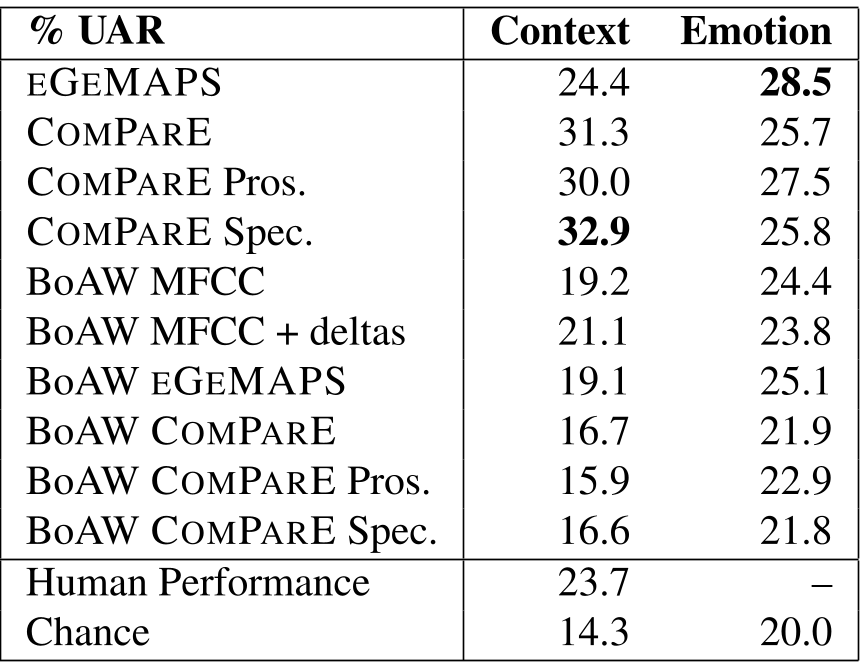
While human crowdsourced listeners achieved a 23.7% Unweighted Average Recall (UAR), the ComParE Spectral features reached 32.9%. This suggests that different contexts (like "Stranger" vs. "Food") create distinct frequency distributions that the human ear often misses but a spectral analyzer captures perfectly.
2. Emotional Intensity
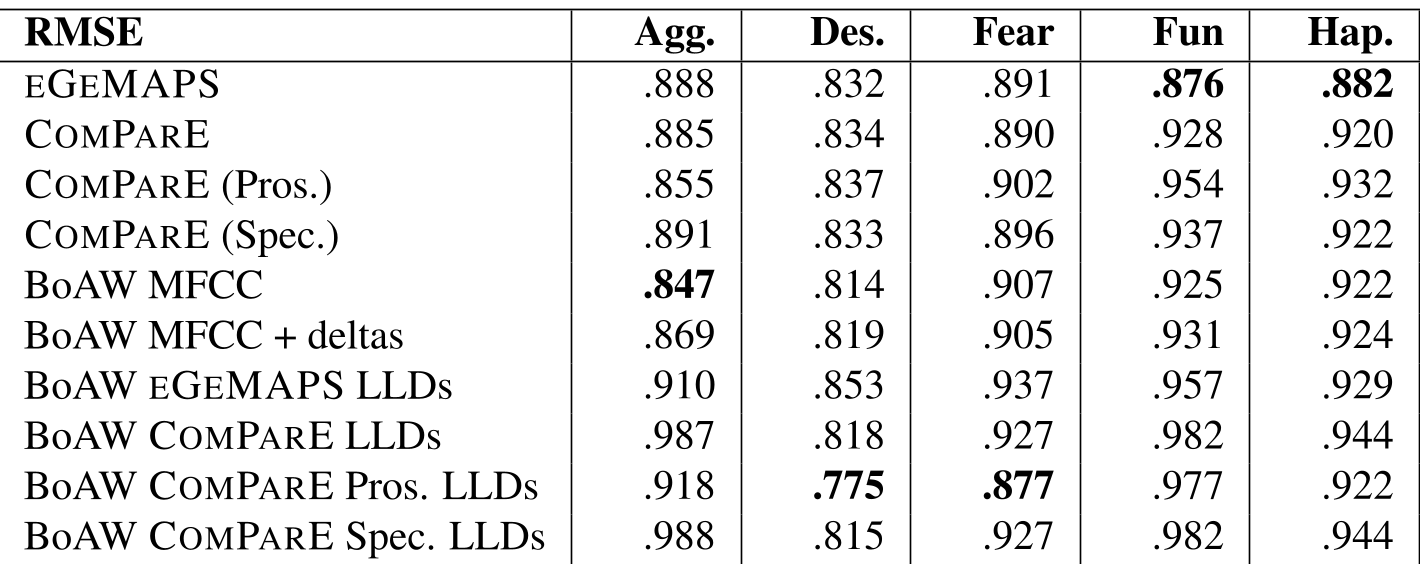
For predicting the intensity of an emotion (1 to 5 scale), the models found it much easier to estimate negative emotions like Aggression and Despair than positive ones like Happiness. High aggression is closely linked to high physiological arousal, which manifests clearly in "Bag-of-Audio-Words" MFCC features.
Critical Analysis & Conclusion
Takeaway
The study successfully validates that human-centric acoustic features are a powerful proxy for canine emotions. The fact that the eGeMAPS feature set—specifically designed for the human voice—performed so well on dog barks confirms a deep homological link between how mammalian brains encode emotion into sound.
Limitations & Future Work
- Breed Specificity: The study focused solely on the Mudi breed. Since different breeds have vastly different vocal tract shapes (e.g., Pugs vs. German Shepherds), the model's generalizability across breeds remains unproven.
- Perceived vs. Actual: The "emotions" were labels assigned by dog trainers (perceived), not direct measurements of the dog's internal state (e.g., cortisol levels).
- Potential: The authors suggest that Transfer Learning (training on humans, testing on dogs) is the next frontier, potentially leading to universal "emotion translators" for animal welfare and veterinary medicine.
Final thought: The next time your dog barks, remember: your computer might actually understand the nuance of that bark better than you do.