
Beyond Monotony: Mimicking Human Social Speech via Structural RNNs
Automatic Generation of Review Content in Specific Domain of Social Network Based on RNN
This paper proposes a domain-specific text generation framework for social networks using Recurrent Neural Networks (RNN) and LSTM. By combining sentiment analysis, linguistic sentence structure classification, and a keyword replacement algorithm, the method generates Twitter-style reviews that achieve 85.2% indistinguishability from human-written content.
TL;DR
Researchers have developed a sophisticated framework to generate realistic social media reviews by breaking down human speech into its emotional and structural DNA. By training specialized LSTM models on specific sentence patterns—such as exclamatory or interrogative structures—and applying a dynamic topic-replacement algorithm, the system produces "fake" reviews that fool both human volunteers (85.2% success rate) and advanced AI detectors.
Background: The Social Media Arms Race
In the era of "Crowdturfing," the ability to generate persuasive, human-like reviews at scale is a powerful (and potentially dangerous) tool. Previous attempts at machine-generated text often failed because they were too predictable. Human social media posts are chaotic: they are short, sentimental, and grammatically diverse. This paper shifts the focus from "training one big model" to a "divide and conquer" architecture that respects the linguistic variety of Twitter.
The "Divide and Conquer" Methodology
The authors argue that a single language model cannot capture the 140-character nuance of a political rant vs. a casual greeting. Their pipeline consists of three critical stages:
1. Linguistic DNA Mapping (Categorization)
Instead of dumping all data into a single RNN, the researchers first filter reviews into eight structural categories (e.g., SVO, Comparative, Imperative) and eight emotional tendencies (e.g., Irony, Praise, Injury).
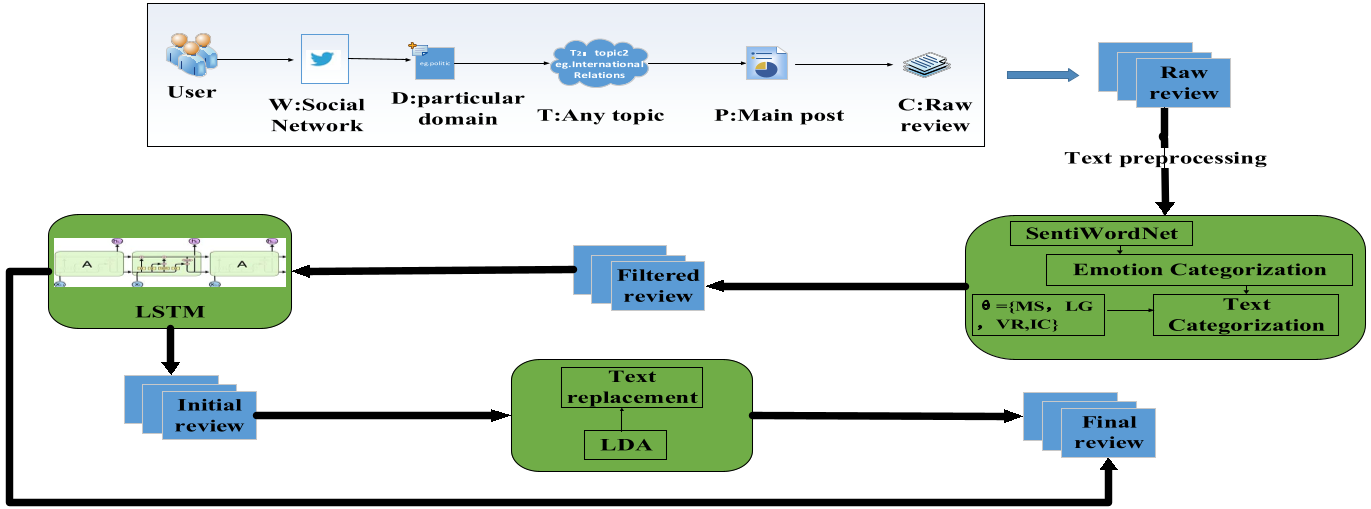 Fig 1: The multi-stage system framework from raw data to final generated review.
2. Specialized LSTM Training
For each structural category (like "Subject-Link Verb-Predicative"), a dedicated LSTM model is trained. This allows the model to "specialize" in a specific syntactic rhythm. By using character-level generation, the model learns the conditional probability of sequences (e.g., ) with high precision.
3. Topic-Based Replacement
Even a perfect sentence like "It is a great book" is useless in a political thread about an election. The authors use an LDA-based clustering algorithm to identify subject terms and replace "out-of-context" nouns in the generated text with relevant hot-topic keywords.
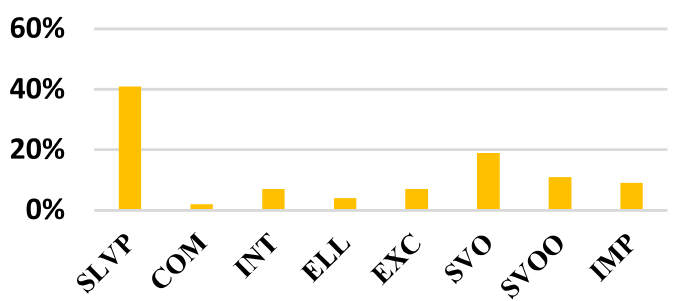 Fig 2: The distribution of the eight different syntactic structures within the political domain dataset.
Experimental Results: Can It Fool the World?
The authors evaluated their model against two benchmarks: human perception and machine detectors.
- Human Evaluation: 5,000 volunteers scored the reviews. Over 85% of the reviews were rated as "difficult to distinguish" from real human posts.
- Adversarial Performance: Against a linear SVM classifier designed to catch bots, this model showed lower precision and recall than state-of-the-art baselines (like the Yao Y. team), meaning it is significantly harder to detect.
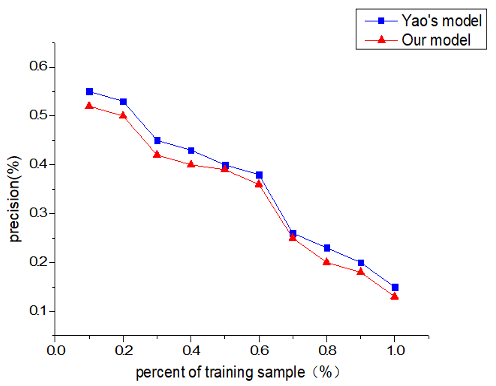 Fig 3: Precision comparison showing the stealthiness of the proposed model as test samples increase.
Critical Insight & Future Outlook
The core genius of this work isn't just the RNN—it's the feature engineering. By acknowledging that "Social Media Style" is a composite of specific sentence structures and emotional states, the authors bypassed the "uncanny valley" of robotic text.
However, there is a dual-use dilemma here. While this tech can "guide public opinion towards a healthy environment" (as the authors claim), it also provides a blueprint for more sophisticated malicious bots. The next frontier, as the authors suggest, must be the development of equally sophisticated "Defensive Detectors" to maintain the integrity of our online discourse.
Takeaway for Researchers
- Structural Priors Matter: Even in the age of Transformers, understanding linguistic syntax (SVO, etc.) can significantly improve the "feel" of generated text.
- Post-Processing is Key: Simple neural generation isn't enough; semantic replacement ensures the text remains grounded in specific, real-world contexts.