
Decoding Social Dynamics: Automatic Role Recognition via Social Affiliation Networks
Automatic role recognition in multiparty recordings: Using social affiliation networks for feature extraction
This paper presents an automated framework for recognizing individual roles in multiparty audio recordings across diverse settings, such as news bulletins, talk shows, and meetings. By utilizing Social Affiliation Networks (SAN) for feature extraction and Bayesian classifiers to model interaction patterns, the system achieves SOTA performance in formal role recognition.
TL;DR
Understanding "who is who" in a conversation is a foundational pillar of Social Signal Processing. This paper introduces a robust framework for automatic role recognition by modeling how people interact over time using Social Affiliation Networks (SAN). While achieving over 85% accuracy in formal broadcast data, the study reveals the inherent difficulty of identifying informal roles in spontaneous meetings, highlighting the gap between behavioral constraints and social status.
Background & Motivation: Beyond Anonymous Voices
In any group setting, people do not interact as anonymous entities; they operate within the constraints of specific roles (e.g., Anchor, Guest, Manager). These roles provide predictability and structure to our social lives.
The authors identify three major gaps in existing literature:
- Scale Constraint: Previous social network-based methods required large groups (8-10+ people) to generate meaningful features.
- Independence Fallacy: Most models assume roles are independent, ignoring the reality that a talk show cannot have five "Hosts" and zero "Guests."
- Contextual Isolation: Research has typically focused on either news or meetings, but rarely compares the two.
Methodology: The Core Engine
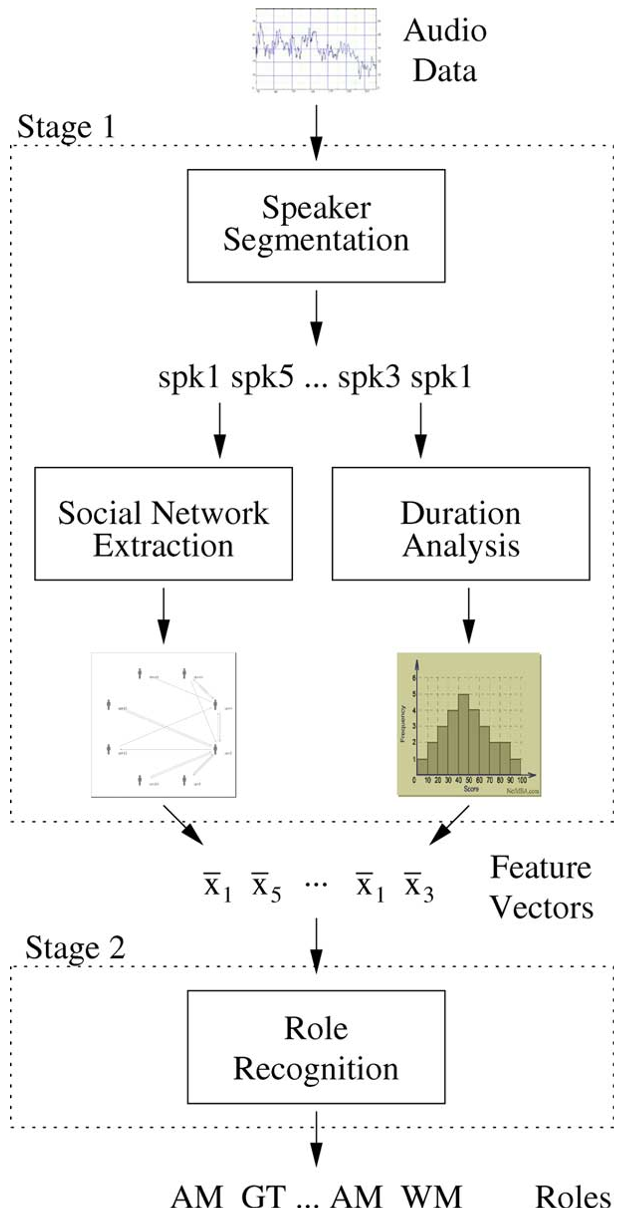
The researchers propose a two-stage pipeline: Feature Extraction and Role Recognition.
1. Social Affiliation Networks (SAN)
To solve the "small group" problem, the authors move away from simple actor-to-actor networks. Instead, they use a Bipartite Graph where nodes represent either Actors or Events (uniform time segments).
- The Intuition: If two people are speaking during the same time interval, they are mathematically "affiliated."
- Representation: Each actor is represented by an -tuple (vector) indicating their participation across all segments.
2. Bayesian Modeling and Role Dependency
The system maps these -tuples and intervention lengths into roles. The "secret sauce" is the Constraint Model:
- Independent Model: Assigns roles to individuals purely based on their local features.
- Dependent Model: Uses Simulated Annealing to find a global role assignment for the whole group that maximizes the likelihood while satisfying social "cardinality" (e.g., exactly one Project Manager per meeting).
Experimental Battleground
The model was tested on 90 hours of data across three corpora:
- C1 (Radio News): Formal, scripted.
- C2 (Radio Talk-Shows): Semi-formal, interaction-heavy.
- C3 (AMI Meetings): Informal, spontaneous, and simulated.
Performance Analysis
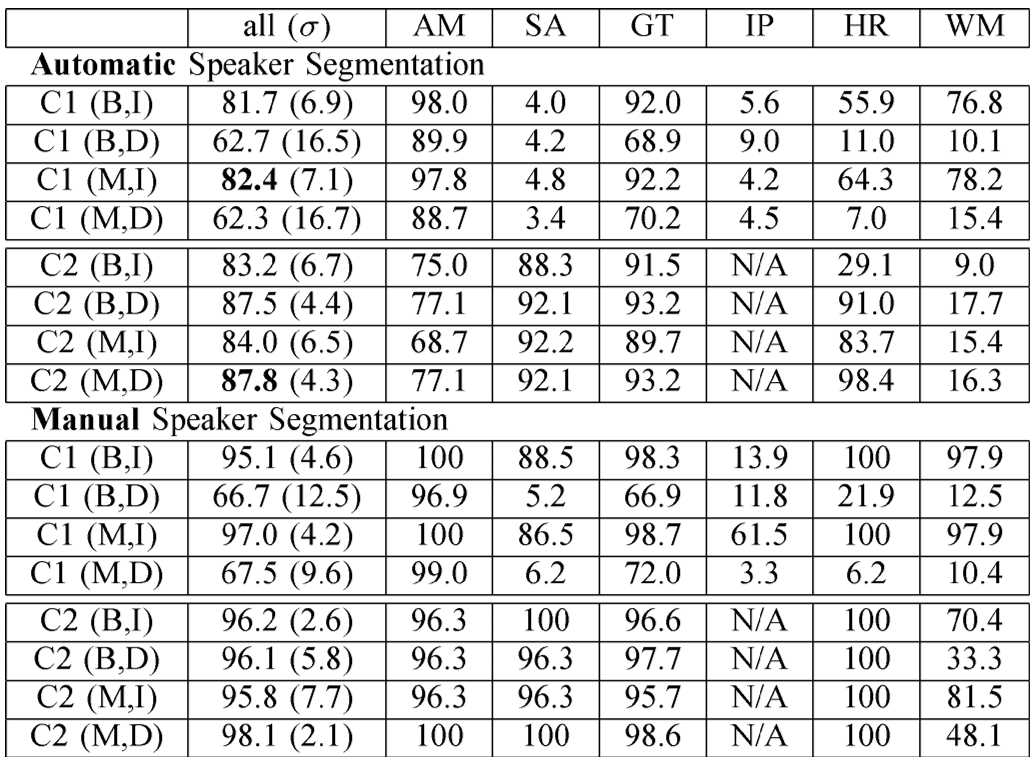
The results showed a stark contrast between "Formal" and "Informal" roles:
| Context | Accuracy | Key Takeaway |
|---|---|---|
| Broadcast (C1/C2) | 81% - 87% | Strict roles create predictable behaviors. |
| Meetings (C3) | ~46% | "Informal" roles like 'Marketing Expert' don't have unique speech signatures. |
Critical Insights: Why do Meetings Fail?
The significant performance drop in the AMI corpus (C3) reveals two critical truths:
- Behavioral Encoding: In news, an Anchor must speak frequently and at specific intervals. In a meeting, a "Marketing Expert" might be vocal or silent depending on the personality, making "role" a latent variable that is not always manifested through turn-taking.
- Acted vs. Real: The AMI participants were roles-playing. The lack of genuine social stakes might have diluted the behavioral distinctions between the roles.
Conclusion & Future Horizons
This work solidifies the use of SANs as a powerful tool for social analysis in small groups. It proves that modeling mutual dependencies between roles is a necessary step for realistic social AI.
However, the "Informal Role" problem remains. The authors suggest that future SOTA models must move beyond "who talks when" and begin to analyze what is being said (Lexical/Semantic features) and how it is being said (Prosody/Affective computing) to truly capture the essence of human social dynamics.