
Protecting Privacy Without Lies: Automatic Sanitization of Social Network Data
Automatic sanitization of social network data to prevent inference attacks
This paper introduces an automatic sanitization framework for social networks using Detail Generalization Hierarchies (DGH) and Detail Value Decomposition (DVD) to thwart inference attacks. The authors propose a generalization-based approach that maintains data accuracy and link structure while successfully reducing the accuracy of predictive classifiers on sensitive user attributes.
TL;DR
In the age of big data, your public "likes" can reveal your private secrets. This paper presents a novel framework for Automatic Sanitization that uses hierarchical generalization and tag decomposition to hide sensitive information. Unlike previous methods, it doesn't delete friends or create fake data; it simply makes specific details "blurrier" to defeat machine learning classifiers while keeping the data useful for researchers.
Background & Positioning
Published at WWW '11, this work sits at the intersection of Social Computing and Data Privacy. It shifts the focus from "who you are" (identification) to "what can be guessed about you" (inference). It is a seminal observation on the utility/privacy trade-off, proving that we can be private without being invisible.
The Invisible Threat: Inference Attacks
Most users understand identity theft, but few understand Inference Attacks. Even if you hide your "Political Affiliation" on a profile, an attacker can build a classifier using your favorite books, music, and activities to guess your politics with high accuracy.
Existing solutions often:
- Break the Graph: Deleting edges (friends) ruins social network analysis.
- Lie to the Reader: Injecting "fake" interests makes the data scientifically useless.
The authors ask: Can we keep the data 100% truthful and the graph intact while still protecting the user?
Methodology: The Art of Generalization
The core contribution is a two-pronged approach to sanitizing user details:
1. Detail Generalization Hierarchies (DGH)
For structured data like interests, the authors use a tree-based hierarchy.
- Specific: "Boston Celtics" (High leakage)
- General: "NBA" (Medium leakage)
- Top-level: "Basketball" (Low leakage) The system programmatically moves up the tree until the attacker's advantage () drops below a safe threshold.
2. Detail Value Decomposition (DVD)
Some data, like music, doesn't fit a neat tree. The authors decompose an artist (e.g., "Enya") into a cloud of tags (e.g., {ambient, irish, new age}). Sanitization involves stripping the most "predictive" tags while keeping the general vibe of the data.
 Figure 1: Conceptual view of the social network graph where nodes carry detailed attributes subject to sanitization.
Experiments & Results
The authors tested their theory on a massive dataset: 167,000 nodes from the Dallas/Fort Worth Facebook network (circa 2007).
Key Findings:
- Effective Suppression: Generalizing "Activities" alone was surprisingly effective at reducing political inference, even more so than group memberships—contrary to prior beliefs.
- Utility Preservation: While the ability to guess sensitive traits dropped significantly, the "Utility" (measured by the ability to classify non-sensitive traits like gender) only fell by 2-3%.
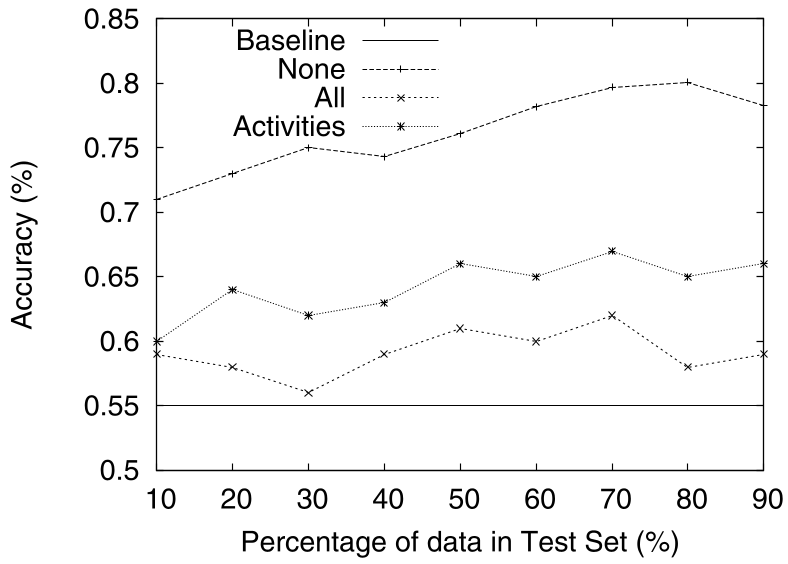 Figure 2: Accuracy of inference attacks under different sanitization strategies. Notice how "All" and "Activities" generalization significantly lower the attacker's success rate.
Critical Analysis & Conclusion
The genius of this paper lies in its honesty. By acknowledging that "perfect privacy" is impossible if data is to be released, the authors provide a framework for a "valid real-world data release."
Limitations:
- The method relies heavily on "Subject Authorities" (like Google or Last.fm) to build hierarchies. If the hierarchy is poorly constructed, the privacy guarantees weaken.
- In the modern era of LLMs, simple tag-based decomposition might be less effective against high-dimensional embeddings.
Final Takeaway: This work proves that privacy is not a binary switch but a spectrum of granularity. To protect users, we don't need to stop sharing; we just need to stop being so specific.