
Bridging the Semantic Gap: Automatic Video Content Extraction via Fuzzy Ontologies
Automatic Semantic Content Extraction in Videos Using a Fuzzy Ontology and Rule-Based Model
The paper introduces ASCEF (Automatic Semantic Content Extraction Framework), a system that utilizes a domain-independent fuzzy ontology (VISCOM) and rule-based models to automatically extract high-level semantic content like objects, events, and concepts from video data. It achieves SOTA performance across multiple domains including basketball, football, and surveillance videos.
TL;DR
The proliferation of video data has outpaced our ability to index it. This paper presents ASCEF, a framework that uses a metaontology named VISCOM to automatically transform raw pixels into semantic "objects" and "events." By integrating Fuzzy Logic and SWRL rules, the system handles the uncertainty of the physical world while maintaining domain-agnostic flexibility, outperforming specialized SOTA models in surveillance and sports analytics.
The Motivation: Moving Beyond Pixels
Traditional Video Information Retrieval (VIR) systems often get stuck at the "low-level" (e.g., "find a red moving blob"). However, users want to search for "high-level" concepts (e.g., "find a rebound in a basketball game"). The gap between these two is the Semantic Gap.
Most existing solutions are either too rigid (specific only to one sport) or manual (requiring humans to tag metadata). The authors recognized that a truly intelligent system needs:
- Spatiotemporal Awareness: Understanding how objects relate in space and time.
- Uncertainty Management: Recognizing that "near" or "inside" are rarely binary states in a noisy video feed.
Methodology: The VISCOM Metaontology
The core innovation is VISCOM (VIdeo Semantic COntent Model). Unlike a standard database, this metaontology provides a "grammar" for defining any domain.
1. The Architecture
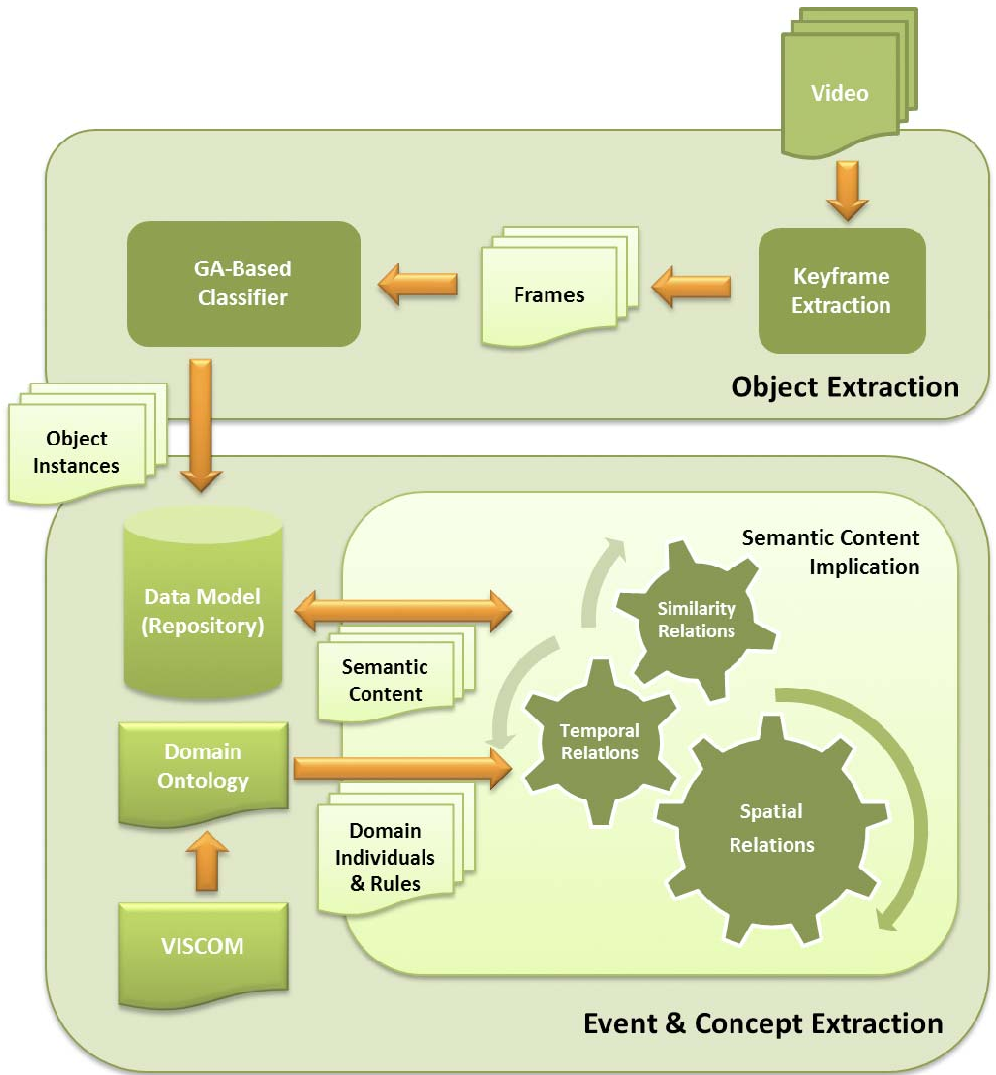
The framework operates in a pipeline:
- Object Extraction: Uses a Genetic Algorithm to classify objects (Players, Balls, etc.).
- Spatial Relation Extraction: Calculates fuzzy values for topological (Inside/Touch), positional (Above/Below), and distance (Near/Far) relations.
- Temporal Reasoning: Employs Allen’s Temporal Interval Algebra to sequence spatial changes into events (e.g.,
Ball hits Hoopfollowed byPlayer jumps=Rebound).
2. The Logic of Fuzziness
In real video, an object is rarely 100% "inside" another. VISCOM uses membership functions () to quantify these relations. For instance, the positional relation "Right" is calculated using the sinus of the angle between object centers, allowing for a smooth transition of truth values rather than a hard "yes/no."
Experimental Results & Efficiency
The system was tested on office surveillance, basketball, and football.
- Accuracy: In surveillance videos, it achieved 90% Precision and Recall.
- Performance Comparison: Compared to "Hakeem" (Sub-event graphs) and "Zhang" (Web-casting text alignment), ASCEF showed better or comparable Boundary Detection Accuracy (BDA) without requiring external text data.
- Optimization: By implementing inverse spatial relations via rules (e.g., if A is Left of B, then B is Right of A), the authors significantly reduced the computational overhead.
Note: The results indicate that while the system is robust, its success is highly dependent on the quality of initial object detection. When objects were provided manually, recall jumped to 98%.
Critical Analysis & Future Outlook
The strength of ASCEF lies in its Domain Independence. Because VISCOM is a metaontology, you can switch from analyzing a basketball game to a hospital hallway simply by swapping the individual definitions, not the underlying engine.
Limitations:
- The 3D Challenge: Current spatial relations are calculated on a 2D image plane. Depth-dimension movements (objects moving toward/away from the camera) can still confuse the logic.
- Occlusion: While consecutive keyframe analysis helps, persistent occlusion remains a bottleneck for the Genetic Algorithm-based object tracker.
Final Takeaway: This paper provides a rigorous mathematical and ontological foundation for semantic video understanding. As we move toward a world of "AI-Everything," the ability to standardize how machines "reason" about spatiotemporal events is a critical step toward truly autonomous video intelligence.
Published as a technical review by Senior Academic Tech Editor.