
SCSC: Automating Social Circles through Multi-View Intuition
Automatic Social Circle Detection Using Multi-View Clustering
The paper introduces Selective Co-Trained Spectral Clustering (SCSC), a multi-view clustering framework designed to automatically detect social circles in ego networks. By integrating structural links, content similarity, and social interactions from Twitter data, SCSC achieves superior accuracy in grouping users compared to single-view and standard co-trained spectral methods.
TL;DR
Managing privacy on social media is a chore—nobody wants to manually sort 500 friends into lists. This paper presents Selective Co-Trained Spectral Clustering (SCSC), an algorithm that understands "circles" by looking at who you talk to, what you talk about, and who your mutual friends are. It solves the "sparsity problem" where missing data in one view (like retweets) usually breaks standard AI models.
Background: The Privacy Paradox
We care about privacy, yet we rarely use the tools provided by Facebook or Google. Why? Because the "Information Boundary" is hard to maintain manually. This paper shifts the burden from the user to a multi-view machine learning model that reconstructs these clusters automatically.
Problem: Why Single-View Fails
Most "Community Detection" algorithms are obsessed with the Friendship Graph (who follows whom). But that's only one piece of the puzzle. Consider a colleague:
- Structure: You share mutual LinkedIn connections.
- Content: You both tweet about
#MachineLearning. - Interaction: You rarely "retweet" each other because you talk in the office.
Standard models see the lack of retweets as a sign of distance. This paper argues that different aspects (Views) of an ego network must complement rather than contradict each other.
Methodology: The Selective Edge
The authors propose 6 views categorized into:
- Structural: Friendship links and mutual friends.
- Content: Similarity in Tweet topics (using Wikipedia-based Tagging).
- Interaction: Replies, Retweets, and Co-replies.
The core innovation is the Selective Co-Trained Spectral Clustering (SCSC). In typical co-training, the model forces all views to agree. However, if a view is sparse (e.g., a user rarely retweets), forcing agreement "pollutes" the other accurate views.
SCSC introduces a Selective Operator (SO):
- It identifies "Partial Graphs" (sparse views).
- It only transfers information when an interaction is observed. If no data exists in a sparse view, it remains neutral rather than penalizing the relationship.
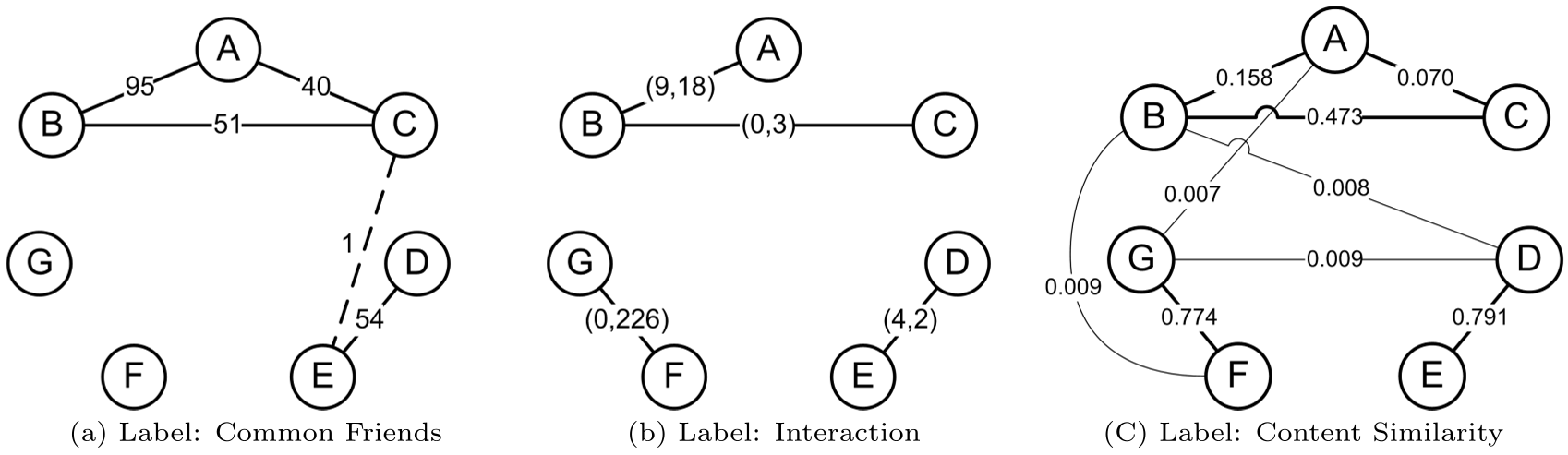 Figure 1: Real-world example showing how content similarity and interactions fill the gaps where structural links (friendship) are missing.
Experiments & Results
The authors crawled 92 Twitter seed users, totaling 22,000 users and 27 million tweets.
The Performance Leap
SCSC didn't just beat the baseline; it crushed the standard Co-trained Spectral Clustering (CSC). While CSC suffered from "negative transfer" due to noise, SCSC's selective logic allowed it to converge almost instantly.
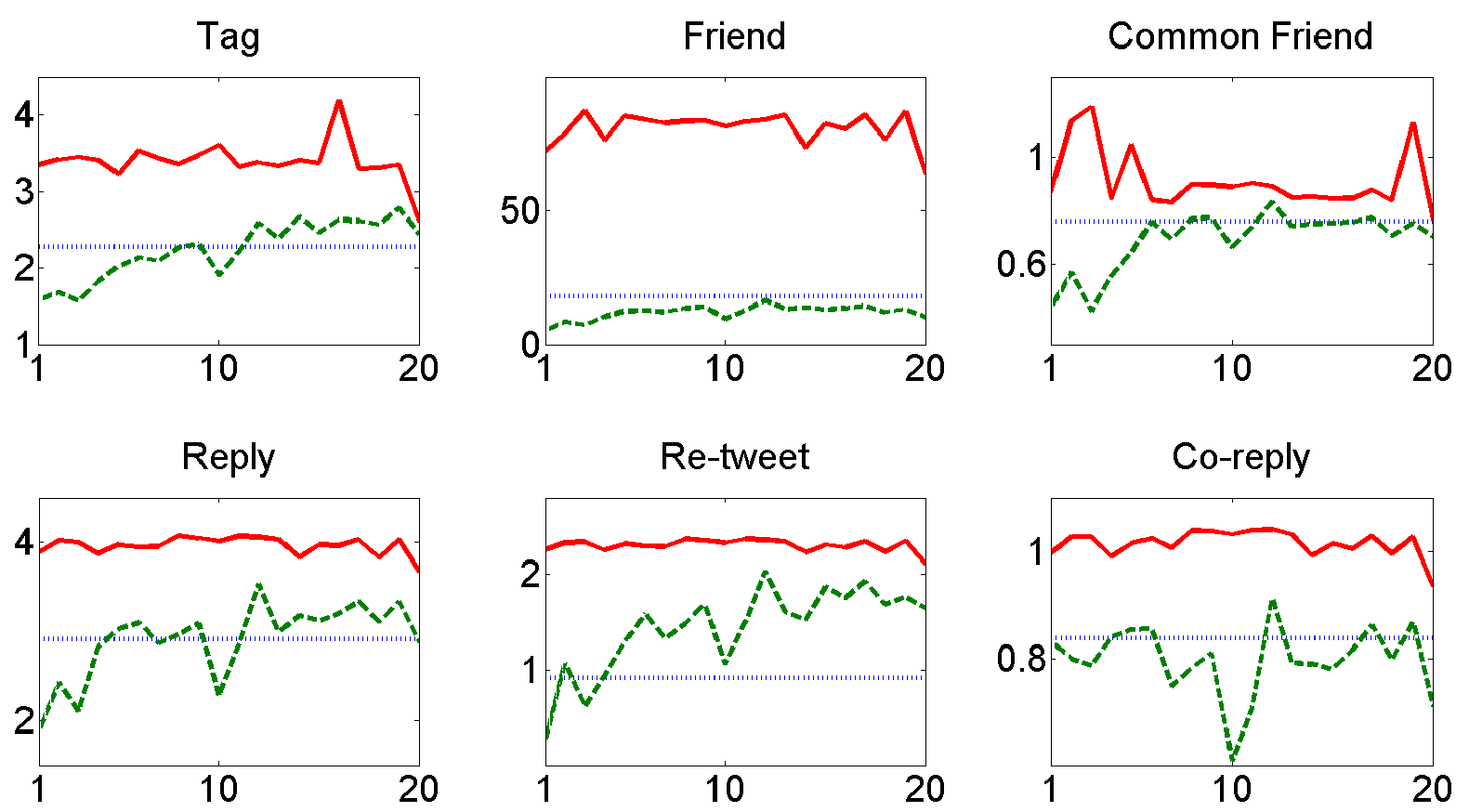 Figure 2: Performance across 6 views. Note how SCSC (red) reaches peak similarity ratio much faster than CSC (green).
Qualititative Insights
By using KL-Divergence to extract keywords from the discovered circles, the authors proved these weren't just random clusters. One circle might be "Entertainment" (Valentine's Day, Dance), while another is "Technical" (Android, Software).
Critical Analysis & Conclusion
Takeaway
The value of this paper is in its Inductive Bias. It acknowledges that "No evidence of interaction is not evidence of no relationship." This is a vital distinction for social data which is notoriously incomplete.
Limitations
- Non-Overlapping: The model assumes a friend belongs to only one circle. In reality, a "College Friend" can also be a "Colleague."
- Scale: While efficient for ego networks (~200 nodes), scaling this to global networks requires more computational optimization.
Future Work
The next frontier is Dynamic Circles—tracking how these groups evolve over time as personal interests and social dynamics shift.