
Automatic Social Network Construction: Moving Beyond Co-appearance via Film-Editing Cues
Automatic Social Network Construction from Movies Using Film-Editing Cues
This paper introduces an automated framework for constructing character social networks from movies by leveraging film-editing cues rather than simple co-appearance. By utilizing the "shot alternation rule," the method quantifies character interactions to build a weighted undirected graph, achieving a more semantically accurate representation of social closeness.
TL;DR
Most AI systems "view" movie social networks by checking if two people stand in the same room. This paper argues that interaction, not presence, is the key. By exploiting the "Shot Alternation Rule"—the cinematic grammar where editors cut between speakers in a dialogue—the researchers have developed a method to automatically map human relationships in films with minimal human intervention.
Background Positioning
While previous SOTA methods like RoleNet required tedious manual scene labeling, this work moves the field toward a fully unsupervised paradigm. It sits at the intersection of Social Computing and Cinematic Analysis, treating the director's editing choices as latent labels for human connectivity.
Problem & Motivation: The "Co-appearance" Fallacy
The standard approach to building a social graph (where vertices are actors and edges are relationships) has a fatal flaw: Co-appearance is a noisy signal.
- Missed Connections: Two people talking on the phone are interacting but never share a frame.
- False Positives: A stranger sitting behind the protagonist in a café is "co-appearing" but has zero social relevance.
- The Scene Dependency: Existing methods need "perfect" scene boundaries, which usually requires a human in the loop to fix shot-detection errors.
The authors' insight? Trust the Editor. Movie editors use specific guidelines (the 180° rule and shot alternation) to show interaction. If the camera cuts from Person A to Person B, they are almost certainly engaged in a social exchange.
Methodology: The Core Mechanism
The pipeline consists of three sophisticated steps that transform raw pixels into a social architecture:
1. Cinematic Face Tracking
Using the 180° Rule (which states that characters should maintain their relative left/right positions to avoid disorienting the viewer), the system stabilizes face tracks. If a face moves or scales within specific thresholds across consecutive frames, it is locked into a "track."
2. Affinity Propagation (AP) Clustering
Instead of pre-defining the number of actors, the authors use Affinity Propagation. Faces exchange "messages" to determine who belongs to which cluster, allowing the model to discover the cast size dynamically.
3. Interaction Sizing via Shot Alternation
This is the mathematical heart of the paper. The weight of a social edge () is calculated by counting how often members of Cluster and Cluster appear in consecutive shots.
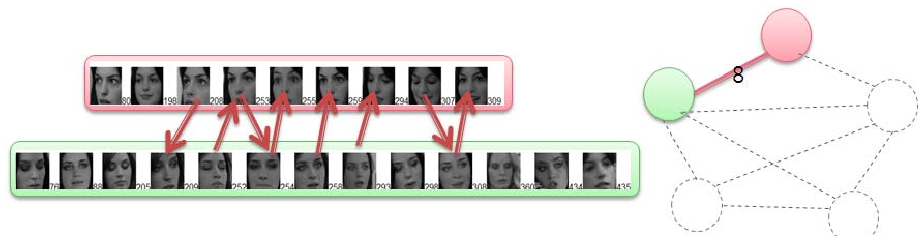 Fig 1: Using shot alternation to quantify closeness. If Andy (Shot 3) is followed by a cut to her friend (Shot 4), an interaction weight is added.
Experiments & Results: Real-World Validation
The system was tested on a 36-minute segment of The Devil Wears Prada.
- Interaction vs. Co-appearance: The proposed method successfully identified a phone conversation (Character 3 and 11) that the co-appearance method completely missed because they were never in the same scene.
- Graph Accuracy: When clusters were refined, the automated graph closely mirrored the manually labeled ground truth.
- Social Cluster Discovery: By applying the Bron-Kerbosch algorithm to find "maximal cliques," the system accurately grouped characters into their narrative roles (e.g., the "College Friends" cluster vs. the "Work Colleagues" cluster).
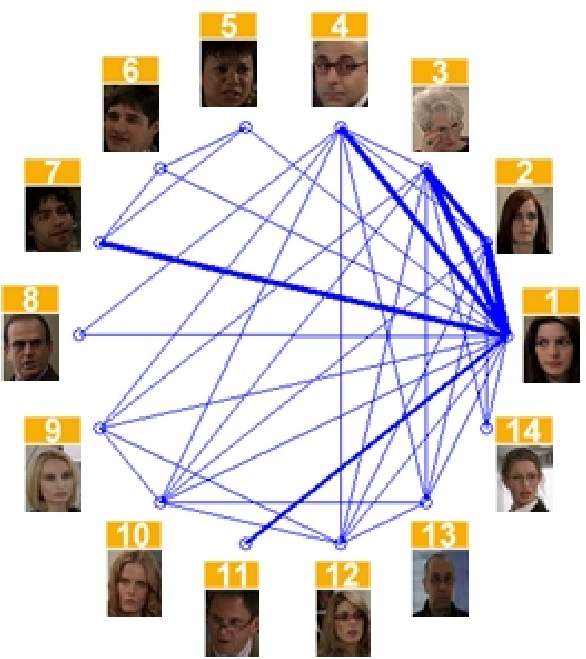 Fig 2: Comparison between (a) Co-appearance graphs and (b) the proposed Shot Alternation graph. Note the increased nuances in interaction density.
Critical Analysis & Conclusion
Takeaway
This work proves that Cinematic Intelligence (understanding how films are made) is just as important as Visual Intelligence (understanding what is in a frame). By decoding the "language of the cut," we can extract deep social structures nearly for free.
Limitations
The primary weakness lies in "Art House" or French New Wave cinema. Movies that intentionally break the 180° rule or use long, static one-shot takes (where no cuts occur during interaction) would cause this system to fail. It is a tool optimized for the "Continuity Editing" style of mainstream Hollywood.
Future Work
The authors suggest that this social graph could be used as a prior for Face Annotation. If the visual features of a face are blurry, but the social graph says the protagonist is talking to his mother, the system can use social context to "guess" the identity more accurately.