
Automated Course Generation: When OER Becomes Autonomous Agents
Automatic Syllabus-Oriented Remixing of Open Educational Resources Using Agent-Based Modeling
This paper proposes an automated system for remixing Open Educational Resources (OER) into comprehensive course packages based on an input syllabus. Leveraging Agent-Based Modeling (ABM) and the IEEE LOM standard, the system simulates interactions between resource agents to select and link the most compatible contents, achieving higher precision in structured repositories like SlideShare.
TL;DR
The explosion of Open Educational Resources (OER) hasn't necessarily made course design easier—it's created an "information overload" problem. This paper introduces an Agent-Based Modeling (ABM) framework that transforms static learning objects into autonomous agents. These agents "talk" to each other to form a cohesive, linked curriculum that perfectly matches a teacher's syllabus.
The "4R" Challenge: Why Remixing is Hard
Open Educational Resources are defined by the 4Rs: Reuse, Redistribute, Revise, and Remix. While the first three are common, Remixing—combining multiple resources into a new, complex course—remains a manual, labor-intensive task.
The authors identify three core pain points:
- Scale: There are millions of OERs; finding the right mix is a "needle in a haystack" problem.
- Compatibility: A great video and a great PDF might not work together if their difficulty levels or technical formats clash.
- Pedagogical Flow: Selecting resources is easy; linking them into a logical learning path (prerequisites and outcomes) is hard.
Methodology: The OER as a Social Agent
The core innovation is treating every OER as an Agent. Instead of a central algorithm trying to solve the whole puzzle, each agent is responsible for its own "neighborhood" in the syllabus.
1. The Architecture
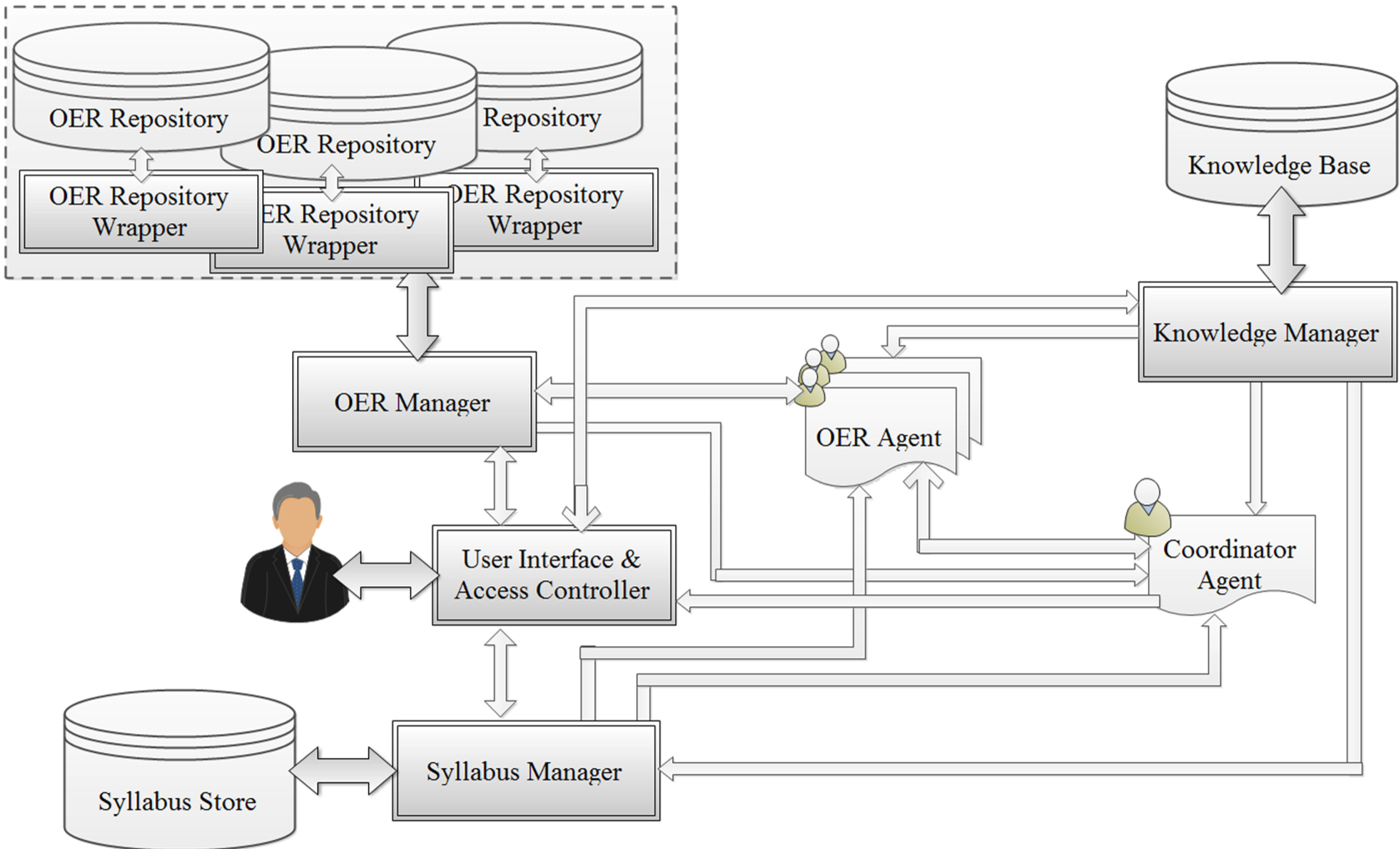
The system utilizes a Coordinator Agent (acting as a blackboard) and multiple OER Agents.
2. Profile Enrichment
Since many OERs have "thin" metadata, the OER Agents perform Self-Optimization:
- Unifying Words: Using ontologies to recognize that "e-learning" and "online education" are the same.
- Keyword Completion: Extracting hidden keywords from titles and descriptions using a specific intersection formula:
3. The Utility Function
To determine if two resources should be "neighbors," agents calculate a Compatibility Score. They look at language, age range, difficulty, and interactivity. If Resource A flows perfectly into Resource B, they form a "link."
Experiments and Results
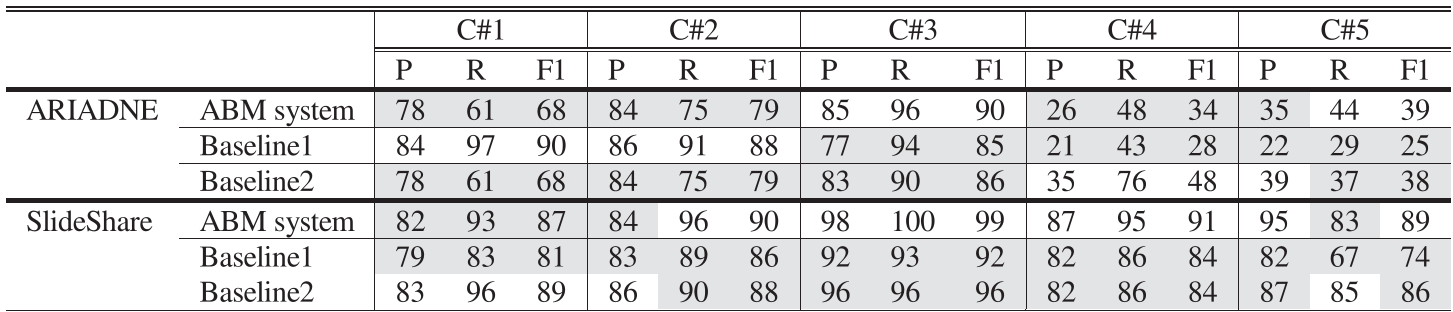
The authors tested the system on two major repositories: ARIADNE (high-quality research-oriented) and SlideShare (community-driven).
Key Insights from the Data:
- SlideShare outperformed ARIADNE: Surprisingly, the community tags and user comments on SlideShare provided "richer" metadata for the agents to work with compared to the formal but often incomplete ARIADNE records.
- Syllabus Precision: The ABM approach achieved high precision (often >85%) in matching resources to specific syllabus topics like "Web 3.0" and "LMS Standards."
Critical Analysis: The Metadata Bottleneck
As a Senior Tech Editor, I find the Metadata Bottleneck the most intriguing takeaway. The system is only as smart as the data describing the OER. In ARIADNE, many agents failed to connect simply because technical metadata (like "End User Role") was missing in 97% of cases.
The Lesson for the Industry: For AI-driven education to work, we don't just need better LLMs; we need "Semantic Openness." If we want automated course generation, publishers must start treating metadata as a first-class citizen, not an afterthought.
Conclusion and Future Outlook
This paper moves us closer to the "Holy Grail" of e-learning: Personalized, Just-in-Time Course Generation. Imagine a world where an employee enters a project goal, and an ABM system instantly remixes a bespoke training course from across the web.
Future Work: The authors suggest moving toward "Full Remixing"—not just linking files, but using NLP to "blur the junctions" between resources, creating a truly seamless textbook-like experience.
Keywords: Agent-Based Modeling, OER, IEEE LOM, Automated Remixing, E-Learning Architecture