
Document-Centered Tagging: Moving Beyond User Snippets to Deep Content Insight
Automatic tag recommendation algorithms for social recommender systems
The paper introduces two robust document-centered frameworks—a graph-based partitioning approach and a prototype-based Sparse Gaussian Process (SGPS) model—for automatic tag recommendation in social bookmarking systems. These methods shift the focus from sparse user-centered history to rich document content, achieving State-of-the-Art performance across large-scale datasets like Del.icio.us and CiteULike.
TL;DR
Social tagging systems like Flickr and Del.icio.us revolutionized the web, but "Cold Start" problems make recommending tags to new users nearly impossible. This paper pivots from the traditional user-centered approach to a document-centered paradigm. By utilizing Graph Partitioning and Sparse Gaussian Processes, the authors achieve faster, more accurate recommendations that can handle the massive, noisy, and growing vocabulary of the modern web.
The Core Challenge: The Long-Tail of Social Behavior
The authors identify a fatal flaw in early recommendation systems: The User-Centered Trap. Most users rarely tag anything (following a power-law distribution), and those who do have rapidly changing interests. Relying on user history creates a sparse, brittle model.
Instead, the authors argue that the document—whether a scientific paper or a web page—contains stable, rich semantic features. By treating tags as a form of "super-word" or "class label," they bridge the gap between unsupervised topic modeling and supervised classification.
Methodology 1: Bipartite Graph Partitioning & PMM
The first approach treats the relationship between documents, tags, and words as a complex ecosystem.
- Graph Representation: It builds two bipartite graphs: (Document, Tag) and (Document, Word).
- Normalization: Using the Normalized Laplacian, the authors extract the "spectral" heart of the data.
- Poisson Mixture Model (PMM): To handle the discrete nature of word counts, it uses a two-way PMM. This simultaneously clusters words and classifies documents, effectively reducing noise.
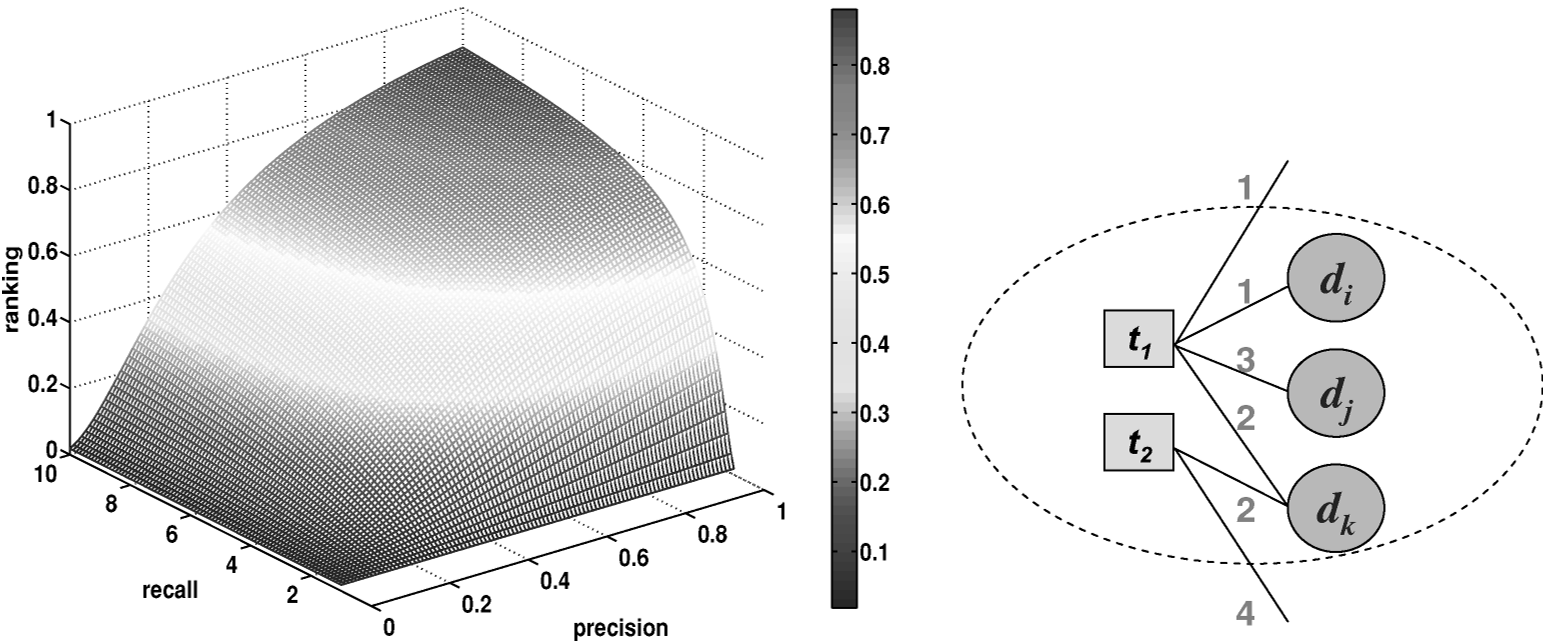 Figure: The Bipartite Graph Framework connecting Tags, Documents, and Words.
Methodology 2: Sparse Gaussian Processes (SGPS)
The most mathematically rigorous contribution is the application of Gaussian Processes (GP) to tag recommendation.
- The Scalability Problem: Standard GPs have complexity—unusably slow for web-scale data.
- The Prototype Solution: The authors introduce SGPS, which selects a specific subset of "Informative Prototypes." Using Laplace Approximation, they provide a closed-form solution for multi-class classification that scales linearly with training size.
- Why GP?: Unlike SVMs, GPs provide a probabilistic interpretation. This "predictive variance" is crucial for tagging because it allows the system to remain "uncertain" about ambiguous tags (e.g., whether "Apple" refers to fruit or technology).
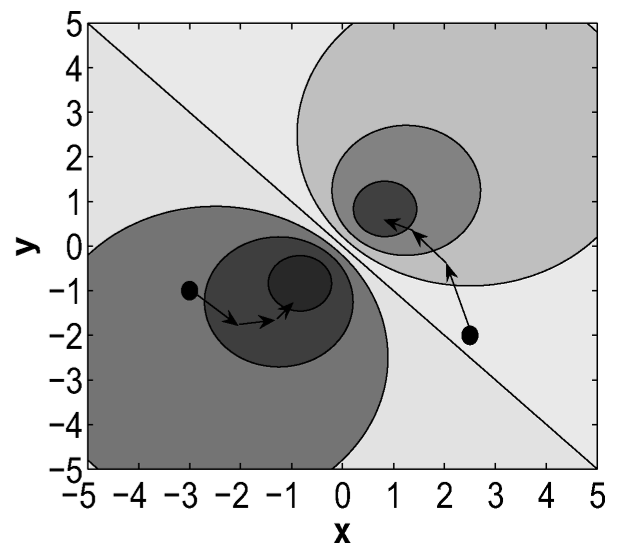 Figure: The prototype selection process efficiently finds the most representative documents to act as class anchors.
Experimental Victories
Testing on CiteULike, Del.icio.us, and BibSonomy, the results demonstrate a significant leap:
- F-Score Performance: MMSG and PMM consistently beat SVM and LDA across the board.
- Rare Tag Accuracy: The MMSG model shows an 18% improvement over SVM for "rare tags." This is critical because rare, niche tags often provide the most value in social discovery.
- Efficiency: Inference takes ~1.2 seconds, making real-time suggestions visible in the UI as the user begins to bookmark.
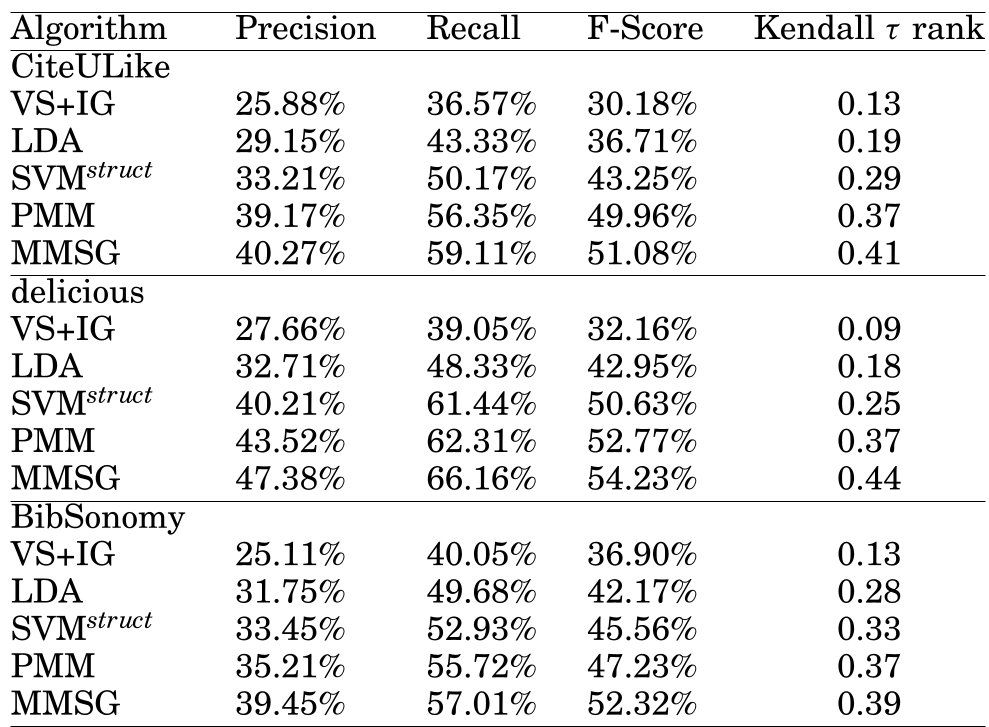 Table: Performance comparison showcasing the dominance of PMM and MMSG over traditional baselines.
Critical Insight: The Value of Uncertainty
The true brilliance of this work lies in its objective acknowledgement of polysemy and synonymy. By using a probabilistic framework, the model doesn't just "guess" a tag; it calculates the semantic likelihood across multiple categories.
Takeaway: Future social recommender systems should focus on content-rich classification and sparse Bayesian learning. While modern LLMs now handle some of this via embeddings, the mathematical foundations of Sparse GPs in this paper provide a fascinating look at how efficiency and semantic accuracy were balanced before the deep learning era.
Potential Limitations
- Dynamic Vocabulary: While content-centered, the models still rely on a predefined tag vocabulary during training.
- Visual Assets: The paper focuses heavily on text; applying this to images (Flickr) would require an additional computer vision feature extraction layer.