
TRAIL: Reimagining Software Traceability via Machine Learning Classification
Automatic Traceability Maintenance via Machine Learning Classification
This paper introduces TRAIL (TRAceability lInk cLassifier), a novel machine learning framework for automated software traceability maintenance. By treating traceability as a binary classification problem, TRAIL leverages historical trace data to train models that predict the validity of links between new or evolving artifacts, outperforming traditional Information Retrieval (IR) baselines.
Executive Summary
TL;DR: The paper presents TRAIL, an automated framework that transforms software traceability maintenance into a binary classification task. By training on historical project data, TRAIL accurately identifies valid links between artifacts (like code and requirements), consistently outperforming classic Information Retrieval (IR) methods by 25%+ in F-score.
Background: Within the software engineering ecosystem, traceability is the "glue" that connects requirements to code. While IR has been the SOTA for a decade, it remains a passive tool. TRAIL marks a shift toward proactive, supervised learning to keep these links alive as code evolves.
The Problem: The Decay of Digital Threads
As software grows, its "digital threads"—the links between a requirement and the specific classes that implement it—inevitably fray.
- Dynamic Decay: Modified artifacts break existing links.
- The New Artifact Problem: Traditional rules can't easily link a brand-new file without human intervention.
- Threshold Sensitivity: IR methods provide a ranked list, but require a human to decide "where to cut," leading to high false-positive rates.
Methodology: The TRAIL Framework
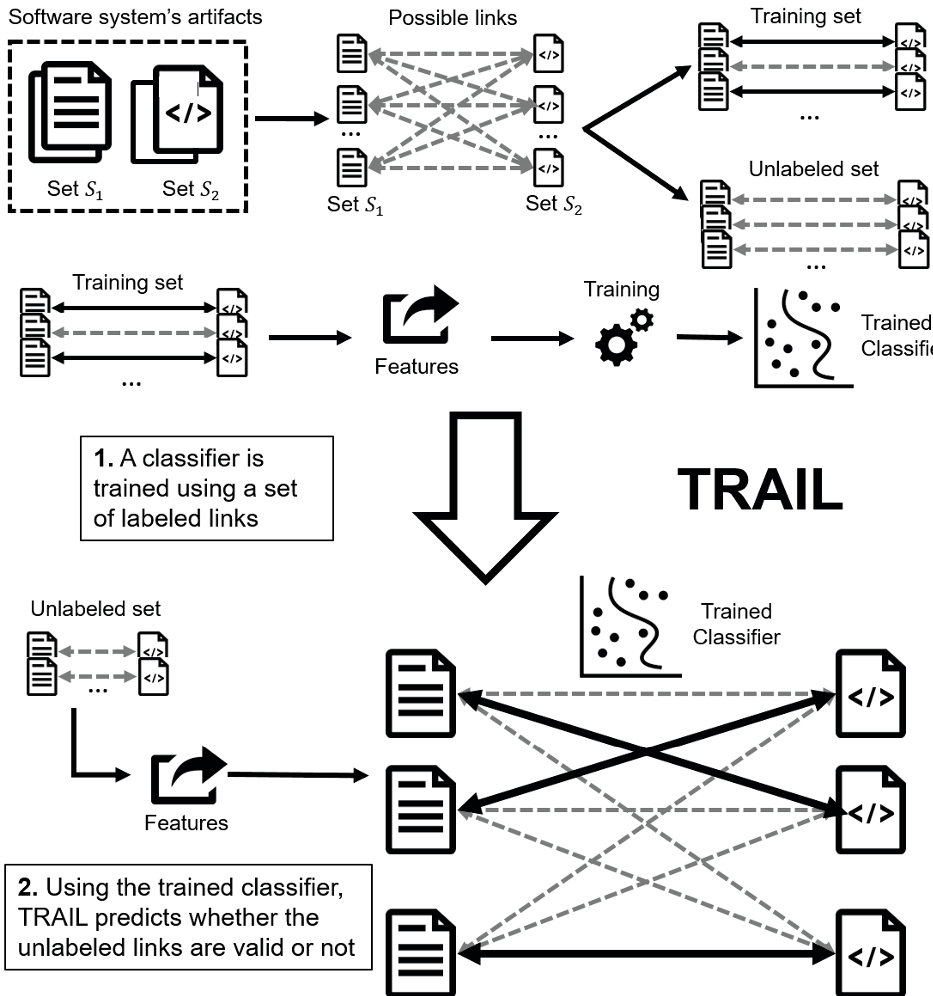
The genius of TRAIL lies in its feature-rich representation. Instead of relying on a single similarity score, it constructs a 131-dimensional vector for every potential link pair.
1. Feature Engineering
TRAIL doesn't throw away IR; it absorbs it. Features include:
- IR-based Features: Ranks from 7 different models (VSM, LSA, LDA, etc.) in both directions.
- Query Quality (QQ): Metrics that predict if an artifact is "hard to trace."
- Document Statistics: Term overlap and document length.
2. Handling the Needle in the Haystack
In any project, 92%+ of potential links are invalid. To prevent the model from simply guessing "Invalid" every time, TRAIL uses SMOTE (Synthetic Minority Over-sampling Technique) to balance the training data, effectively "hallucinating" valid link examples to teach the model what to look for.
3. The Classifier
After testing k-NN, Naive Bayes, and SVM, the authors found that Random Forest provided the highest inductive bias necessary to navigate the complex relationships between software artifacts.
Experimental Results: A Clear Winner
The authors tested TRAIL against 11 datasets (e.g., eTour, iTrust, EasyClinic). The results weren't just better; they were transformative.
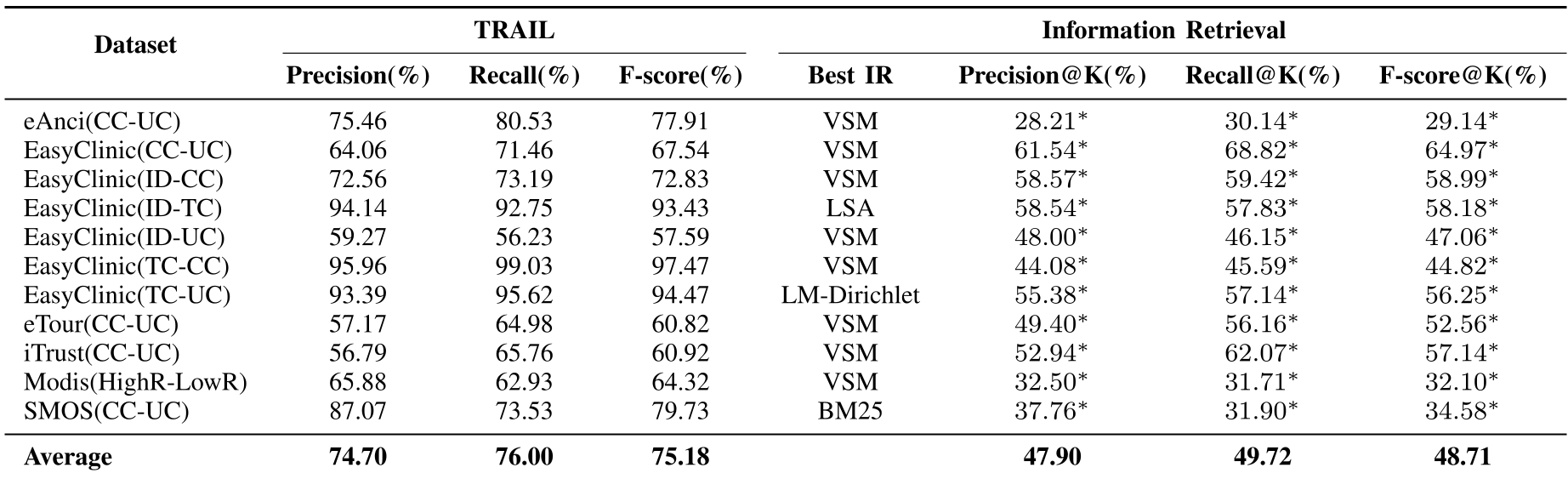
- Baseline Superiority: Even the strongest IR baseline (often VSM) failed to match TRAIL. While IR averaged 48% F-score, TRAIL hit 75%.
- High Precision/Recall: In the EasyClinic(TC-CC) dataset, TRAIL achieved a near-perfect 97.47% F-score, whereas the best IR method lagged at 44.82%.
- Statistical Significance: Using the Mann-Whitney U test, the improvements were confirmed to be robust, with a large effect size across almost all test cases.
Critical Insight: Why Does Classification Beat Retrieval?
Traditional IR treats every query in isolation. TRAIL, however, learns the "meta-patterns" of what a link looks like in a specific project. By looking at "Query Quality" and "Retrieval Direction," it identifies when a low IR score is just a result of a poorly written artifact rather than a lack of relationship.
Conclusion & Future Outlook
TRAIL demonstrates that software maintenance can be largely automated if we treat historical data as a goldmine for training.
Limitations:
- Cold Start: You need existing links to train the model (Greenfield projects).
- Vocabulary Mismatch: It still relies on term matching, which can fail if developers and clients use different jargon.
What's Next? The authors hint at Deep Learning and Transfer Learning. Imagine a transformer model pre-trained on GitHub that understands the "intent" of a requirement and automatically links it to a Java class—that is the future TRAIL is blazing.