
Automatic Visual Concept Learning: Beyond Manual Labels for Social Event Understanding
Automatic Visual Concept Learning for Social Event Understanding
The paper introduces an automatic visual concept learning framework for social event understanding in videos. It features an automated concept mining pipeline and a Boosted Concept Learning (BCL) algorithm that iteratively learns multiple classifiers per concept while performing domain adaptation across video and image datasets.
Executive Summary
TL;DR: This work presents a fully automated pipeline for understanding complex social events in videos by mining visual concepts from the web and refining them through a novel boosted learning framework. By moving away from brittle, manually defined concepts, the system achieves a significant performance leap (76% accuracy) on challenging social event datasets.
Positioning: This paper acts as a bridge between traditional attribute-based recognition and modern automated discovery, offering a robust solution to the "domain gap" between clean auxiliary images and noisy real-world video frames.
The Problem: The Manual Bottleneck
Traditional video event analysis suffers from two primary "myopias":
- Static Definitions: Concepts like "action" or "object" are manually predefined, often missing the unique context of a specific social event (e.g., "supporters" in an election event).
- Visual Variance: A single classifier is often used for a concept, which fails to capture the immense diversity in appearance caused by scale, illumination, and viewpoint changes.
Methodology: Concept Mining and Boosting
The authors break the task into two intelligent segments:
1. Automatic Concept Mining
Instead of experts choosing labels, the system mines them. It looks for "Compact Semantic Units"—phrases that stick together.
- Stickiness: Uses Microsoft N-gram and Wikipedia to ensure phrases are semantically valid.
- Visual Representativeness: Validates phrases via Flickr image searches to ensure they can actually be visualized.
2. Boosted Concept Learning (BCL)
This is the engine of the paper. It treats concept learning as an iterative domain adaptation problem.
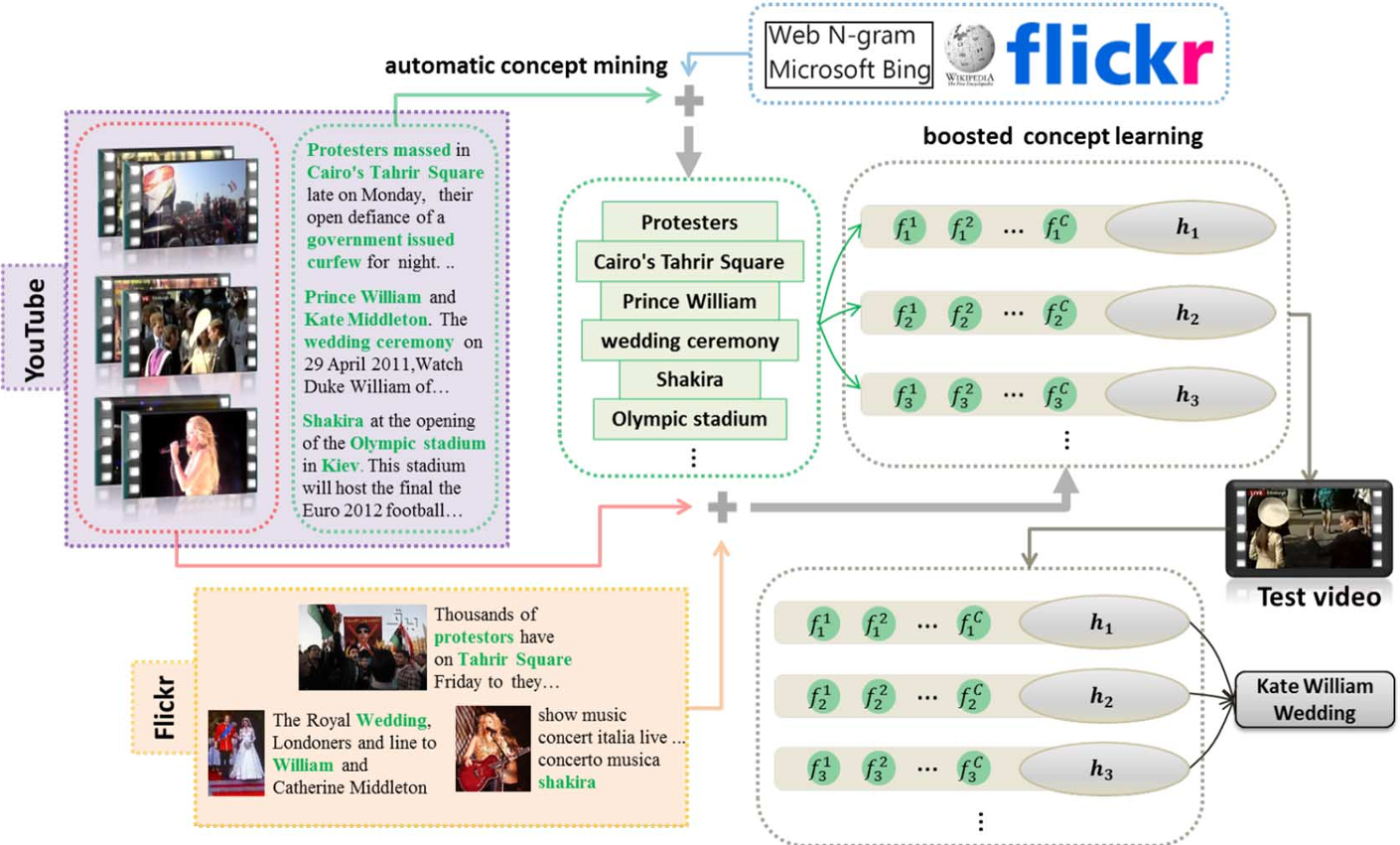
- Domain Adaptation: Using mSDA, the model aligns features from auxiliary Flickr images (source) with video frames (target).
- Weighted Iteration: If a video is misclassified, the weights of its frames are increased in the next iteration, forcing the model to learn more discriminative classifiers for the specific visual aspects it missed before.
Experimental Performance
The system was tested against heavyweights like Dense Trajectories and Co-training methods.
| Method | Avg Accuracy |
|---|---|
| PoolFeature | 0.46 |
| DenseTraj | 0.69 |
| BoostConcepts (Proposed) | 0.76 |
The results in the table above highlight that leveraging automated concepts outperforms even sophisticated handcrafted motion features (DenseTraj). Furthermore, the confusion matrix reveals that the model struggles only when events have near-identical backgrounds (e.g., "Bomb attack" vs. "Flood" events sharing similar outdoor square environments).

Deep Insight: Why it Works
The "magic" lies in the iteration. By allowing each concept to have multiple classifiers, the model effectively learns a "mixture of experts" for every label. For the concept "Obama Talk," one classifier might handle close-ups, while another handles wide shots of a podium. This granularity is what allows the model to surpass previous SOTA which relied on a "one-concept-one-classifier" dogma.
Conclusion & Limitations
Takeaway: The marriage of web-scale text mining and iterative boosting offers a powerful blueprint for unsupervised event understanding. Limitations: The system still relies on high-quality text descriptions for the initial mining phase. If a video has no metadata, the pipeline requires an external source (like the auxiliary Flickr set) to be highly relevant.