
Automatic Optimization of Web Recommendations: Bridging Semantics and Reinforcement Learning
Automatic Optimization of Web Recommendations Using Feedback and Ontology Graphs
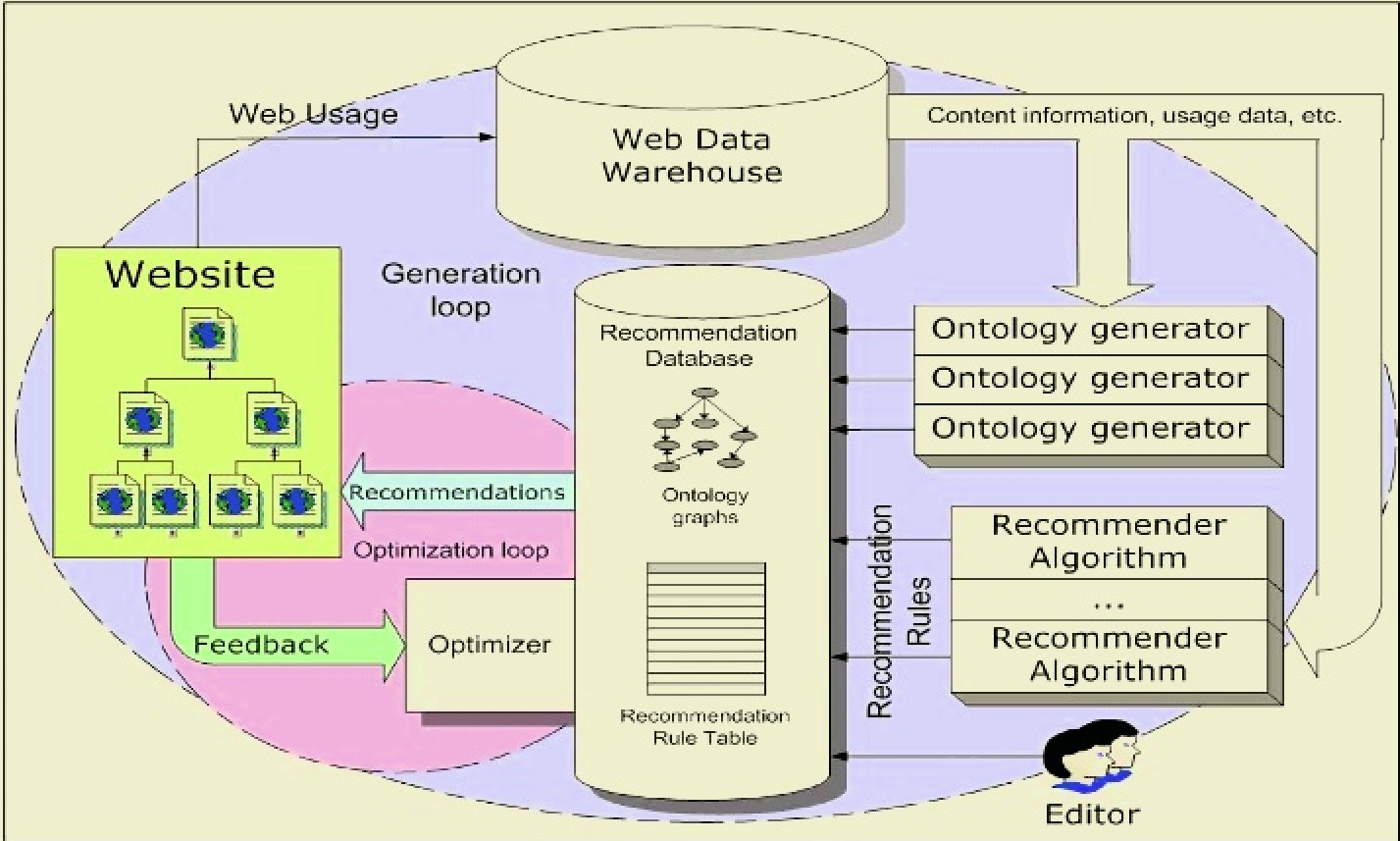
This paper presents a hybrid, rule-based web recommendation architecture that combines multiple algorithms (Content Similarity, Sequence Patterns, Collaborative Filtering) into a central database. It leverages ontology graphs for semantic enrichment and employs feedback-based machine learning (Reinforcement Learning) to dynamically optimize recommendation weights based on user interactions.
TL;DR
This research tackles the limitations of isolated recommendation algorithms by introducing a hybrid framework that stores rules in a central database. By combining Ontology Graphs (for semantic stability) with Feedback-Based Optimization (Reinforcement Learning), the system achieves significantly higher user engagement and conversion rates, proving that how you select and weight recommendations is just as important as how you generate them.
Problem & Motivation: The Limits of Static Algorithms
Modern websites often rely on a single recommender algorithm—be it Collaborative Filtering or Content-Based filtering. However, the authors argue that no single algorithm is a "silver bullet." Two major issues persist:
- Semantic Rigidity: Standard algorithms often operate on low-level IDs, making them fragile when a website is restructured.
- Lack of Adaptation: Static weights don't account for changing user interests (Drift of Interest) or the need to "test" new content (Exploration vs. Exploitation).
The insight here is to treat recommenders as "suggestion engines" and the central system as a "decision engine" that learns from real-world clicks.
Methodology: The Generation and Optimization Loops
The architecture is split into two distinct cycles:
- The Generation Loop: Various algorithms (TF/IDF similarity, sequence patterns, etc.) populate the database with recommendation rules.
- The Optimization Loop: This is the "brain." It maps the current user context (e.g., ProductID, Country) to an Ontology Graph.
Semantic Selection via Ontologies
Instead of matching contexts directly, the system maps users and content to nodes in a Directed Acyclic Graph (DAG). This allows for "Direct + Parents" matching—if no specific recommendation exists for a product, the system can "climb" the graph to suggest something from the same category (e.g., "History Books" if a specific biography has no rules).
The Optimization Math
To handle user interest drift, the authors use Exponential Smoothing: This ensures that recent clicks have more weight than old ones, allowing the system to naturally phase out "stale" recommendations.
Experiments & Results: Real-World Impact
The system was tested on a commercial software shop and a university site. The results validate the "Value-First" approach:
- Click-Through & Conversion: In the e-commerce setting, users who interacted with recommendations were over 4 times more likely to purchase (8.55% CCR vs 2.07% average).
- Optimization Efficiency: The "Reward-Penalty" approach, which penalizes unclicked items when others are selected, proved superior to mere random exploration (-greedy).
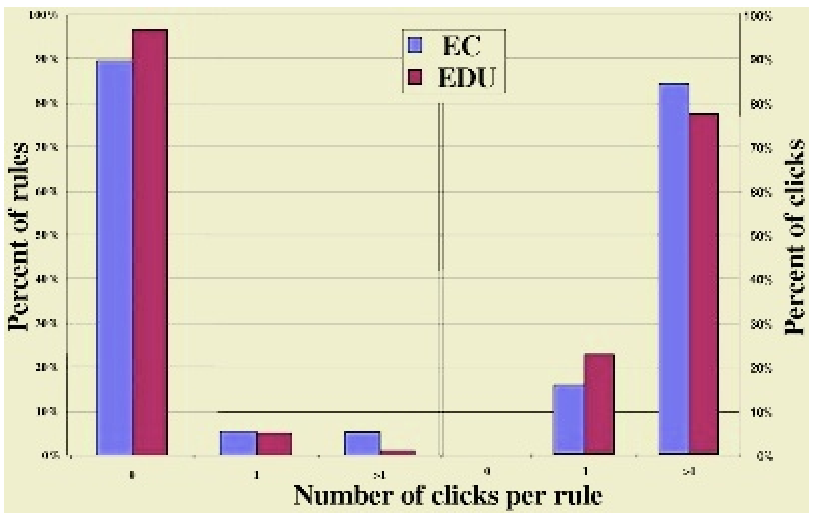
- Distribution: A Zipfian distribution of clicks confirmed that a few "star" recommendations drive most value, justifying an optimizer that hunts for these high-performers.
Critical Analysis & Conclusion
Takeaway
The core achievement of this work is the decoupling of recommendation logic from selection logic. By using a central database of rules and a semantic ontology, the system remains robust even as the website content evolves.
Limitations & Future Work
While the ontology approach is powerful, the paper notes that manual editing is still sometimes required for mapping clauses. Modern applications might look toward Automated Knowledge Graph Construction to replace these manual steps. Additionally, the parameter in aging requires experimental tuning, suggesting a need for meta-learning approaches to adjust hyperparameters dynamically.
Ultimately, this work serves as an early blueprint for what we now see in large-scale industrial rankers: a hybrid ensemble refined by real-time reinforcement learning.