
Deconstructing Quality: How Machine Learning Can Scale Educational Curation
Automatically characterizing resource quality for educational digital libraries
This paper presents an automated framework for characterizing the quality of educational digital resources by decomposing the abstract concept of "quality" into concrete, measurable indicators. Using a mixed-methods approach and Support Vector Machines (SVM), the authors developed models that identify key quality factors like prestigious sponsorship and instructional guidance, achieving up to 18% improvement over statistical baselines.
TL;DR
As digital libraries struggle to keep up with the explosion of community-generated content, manual vetting has become a major bottleneck. This research demonstrates that by decomposing the vague notion of "quality" into 7 concrete, expert-validated indicators—such as the presence of instructions or prestigious sponsorship—machine learning models can automate high-stakes curation tasks with significant accuracy, bridging the gap between human intuition and algorithmic scalability.
Background: The Scalability Crisis in Digital Libraries
Digital libraries serve as essential gatekeepers for educational quality. However, platforms like MERLOT report contribution-to-review ratios as high as 8:1. The core challenge isn't just volume; it's the subjectivity of quality. What makes a science resource "good" depends on the grade level, the pedagogical approach (hands-on vs. theoretical), and the authority of the source. Current automated systems often treat quality as a binary "thumbs up or down," which fails to capture the multi-dimensional nuances educators care about.
Methodology: From Human Intuition to Machine Features
The authors' approach is rooted in Empirical Decomposition. They didn't just guess what quality looked like; they derived it through a two-stage study:
- Meta-Analysis: Analyzing hundreds of educator reviews to identify 12 major dimensions, including "Readability," "Focus on Key Content," and "Appropriate Graphics."
- Expert Validation: Curation experts performed "think-aloud" evaluations of resources. This narrowed the list to 7 Key Quality Indicators that most strongly correlate with an expert's decision to accept or reject a resource.
The Taxonomy of Quality Indicators
The most predictive indicators identified were:
- Has Prestigious Sponsor: (e.g., NOAA, NASA, USGS)
- Identifies Age Range: Clear signaling of who the content is for.
- Has Instructions: Guidance on how to use the resource in a classroom.
- Organized for Learning Goals: Structural alignment with educational objectives.
Model Architecture & Feature Engineering
To transform these insights into code, the researchers used Support Vector Machines (SVM) trained on a corpus of 1,000 resources.
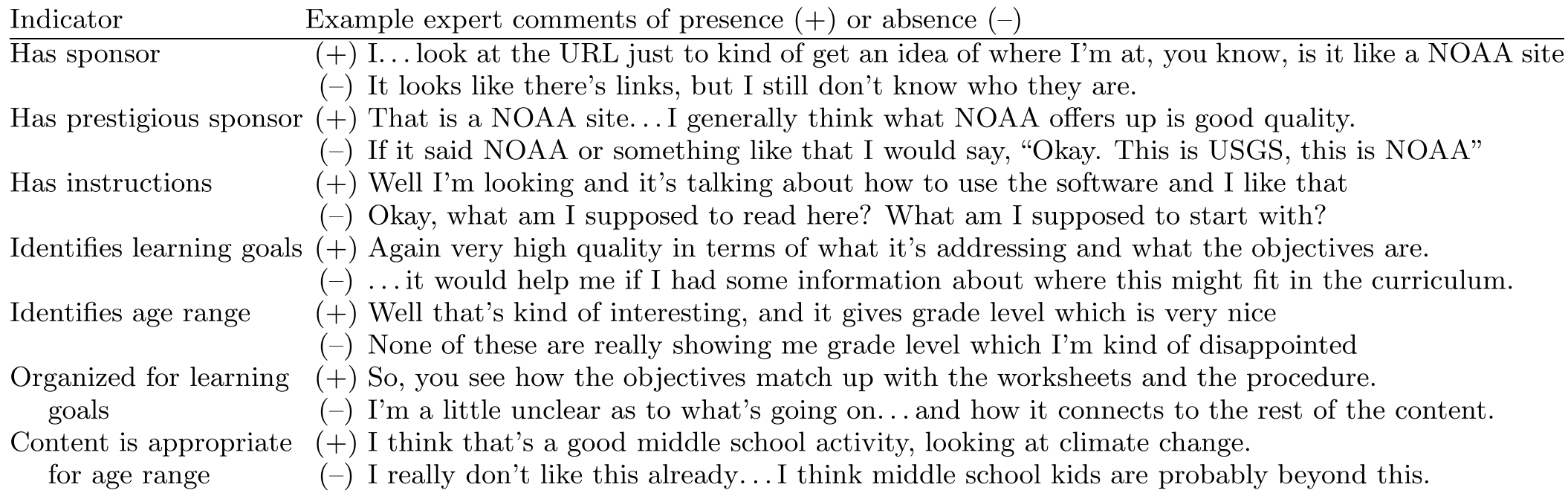 Table: Examples of how experts identify quality indicators in text.
The feature set combined traditional NLP with web-specific signals:
- Linguistic Features: Bag-of-words, TF-IDF, and Bag-of-bigrams to catch semantic cues like "learning objectives."
- Structural/Web Features: URL domain analysis (detecting
.govor.edu), Google PageRank (measuring authority), and Alexa TrafficRank (measuring popularity).
Experimental Results: Can Machines Grade Like Teachers?
The results confirm that specific indicators are much easier for machines to detect than "overall quality."
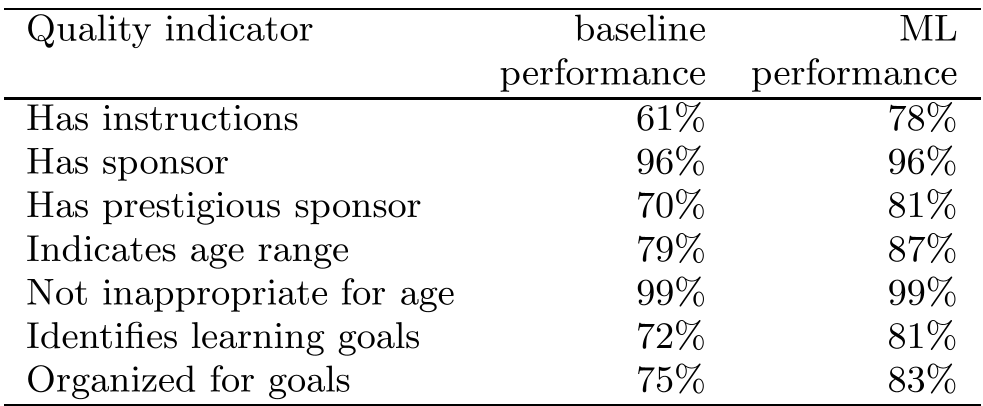 Table: Machine Learning performance vs. Base-rate baselines.
- Successes: The models achieved 78% accuracy in detecting instructions and 81% accuracy in identifying prestigious sponsors.
- The "Linguistic Gap": The error analysis revealed that models often failed when resources used non-standard terminology (e.g., "curriculum standards" instead of "learning goals") or when vital information was locked inside images/buttons rather than raw HTML text.
Critical Insight & Future Outlook
The genius of this work lies in its Inductive Bias: it assumes that quality is not a single value but a collection of "features" that can be individually detected.
Limitations
- Static Features: The reliance on Bag-of-words makes the system fragile to synonyms—a problem modern Transformers (like BERT or GPT) would likely solve today.
- Visual Blindness: Since the system primarily parses text, it misses the "Appropriate inclusion of graphics" dimension, which experts rated as highly important.
The Path Forward
The authors propose moving toward Surface Structure analysis—segmenting web pages into blocks to distinguish between core educational content and "boilerplate" (like navigation menus). By combining this structural awareness with semantic concept mapping, we can build tools that don't just "filter" content, but "describe" it, empowering educators to find the exact resource that fits their specific classroom needs.
Conclusion
This paper provides a roadmap for the "automated librarian." By moving from abstract judgments to concrete indicators, we can build scalable curation systems that actually reflect the nuanced values of the educational community.