
OpenClaw: Decoupling Reasoning from Execution in Computational Chemistry Automation
Automating Computational Chemistry Workflows via OpenClaw and Domain-Specific Skills
This paper introduces a decoupled automation framework for multi-step computational chemistry built on the OpenClaw agent-skill architecture. It orchestrates complex workflows—including molecular preparation, quantum chemistry, reactive molecular dynamics (MD), and reaction network extraction—by combining a general-purpose LLM agent with domain-specific "skills" and the DPDispatcher for heterogeneous HPC execution.
TL;DR
Researchers have developed a new framework using OpenClaw that allows AI agents to handle complex, multi-step chemistry research—from 3D structure generation to reactive molecular dynamics on supercomputers—by treating domain expertise as "reusable skills" rather than hardcoded logic.
The "Entanglement" Problem in Scientific AI
Today’s computational chemistry relies on a patchwork of software (Gaussian, LAMMPS, DeepMD-kit) and environments (local workstations, Slurm-based clusters). Automating this usually leads to two problems:
- Rigidity: Classic workflows (like AiiDA or FireWorks) break if a single unexpected error occurs.
- Entanglement: Modern LLM agents often bundle their "reasoning" with their "tools," making it nearly impossible to swap out a specific quantum chemistry package without rewriting the whole agent.
Methodology: The Decoupled Skill Ecosystem
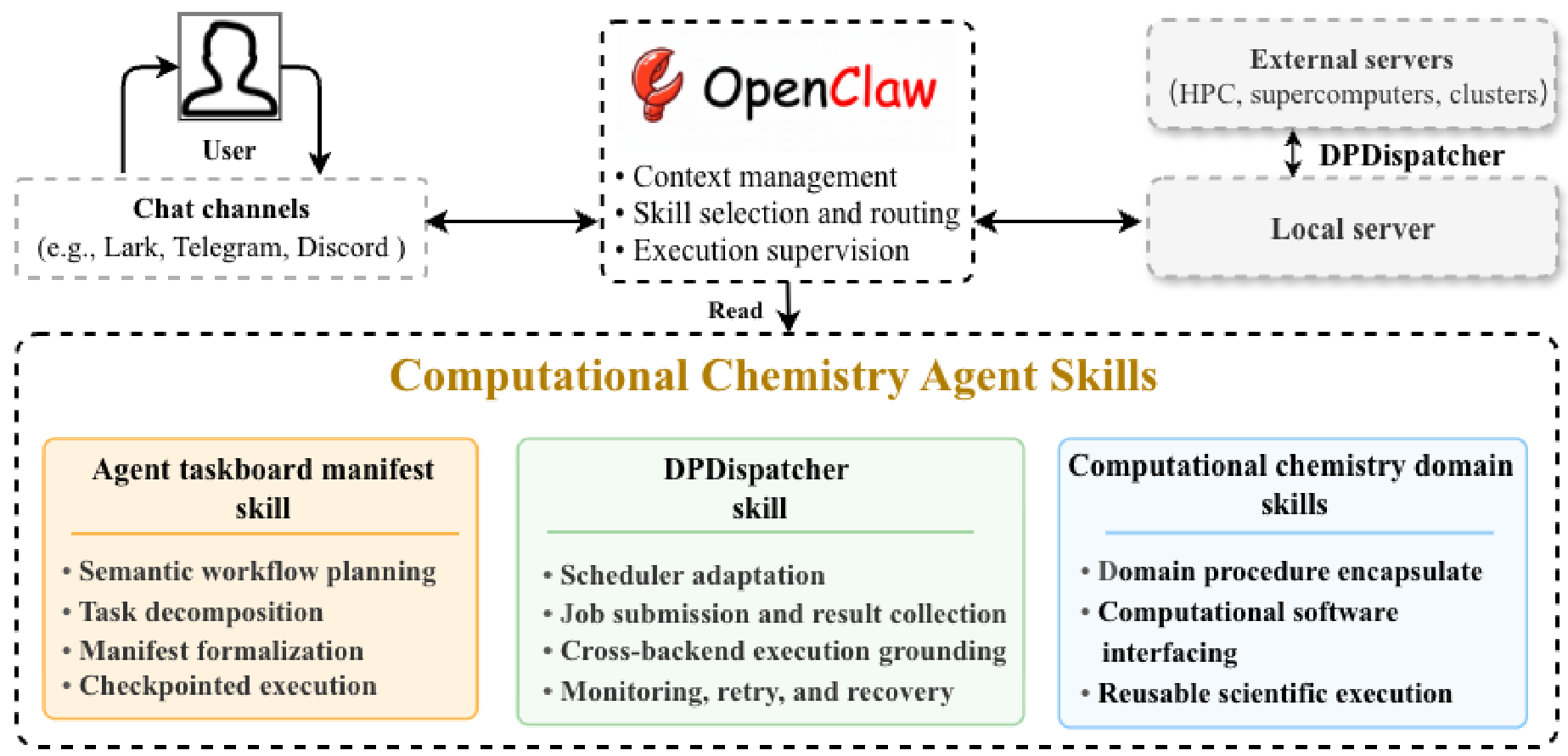
The core insight of this paper is externalization. The system separates the "Brain" (OpenClaw/LLM) from the "Muscle" (Domain Skills).
1. The Architecture
The system organizes automation around three pillars:
- OpenClaw: The coordinator and supervisor.
- Taskboard Manifest Skill: Translates vague human requests into structured stage-dependencies and validation criteria.
- DPDispatcher Skill: The "grounding" layer that speaks the language of HPC schedulers like Slurm or PBS.
2. Autonomous Error Recovery
Unlike a script that simply crashes, the OpenClaw agent monitors logs. If a job fails due to an environment variable error (a common HPC headache), the agent can:
- Analyze the error log.
- Patch the execution script (
run.md.sh). - Resubmit the job automatically.
Case Study: Methane Oxidation
The authors put the system to the test with a complex "Methane Oxidation" simulation.
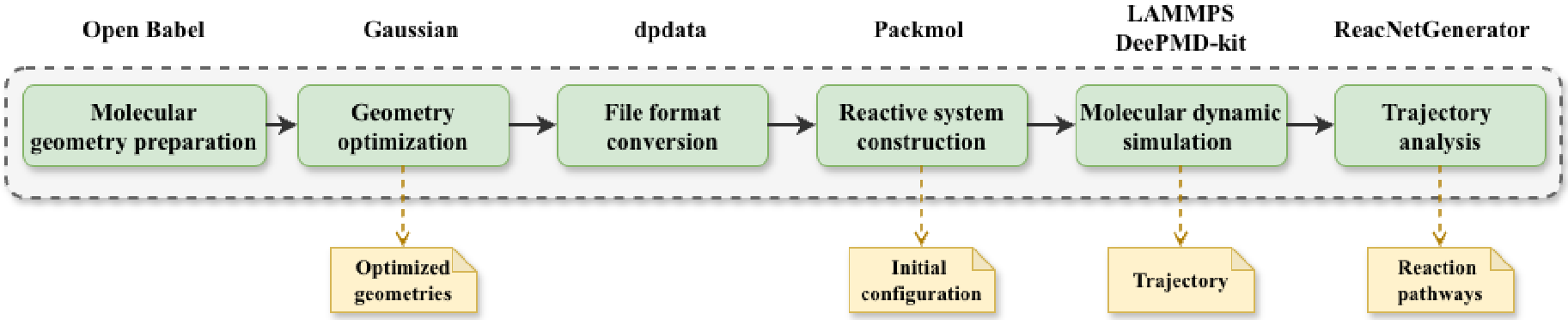
The workflow was daunting:
- Search SMILES and generate 3D coordinates.
- Optimize geometry at the B3LYP/6-31G(d,p) level in Gaussian.
- Pack 50 CH4 and 100 O2 molecules into a cube using Packmol.
- Run 1ns of reactive MD using DeePMD-kit and LAMMPS at 3000 K.
- Extract the reaction network via ReacNetGenerator.
Scientific Validation
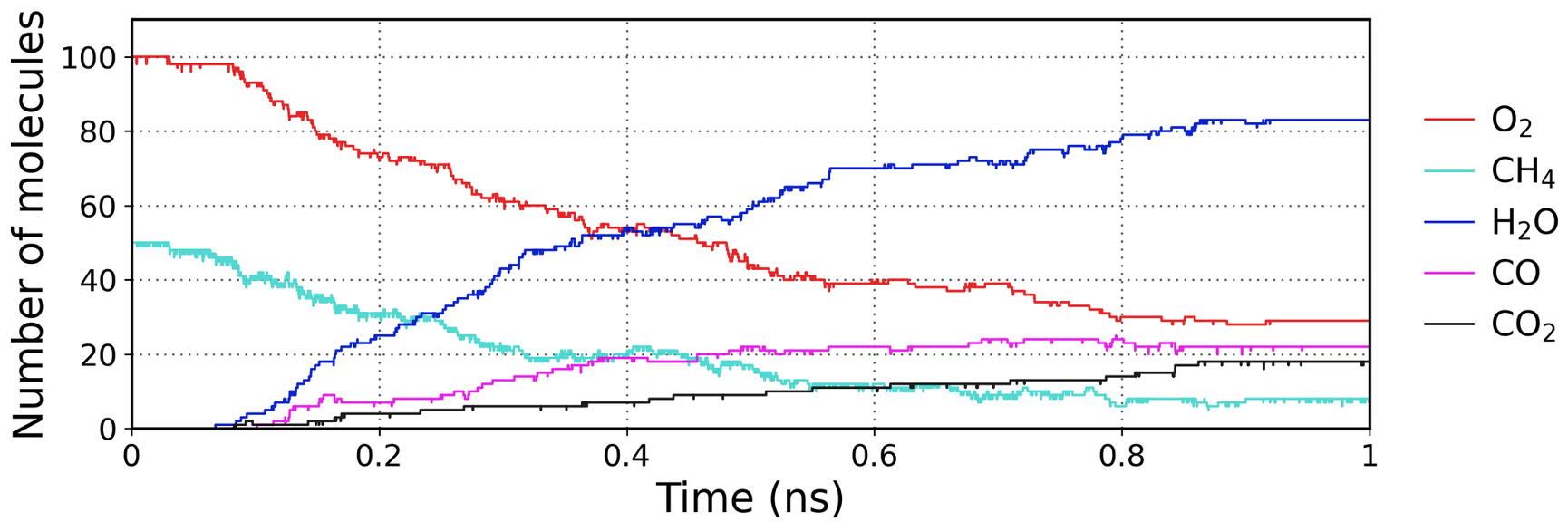
The results weren't just "automated"; they were accurate. The agent tracked the depletion of reactants and the formation of products (H2O, CO, CO2), identifying key intermediates like [H]C[H] (methyl) and [H][O][O] (hydroperoxyl).
Critical Insight & Future Outlook
The performance of the agent is heavily dependent on the "reasoning engine" (GPT-5.5/xhigh was used here). While the token cost (~$7.60 for a multi-day workflow) is negligible compared to the salary of a PhD researcher, the real value is the reduction in human-hours spent on "HPC plumbing"—formatting files, debugging Slurm scripts, and babysitting long jobs.
Limitations: The system still relies on the LLM’s ability to "correctly" interpret skill documentation. As the skill library grows, "context window saturation" might become a challenge, though the authors' use of lazy-loading helps mitigate this.
Conclusion
OpenClaw represents a shift toward modular scientific intelligence. By open-sourcing a library of chemistry skills (Quantum Chemistry, MD, ML Potentials), the authors are building a "Common Language" for AI to interact with the foundational tools of modern science.
All agent skills are available on GitHub: jinzhezenggroup/computational-chemistry-agent-skills