
AUTOMEM: Teaching LLMs the Cognitive Skill of Memory Management
AutoMem: Automated Learning of Memory as a Cognitive Skill
AUTOMEM is a novel framework that treats memory management as an automated, trainable "cognitive skill" for LLM agents. By optimizing both the memory structure (scaffold) and model weights (proficiency), it enables a Qwen2.5-32B model to achieve 2x–4x performance gains on long-horizon games like NetHack and Crafter, rivaling frontier models such as Claude 4.5 and Gemini 3.1 Pro.
TL;DR
Standard LLM agents are often "memory-clumsy"—they either forget crucial details or drown in their own redundant logs. AUTOMEM changes the paradigm by treating memory management not as a static retrieval system, but as a trainable cognitive skill. By automating the design of memory files and fine-tuning models specifically to handle them, researchers from Stanford have enabled mid-sized open models (32B) to outperform some of the world's most powerful proprietary engines on complex, long-horizon tasks.
The Problem: The "Messy Desk" Syndrome in LLMs
In long-horizon tasks like NetHack (which can span over 100,000 steps), an agent must remember the location of a staircase found 5,000 steps ago. Existing agents typically use a "sliding window" (forgetting the past) or basic RAG (retrieving the wrong things). The core issue is a lack of metamemory: the ability to monitor and regulate one's own memory.
Current scaffolds are manually designed. If the developer forgets to include a "deduplication" rule in the prompt, the agent's memory file grows exponentially with useless data, eventually "choking" the model's context window.
The AUTOMEM Solution: A Dual-Loop Optimization
AUTOMEM treats the agent's memory as a File System. The agent can READ, WRITE, and SEARCH files. To master this, AUTOMEM uses two distinct optimization loops:
1. Loop #1: Scaffold Optimization (The Architect)
The framework uses a high-powered Meta-LLM (like Claude 4.5/4.7) to act as a "senior developer." It reviews thousands of steps of execution logs, identifies where the memory structure failed (e.g., "the map file is too big"), and rewrites the agent's code and file schema.
- Evolution in Action: In NetHack, the system evolved from a messy append-only log to a structured
UPSERT_MAPformat that automatically deduplicates coordinates.
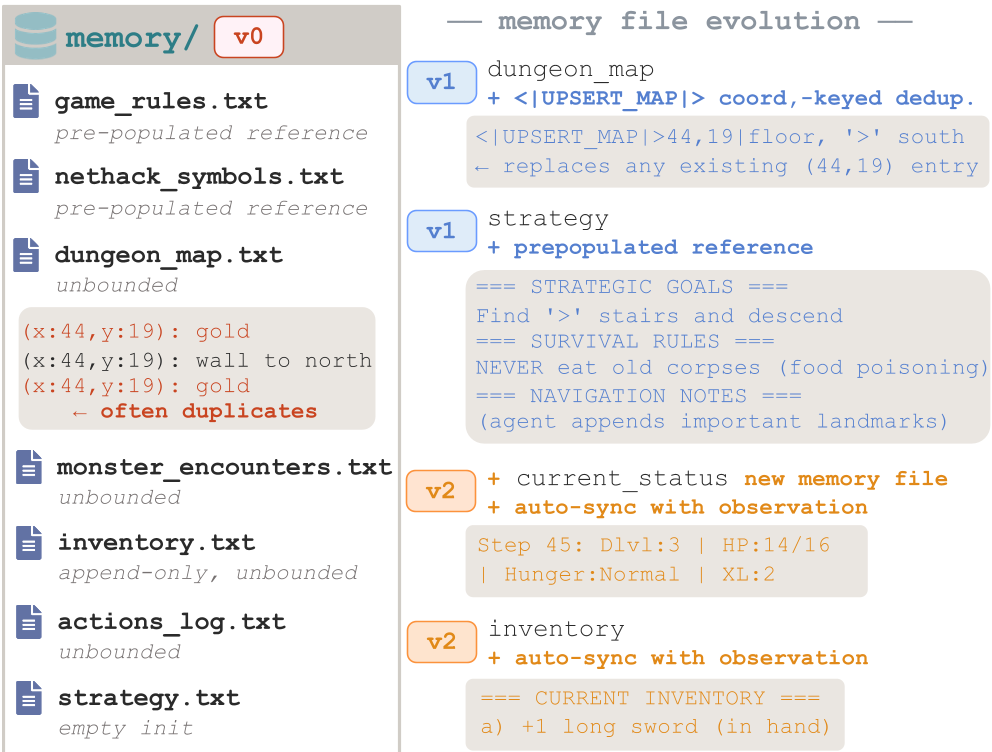 Figure 1: NetHack memory evolution from unstructured logs (v0) to a highly efficient, coordinate-keyed system.
2. Loop #2: Proficiency Training (The Specialist)
Even with a good filing system, the model might be "lazy" or inaccurate. Loop #2 collects the agent's best memory decisions and uses them to train a Memory Specialist (a LoRA adapter).
Crucially, this specialist only handles memory operations. A separate "Gameplay Model" handles the actual game actions. This separation ensures that fine-tuning for memory doesn't break the model's ability to play the game.
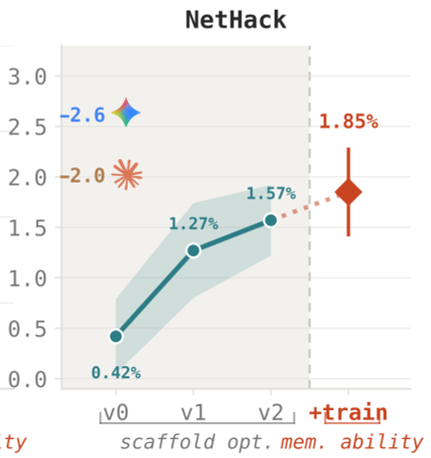 Figure 2: Performance gains across iterations. Each 'v' represents a scaffold update, followed by the '+train' proficiency boost.
Breakthrough Results
The impact of focusing purely on memory optimization is startling. Without changing how the model "thinks" about the game actions themselves, the agent's success rate skyrocketed:
- Crafter: Performance jumped from 25% to 51.4%.
- NetHack: While still incredibly difficult, the agent survived significantly longer, reaching experience levels previously only seen in much larger models.
- Efficiency: Memory per step in NetHack was reduced by 95% (from 138 characters to just 6).
| Agent | Crafter (%) | MiniHack (%) | NetHack (%) |
|---|---|---|---|
| Qwen2.5-32B (Base) | 25.0 | 7.5 | 0.42 |
| AUTOMEM (Ours) | 51.4 | 30.0 | 1.85 |
| Claude-Opus-4.5 | 49.5 | 27.5 | 2.0 |
As shown above, the 32B model with AUTOMEM matches or exceeds the performance of Claude Opus 4.5 in two out of three environments.
Insight: Why Does This Work?
The success of AUTOMEM reveals a "hidden leverage point" in AI agent design. Most researchers try to improve reasoning or planning. AUTOMEM proves that context management is a bottleneck.
By teaching the model a "consult-before-write" discipline—where it searches existing memory before adding new info—the researchers reduced "Stuckness" and "Oscillation" (loops where the agent paces back and forth because it forgot where it was).
Conclusion & Future Look
AUTOMEM proves that memory is not just a storage bin; it is a skill. This work suggests a future where agents are not just "prompted," but iteratively "coached" by meta-models to refine their internal workflows. Combining automated code architecture (Loop 1) with targeted parametric training (Loop 2) provides a blueprint for making small models behave like giants.
Key Limitation: The current version clears memory between episodes. The next frontier? Persistent Memory that allows an agent to learn from one game to the next.