
Reactive Force Interaction: Mastering Bipedal Balance through Real-Time Optimization
Simulation of an autonomous biped walking robot including environmental force interaction
This paper introduces an autonomous biped walking control system centered on reactive force interaction and a high-fidelity 3D dynamic simulator. It combines a hierarchical posture controller utilizing Quadratic Programming (QP) for force distribution with a real-time Center of Mass (COM) tracking controller based on a discrete inverted pendulum model, achieving stable locomotion at 0.25 m/s.
TL;DR
This seminal work addresses the fundamental challenge of bipedal stability: how to translate desired body motion into feasible ground reaction forces. By utilizing Quadratic Programming (QP) to distribute forces within physical constraints (friction and ZMP) and a Discrete Inverted Pendulum for foot placement, the authors achieved robust 0.25 m/s autonomous walking in a high-fidelity 3D simulation.
Problem & Motivation: The Approximation Gap
At the time of this research, most biped robots were controlled using "off-line" planning. Engineers would calculate joint trajectories that theoretically satisfied stability. However, the real world is messy. Once a robot interacts with the ground, the relationship between actuator torque and reactive force becomes highly non-linear and constrained by:
- Unilateralism: The ground can push, but it cannot pull the foot.
- Friction: Excessive horizontal force leads to slipping.
- Geometry: Torque is limited by the physical size of the foot (the ZMP condition).
The authors' insight was to stop treating the ground as a passive constraint to be avoided and start treating ground reaction forces as direct control inputs.
Methodology: The Hierarchical Architecture
The system is split into two distinct layers that bridge the gap between high-level intent and low-level physics.
1. The Posture Controller (The Optimizer)
Instead of simple PID on joints, the lower layer treats the robot as a "free-fall manipulator." It calculates an ideal force () required to keep the body upright. Since this ideal force might be physically impossible (e.g., requiring the ground to suck the foot down), the system solves a Quadratic Programming (QP) problem: This is subject to , where and represent the friction cone and ZMP boundaries.
2. COM Tracking & Foot Placement
To move forward, the robot must step. The authors use a linearized inverted pendulum model to predict where the next footstep should land to "catch" the falling COM. This ensures global locomotion while the posture controller handles local balance.
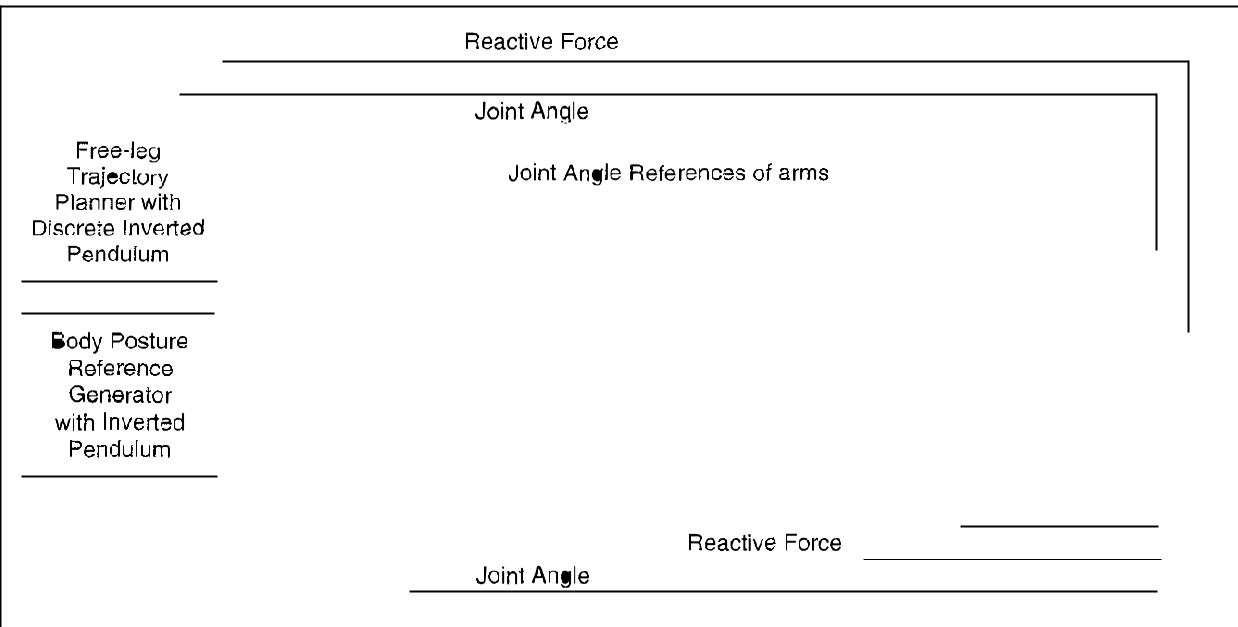 Figure: The coordinate transformations and link-fixed representations used to solve the 3D dynamics.
A Mathematically Exact 3D Simulator
One of the paper's major contributions is the simulation scheme itself. Most simulators of the era used "spring-damper" contact models, which required infinitesimal time steps to stay stable. The authors proposed a Plastic Collision Model based on mathematical programming, allowing for exact ideal constrained motion and Coulomb friction without the numerical instability of virtual springs.
Results & Performance
The system was tested on a 20-axis humanoid model (0.99m tall, 28.7kg).
- Walking Velocity: 0.25 m/s.
- Cycle: 0.5 sec/step.
- Stability: The Zero Moment Point (ZMP) was kept well within the foothold, even during the transition between single and double support phases.
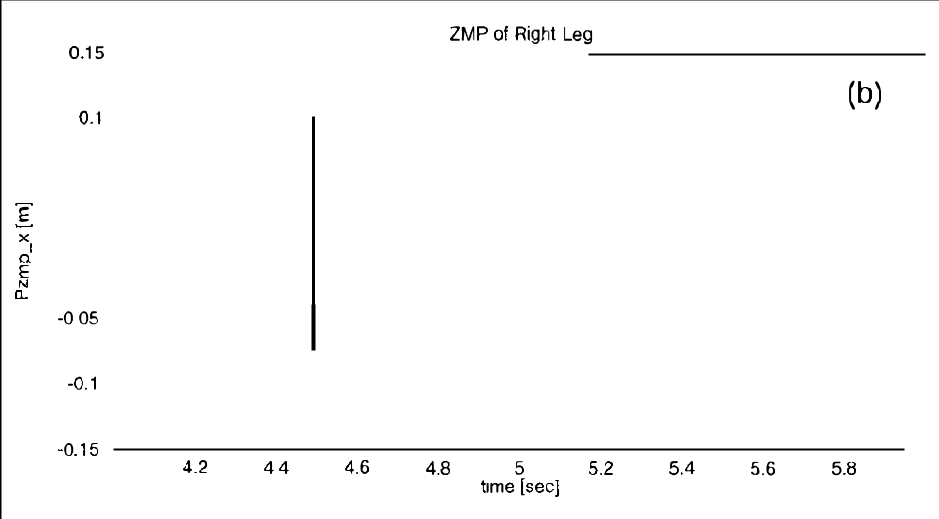 Figure: Snapshots of the 20-axis biped model performing stable walking.
As seen in the COM trajectory plots, the robot successfully follows the reference path with minimal error, demonstrating that the QP-based force distribution can handle the high-dimensional dynamics of a 20-DOF system in real-time.
Critical Analysis & Conclusion
This work was a precursor to modern "Whole-Body Control" (WBC) frameworks used by robots like Boston Dynamics' Atlas. By formulating balance as a constrained optimization problem, it moved the field away from rigid trajectory following and toward reactive, force-aware locomotion.
Limitations: The stepping period was fixed (0.5s), meaning the robot couldn't yet adjust its timing to recover from massive shoves—only its landing position. Future work in this lineage would eventually lead to Divergent Component of Motion (DCM) and capture point theory, which are standard in today's SOTA humanoids.